
AI in Healthcare App Development: What Startups and Providers Need to Know


12 August, 2026
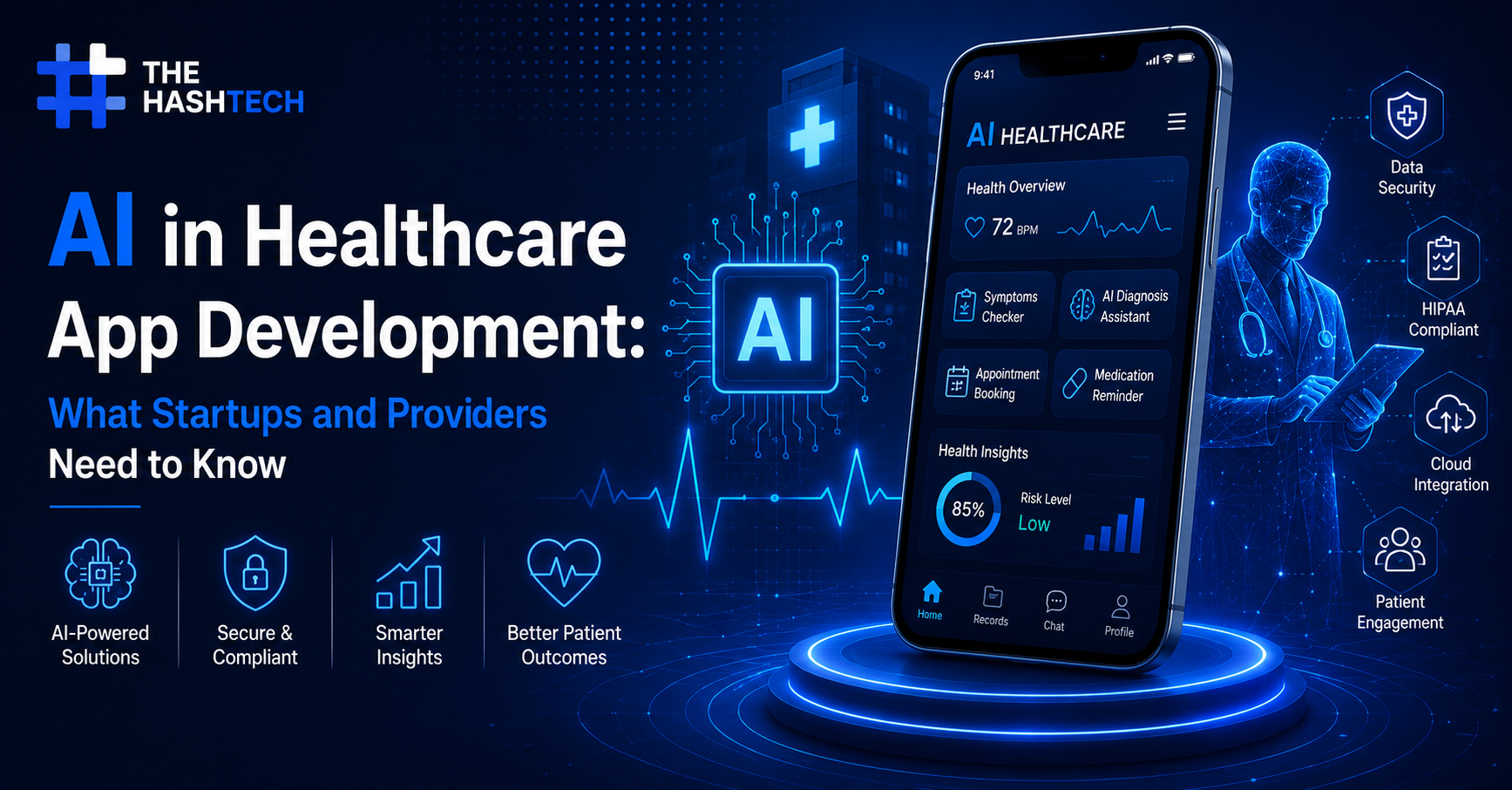
AI has moved from experimental add-on to core expectation for any serious digital health product entering the market today. Patients expect proactive insights rather than static dashboards. Clinicians expect decision support that reduces workload rather than adds to it. And healthcare organizations need a demonstrated return on investment, not just a neat new application. But before a single line of code is written, startups and healthcare organizations alike need to understand what artificial intelligence in medical app development can realistically deliver, and where the real risks lie, in order to prioritize where to direct their limited development budget.
In this article, we will walk through the key considerations in how to build AI-powered healthcare apps that are safe, scalable, and actually useful. Rather than treat artificial intelligence as a single feature to bolt onto an existing product, the strongest health tech apps build their core architecture around how intelligent features will actually function within clinical or patient-facing workflows.
Where AI Genuinely Improves Healthcare Apps
Clinical Decision Support That Reduces Physician Burden
The clearest example of this lies within clinical decision support. Here, algorithms use input data to cross-reference research and can process millions of clinical decisions, suggesting diagnoses or treatments based on a raw formula. While in general, this kind of decision support doesn’t replace a doctor’s intuition, it does surface patterns and comparisons that would be almost impossible to discern manually. Certain deep learning models that are trained on thousands of medical images, for instance, have proven that they can detect millimeter-fine findings in imaging and pathology that human eyes miss completely despite the years of experience they bring to the table.
This decision support is most effective in places where specialist access is structurally limited. A diagnostic support tool that takes in all vital signs, medical history, and tests performed can give a general practitioner a familiar amount of specialist-level insight (or even supersede it in some cases) when specialist care isn’t readily accessible. This ability to significantly democratize expert insight is one of the most genuinely transformative uses of this exciting technology available today.
Remote Monitoring and Proactive Risk Detection
Mobile health apps are gradually using AI to move beyond reactive data display and towards predictive insights. This data can be used to identify concerning signals of deterioration (for example, multiple readings of high blood sugar), unusual biometrics, or a missing dose of medication, long before this reaches a clinical emergency. This can make a big difference in managing chronic disease, where catching a trend early can mean the difference between a readmission to hospital that a system cannot prevent or treat fast enough, or a short emergency room visit.
Virtual Triage and Symptom Assessment
Conversational AI-powered triage tools let patients describe symptoms in natural language and help guide them to the right level of care needed. These tools are not meant to replace a formal diagnostic visit. They are helpful for reducing unnecessary ER visits and also for rightfully sending high-urgency patients directly to emergent care settings. Finding the right balance between these two extreme cases is essential to the usefulness of such a tool.
Compliance Requirements That Shape the Build Process
HIPAA, FDA Considerations, and Data Protection
Building a new AI app for a medical use case adds a lot of planning and design considerations, especially if your app will need to be compliant with a healthcare-specific regulation. In the consumer app world, most teams could safely ignore planning for regulations until late in development. This is the first significant departure for healthtech developers, where HIPAA compliance is a requirement that must pervade all levels of the architecture. Additionally, your team will have to carefully evaluate different third-party AI services for use in your app, since many popular APIs are not yet configured to meet healthcare data privacy and compliance requirements. You may also need to consider Food and Drug Administration classification.
Building Compliance Into Architecture From Day One
Retrofitting compliance requirements into an app built without them will almost always cost users time and money, especially in healthcare. If you haven’t thought about HIPAA, HITECH, or 21 CFR Part 11 from the beginning, you may find yourself re-architecting data flows, storage, and encryption just to figure out a way to sync with hospital EHRs later. That’s because in non-healthcare app development, you may never have had to think about encrypting protected health information.
Or licensing an AI model that’s ALATAA-compliant. Or building a video auditing system that’s accurate down to the millisecond. You also need to keep in mind that you can be asked to adapt to a tightly-coupled EHR API that only allows 15k API calls per minute, or develop other workarounds that may not adhere to the highest security standards. Building a compliant medical app starts on your foundation and not as an afterthought. Your vendors deserve your equal consideration.
Not all AI APIs and cloud providers are able to sign a Business Associate Agreement, and many do not offer any healthcare-grade data handling qualifications out of the box. If your product’s intended use case is healthcare, find out how a potential vendor handles your data early in your evaluation process. Don’t wait until you deploy the product to discover that a vendor you never heard of is sharing your patient data with third parties.
Common Mistakes Startups Make With Healthcare AI
Choosing the Algorithm Before Defining the Problem
Here’s a common mistake that I see healthtech AI companies make: They find a cool ML model or technology and then try to figure out if it can be applied to a healthcare problem. Development teams who offer dedicated android app development services with their AI expertise could stand apart from the competition simply by making sure that the AI features work reliably on older devices, That’s an inefficient approach. Too many companies have suffered from this approach, which results in a cool or interesting ML-powered application that nobody asked for. In fact, better healthtech apps don’t ask “which model do we want to pioneer”. They ask first what clinical or patient need exists in the first place and then determine the architecture of the app accordingly. They ask “what decision do we want to support” as the initial question and go from there.
Underestimating the Need for Human Oversight
For healthcare, fiction has a deadly way of disrupting our reality. Presenting AI-powered decisions as being infallible, accurate and transparent is a dangerous game. The stakes just do not allow for it. Rigid guardrails are needed for how and when an AI-powered feature can bypass a human interface. Unlike in many other apps, an automated decision in health requires some degree of human review to be considered safe and reliable. The app’s interface should clearly communicate the degree of confidence in its decision, ask for human input for grey cases, and empower the user to easily review the AI’s rationale or detection process. This is not only necessary for safety and quality, but it can actually spur greater trust from clinicians and patients.
Choosing the Right Development Partner
What Genuine Healthcare AI Experience Looks Like
The core question here is “has this team had most to all of the complex battles that have actually characterized AI in healthcare app development?” Responsiveness is a good place to start, but (at least from my experience) healthcare app development expertise is more about where you’ve been and the pace of true innovation. Teams developing AI for healthcare that have not actually been doing so have not been forced into the corner that leads to novel, responsible AI in healthcare. And they’re not close enough to the space to provide much guidance.
Platform Considerations for Healthcare Apps
Healthcare apps built through custom mobile app development need particular attention paid to how AI features perform (or don’t) across both of the major platforms out there. Providers and consumers might be equally likely to use any given app on the latest iPhone from the Apple Store or the most inexpensive Android device from the AT&T network. Scaled on-device processing, and even work offline for areas with patchy internet coverage (such as in many healthcare deployments). But for those businesses that are trying to differentiate on the underlying AI capability itself, working with a top artificial intelligence development company that understands both the technical and regulatory landscape could give organizations the assurance that their models are genuinely fit for healthcare, at scale.
Measuring Whether an AI Feature Is Actually Working
Defining Success Before Launch
Instead of hoping that AI will improve outcomes at some unknown point in the future, it’s vital to clearly define the criteria for success first, so you’ll know when you get there. Some teams have performed pre-deployment measurements to establish a baseline performance for the model before deployment (like the readmission rate for a predictive risk detection feature), but that’s not always feasible because their clinicians didn’t collect those metrics or the system’s early performance is not representative of how the model performs once it’s integrated into their workflows (maybe it actually adds more work at first).
Monitoring Model Performance Over Time
One common misconception about building a healthcare AI product is assuming that once you’ve shipped your AI features, they will work exactly the same way for the next ten years. That’s not how it works with AI. Unlike traditional software features, which can be expected to behave consistently once deployed, AI models can drift in accuracy over time. This is why a healthcare app with long-term intent needs to have a process for monitoring these potential departures and for promptly retraining and adjusting models when needed.
Building Patient and Clinician Trust in AI Features
Why Transparency Matters More in Healthcare Than Almost Any Other Category
However, we have also learned that in a clinical setting, this is less likely to be the case. Patients and clinicians are aware of the risks and sway of recommendations we see on shopping apps, and would prefer to know how your algorithm arrived at the suggested course of action. There are also clear regulatory reasons to include reasoning on the frontend; black-box algorithms drawing conclusions without explanation are no longer an attractive recommendation for healthcare AI.
Involving Clinicians Early in the Design Process
Clinicians themselves should be involved in the design and testing of these apps from the very beginning, not just as a final validation step. Because an engineer or user experience researcher does not actually practice medicine, they simply won’t be able to fully understand all of the non-textbook workflows in a typical day-in-the-life of a busy provider. Too many attempts at healthcare apps by startups have fallen victim to a flawed assumption that a clinician’s input is a late-stage formality, rather than a backbone of the design process.
Final Thoughts
AI can bring real, measurable value to healthcare apps when it’s built on a real clinical or patient need, not shoehorned onto an app because it’s cool. It also makes sense to treat compliance and human oversight from the regulatory, clinical, and end-user perspectives as minimum design requirements rather than add-on features. Both end users and regulators will zoom in on what you’re actually trying to do, and demand to see how it delivers value, rather than whether the interaction is powered by Java, Rails, or LLMs. Startups or healthcare providers that are considering these technologies should not get caught up in which algorithm or LLM the vendor can deploy to make them splashier. Instead, they should focus on the problem they are trying to solve, learn and understand the compliance landscape of their application, and partner with an experienced medical software developer.
FAQs
1. What are the most valuable AI use cases in healthcare apps?
There is no clear-cut answer to what the perfect AI assistant for doctors looks like. But to illustrate the wide range of applications of the technology, let’s look at the best use cases for AI in medicine in broad strokes: clinical decision support, remote monitoring, and virtual triage systems.
2. Is HIPAA compliance different for AI-powered healthcare apps?
Yes, actually, the requirement to be HIPAA compliant influences just about every other technical decision. The list of AI services that can even be considered safe enough for healthcare apps is nowhere near as comprehensive as others, and vetting vendors early is vital.
3. Can AI replace a doctor’s judgment in a healthcare app?
No, and apps that treat AI output as the final answer rather than a decision support tool can cause more harm than good. Strong apps clearly communicate the AI’s confidence level with various recommendations, build in guardrails for when a human healthcare professional should step in, and avoid certain diagnoses altogether.
4. How much does compliance add to the cost of building a healthcare AI app?
Generally speaking, building compliance into the architecture from the start is the most cost-effective route, as end-to-end solutions are iterated and refined specifically around what HIPAA requires. The cost of a re-build at the end of the process generally vastly outweighs the effort of building it into the app from the start.
5. How do you know if an AI feature in a healthcare app is actually working?
Defining your success criteria at the beginning of the build is essential, and it can be tricky to determine a healthcare-specific one. For a chronic disease management app, reducing readmissions is an obvious goal. For virtual triage, reducing emergency room visits without missing a diagnosis is critical. Also, planning for the long term and continuously monitoring is vital