
What Is a Web App? Web App vs Website vs Mobile App Explained


2 September, 2026
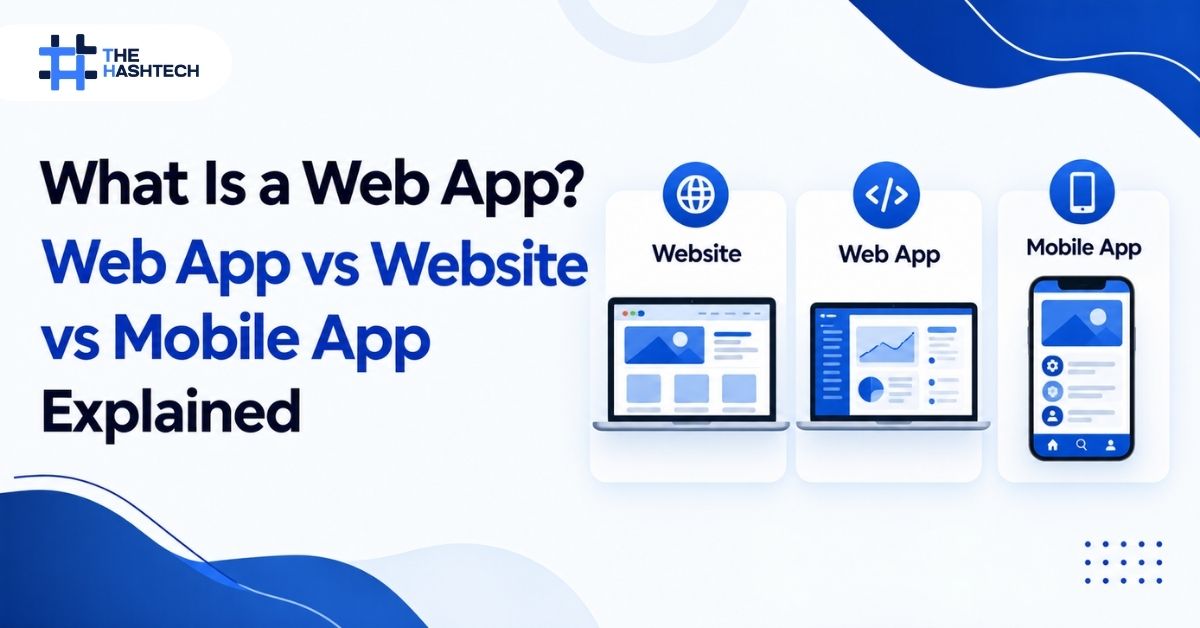
A web app is interactive software that runs in a browser and requires a server to function, think a project management dashboard or an online banking portal. A website is primarily informational, built to be read rather than operated, such as a company homepage or a blog. A mobile app is installed directly on a phone through an app store and can access device hardware like the camera or GPS directly. The distinction matters because building the wrong one for your actual need means paying for capability you don’t use, or worse, hitting a wall you can’t build past later.
Three Terms, Three Very Different Things
What Is a Website?
A website is a collection of static or lightly dynamic pages, primarily built to inform, market, or represent a brand. Think of a company’s homepage, a blog, a portfolio, or a brochure-style small business site. Content is largely the same for every visitor, and the primary goal is to be read or browsed rather than operated. Most websites today run on platforms like WordPress with custom themes, and standard builds typically take 4-8 weeks, while ecommerce or custom-functionality sites run 10-16 weeks.
What Is a Web App?
A web app is interactive, browser-based software where users log in, input data, and get personalized results a SaaS dashboard, an internal business portal, an online banking interface, or a project management tool. Unlike a website, a web app requires a server-side backend, handles user accounts and permissions, and behaves more like installed software than a document you read. Small-to-mid complexity web apps typically take 3-4 months to build, while complex, enterprise-grade web apps take 6-9 months.
What Is a Mobile App?
A mobile app is software installed directly on a phone or tablet through the App Store or Play Store. It can work offline, send push notifications, and access device hardware camera, GPS, biometric sensors directly, in ways a browser-based product cannot. Simple mobile apps typically take 6-10 weeks, while complex, multi-integration builds run 3-9 months.
Quick Comparison
| Factor | Website | Web App | Mobile App |
| Primary purpose | Inform / market | Interactive, task-based software | Task-based, hardware-integrated software |
| Access | Any browser, any device | Any browser (desktop or mobile) | Installed via App Store / Play Store |
| Offline capability | Minimal to none | Limited, unless built as a PWA | Full offline capability possible |
| Device hardware access | None | Limited (via browser APIs) | Full (camera, GPS, biometrics, sensors) |
| User accounts / login | Rarely required | Almost always required | Often required |
| Typical build timeline | 4-8 weeks (16 weeks for ecommerce) | 3-4 months (up to 9 for complex builds) | 6-10 weeks (up to 9 months for complex builds) |
| Discoverability | Google search | Direct link / Google search | App Store / Play Store search |
| Update process | Instant (server-side) | Instant (server-side) | Requires app store review for updates |
Real Use Cases: Where Each One Actually Fits
Website examples: a law firm’s marketing site, a restaurant’s menu and hours page, a personal portfolio, a company blog driving SEO traffic.
Web app examples: a SaaS product with subscription billing and multi-tenant user accounts, an internal employee portal with role-based access, an ecommerce storefront with real-time inventory and AI-driven recommendations, an enterprise system handling large data volumes with audit logs and two-factor authentication.
Mobile app examples: a ride-sharing app using live GPS tracking, a fitness app using phone sensors for step counting, a banking app using biometric login, a food delivery app sending push notifications for order updates.
The Progressive Web App Middle Ground
Here’s where the lines blur: a Progressive Web App (PWA) is a web app built to behave like a mobile app, with offline support, push notifications, and fast, native-like loading all delivered through a browser, without requiring an app store download. PWAs are a genuinely useful middle path when you want mobile-app-like engagement (notifications, an installable icon, offline access) without the cost and timeline of two separate native builds, or when app store approval isn’t necessary or desirable for your use case. They’re not a full replacement for a native app when you need deep hardware integration, but for content-driven products or businesses that want broader reach without app store gatekeeping, they’re worth a real look before defaulting to native.
Decision Framework: Which One Do You Actually Need?
Ask these questions in order; the first one that applies usually points to your answer:
- Does it just need to inform people, with no login or interactive functionality? → Website.
- Does it need user accounts, complex business logic, or real-time data, but doesn’t need offline access or deep device hardware integration? → Web app.
- Does it need offline functionality, push notifications, or direct access to camera/GPS/biometrics? → Mobile app (or a PWA if the hardware needs are minimal).
- Do you need both broad reach and mobile-like engagement, with a limited budget? → Start with a PWA, and evaluate native mobile once you’ve validated demand.
Most businesses actually need more than one of these working together: a marketing website that drives signups into a web app, which later gets a companion mobile app once the product has proven demand. Building all three simultaneously before validating the product is one of the more common expensive mistakes early-stage founders make.
Frequently Asked Questions
Is a web app the same as a website?
No. A website is primarily informational and read-only for most visitors; a web app is interactive software requiring user accounts, a backend, and real business logic closer to installed software than a document.
Can a web app work offline?
Standard web apps generally require an internet connection. A Progressive Web App (PWA) can offer limited offline functionality by caching data locally, though it’s not as robust as a native mobile app’s offline capability.
Is it cheaper to build a website, a web app, or a mobile app?
Websites are typically the least expensive and fastest to build (4-8 weeks for standard sites). Web apps and mobile apps both involve more backend complexity and generally cost more, with timelines of several months depending on feature scope.
Do I need a mobile app if I already have a web app?
Not necessarily. If your users primarily need browser-based access without offline use or deep hardware integration, a responsive web app (or PWA) may fully cover the need without the added cost of native app development.
What’s the difference between a web app and a PWA? A PWA is a specific type of web app built with additional capabilities: offline support, push notifications, and an installable home-screen icon designed to feel more like a native mobile app while still running through a browser.
Not Sure Which One Your Project Actually Needs?
If you’re building something interactive with user accounts and business logic, our custom web app development team builds everything from SaaS platforms to enterprise portals and Progressive Web Apps.
If your immediate need is a marketing site or informational presence, our best website design and development team can get that live faster and at lower cost than a full application build.
And if hardware access, offline use, or app store presence genuinely matter to your product, our digital mobile app development team handles native and cross-platform builds for both iOS and Android.
Talk to our team if you’re not sure which one fits; we’ll give you a direct recommendation based on what your product actually needs, not the one that’s easiest for us to sell.