
Education App Development Cost: LMS, Activities, Video, Analytics


17 September, 2026
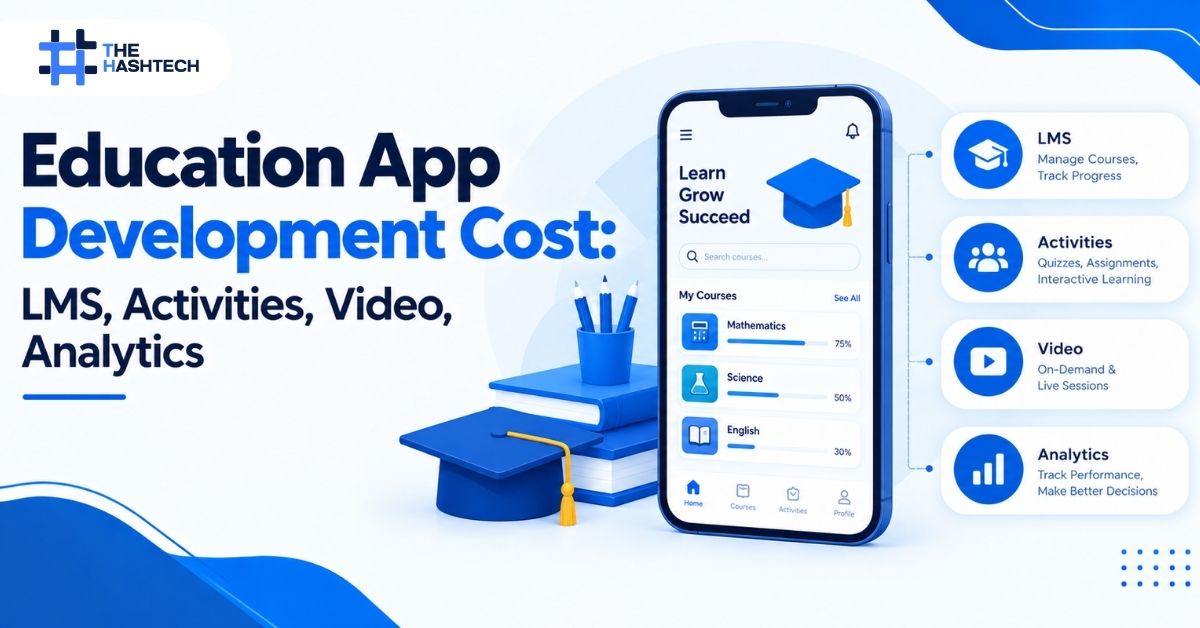
Education is no longer limited to classrooms, textbooks, and fixed schedules. Students can now attend live classes, watch recorded lectures, complete assignments, take assessments, track their progress, and communicate with teachers through a single mobile application.
This shift has created growing demand for education and eLearning applications among schools, universities, training institutes, tutoring businesses, and EdTech companies. However, building an education app with meaningful learning features requires more than simply creating a few screens and publishing an app.
The education app development cost depends heavily on what the application is expected to do. A basic learning app with courses and videos will require a different budget than a complete Learning Management System (LMS) with interactive activities, live video classes, assessments, analytics, teacher dashboards, student profiles, and administrative controls.
So, how much does it cost to develop an education app?
A basic education application can start at around $25,000, while a feature-rich LMS or eLearning platform can cost $100,000 or more depending on its complexity, technology stack, integrations, design requirements, and development team. These figures are broad estimates because every education platform has different requirements.
In this guide, we will break down the major factors behind education app development cost, including LMS functionality, activities, video learning, analytics, design, backend development, integrations, maintenance, and development time.
What Is the Average Education App Development Cost?
The cost of developing an education app generally depends on the complexity and number of features included in the product.
| Education App Type | Estimated Development Cost | Typical Development Time |
| Basic education app | $25,000–$40,000 | 3–5 months |
| Medium-complexity learning app | $40,000–$70,000 | 5–7 months |
| Advanced LMS app | $70,000–$120,000+ | 7–10+ months |
| Enterprise education platform | $120,000+ | 10–15+ months |
These ranges should be treated as planning estimates rather than fixed quotations. Features such as live classes, video streaming, gamification, AI-powered recommendations, advanced analytics, payment systems, multilingual support, and integrations can significantly increase the overall budget.
For businesses planning an education product, the most useful approach is to define the required functionality first and then estimate development costs feature by feature.
What Determines Education App Development Cost?
There is no single price for education app development because the final budget is influenced by several technical and business decisions.
The most important factors include the application’s feature set, platform selection, UI/UX requirements, backend architecture, development location, integrations, security requirements, testing, and post-launch maintenance.
An application designed only for students will have a different architecture from a platform supporting students, teachers, parents, administrators, and content managers.
The number of user roles is particularly important because every role can require separate dashboards, permissions, workflows, and functionality.
For example, a basic student application might allow users to browse courses and watch lessons. A complete LMS could require separate interfaces for students, instructors, administrators, and parents, along with course management, assignments, grading, attendance, communication, and analytics.
When businesses plan their education product for both major mobile platforms, they also need to consider the development approach and available technical expertise. Organizations targeting Android users may explore specialized android app development in usa services, particularly when they need an application that can support different Android devices and user requirements.
LMS Features and Their Impact on Cost
A Learning Management System is often the largest component of an education application.
An LMS allows institutions or instructors to create, organize, distribute, and monitor educational content. Building these capabilities requires a strong backend because the platform needs to manage users, courses, lessons, assessments, progress, permissions, and learning records.
A basic LMS may include course creation, lesson management, student enrollment, progress tracking, and instructor controls.
A more advanced LMS may include:
- Course and lesson management
- Student enrollment
- Teacher dashboards
- Assignment management
- Quizzes and examinations
- Grading
- Attendance tracking
- Certificates
- Learning progress
- Discussion features
- Notifications
- Content management
- Subscription management
- Detailed reports
The more advanced these features become, the greater the development effort.
For example, a simple quiz system may allow multiple-choice questions and automatic scoring. An advanced assessment engine could support question banks, randomized questions, different examination formats, time limits, negative marking, automated grading, certificates, and detailed performance reports.
This is why LMS functionality can have a major effect on the total education app development cost.
Student and Teacher Activities
Educational applications need to keep students actively involved rather than simply providing static content.
Activities can include assignments, quizzes, polls, discussions, practice exercises, attendance, challenges, and interactive learning tasks.
From a development perspective, each activity may require its own workflow.
An assignment feature, for example, may require students to upload files, teachers to review submissions, instructors to provide grades and feedback, and the backend to store submission history.
Similarly, interactive quizzes require question management, answer validation, scoring logic, result storage, and progress tracking.
Teacher functionality can add another layer of complexity. Instructors may need to create activities, publish lessons, review submissions, communicate with students, and monitor individual or class-level performance.
If parents are included as another user type, they may also receive dashboards showing attendance, grades, assignments, and learning progress.
Consequently, the cost of an education app increases as the number of roles and learning workflows expands.
Video Learning and Streaming Costs
Video is one of the most important features in modern education applications.
An education platform may support recorded lectures, video courses, live classes, webinars, instructor recordings, or a combination of these features.
A basic implementation can allow administrators or teachers to upload videos that students can stream from the application.
However, large-scale video delivery introduces additional technical requirements.
Developers may need to implement:
- Video uploading
- Video compression
- Adaptive streaming
- Video storage
- Content delivery
- Playback controls
- Video progress tracking
- Resume watching
- Subtitles or captions
- Access restrictions
- Download controls
- Live streaming
Live classes can increase complexity further because the platform may require real-time communication, participant management, chat, screen sharing, recording, and notifications.
Third-party services can sometimes reduce development time, but they can introduce recurring infrastructure or usage costs.
Therefore, when calculating education app development cost, businesses should consider both the initial development expense and the ongoing cost of hosting and delivering video content.
Analytics and Reporting
Analytics can transform an education app from a content-delivery platform into a learning-management system that provides actionable information.
Students may want to see their own progress, completed lessons, grades, attendance, and assessment performance.
Teachers may need information about individual students, class performance, assignment completion, and weak subject areas.
Administrators may require broader reports covering enrollment, course engagement, completion rates, revenue, attendance, and overall platform activity.
A basic analytics system might display simple progress percentages and test scores.
Advanced analytics could include:
- Course completion rates
- Student engagement
- Lesson performance
- Assessment results
- Attendance trends
- Assignment completion
- Time spent learning
- Student retention
- Instructor performance
- Course-level reports
- Class comparisons
- Custom dashboards
The complexity of the data architecture and dashboard design directly affects development costs.
Education App Development Cost by Feature
Looking at features individually can make the budget easier to understand.
| Feature | Relative Development Complexity |
| User registration and login | Low |
| Student profile | Low |
| Course catalog | Low–Medium |
| LMS | High |
| Teacher dashboard | Medium–High |
| Assignment system | Medium |
| Quiz and assessment engine | Medium–High |
| Video lessons | Medium–High |
| Live classes | High |
| Messaging | Medium |
| Push notifications | Low–Medium |
| Payment integration | Medium |
| Certificates | Medium |
| Analytics dashboard | Medium–High |
| Admin panel | High |
| AI-based learning features | High |
| Multilingual functionality | Medium–High |
This table illustrates why two education apps can have completely different development budgets even when both are described as “learning apps.”
UI/UX Design Costs
The user experience is another important part of education app development.
Students may spend hours inside a learning application, so navigation needs to be straightforward. Courses, lessons, assignments, tests, notifications, and progress information should be easy to locate.
A basic education app may use a relatively simple interface with standard navigation patterns.
A more advanced product may require custom dashboards for students, teachers, administrators, and parents.
The design process may include user research, wireframes, prototypes, visual design, interactive components, accessibility considerations, and usability testing.
Education apps also need to account for different age groups. An application designed for young children will have very different visual and interaction requirements from a university LMS.
Therefore, UI/UX should be treated as a core product investment rather than an optional visual layer.
Backend Development and Admin Panel
The mobile application is only one part of an education platform.
Behind the app, the backend manages users, courses, videos, assessments, progress, payments, notifications, reports, and permissions.
The admin panel allows platform owners to control this information without relying on developers for every routine operation.
A comprehensive education admin panel may allow administrators to:
- Create and manage courses
- Manage students and teachers
- Upload learning material
- Review assignments
- Manage assessments
- Monitor attendance
- Manage subscriptions
- View analytics
- Send notifications
- Manage reported content
- Control user permissions
The more functionality included in the admin panel, the more backend development is required.
Third-Party Integrations
Education applications frequently rely on external services.
Examples include payment gateways, cloud storage, video platforms, communication services, authentication systems, analytics tools, CRM systems, and calendar services.
For example, a paid learning platform may require payment processing and subscription management. A live-learning platform may integrate video conferencing technology. A university application may need integration with an existing student information system.
Every integration requires development, testing, authentication, error handling, and ongoing maintenance.
The number and complexity of integrations therefore contribute to the final education app development cost.
Security and Data Protection
Education platforms handle important user information, including student profiles, academic records, assessments, communications, and potentially payment information.
Security should therefore be considered during architecture and development rather than added after launch.
Common security considerations include secure authentication, authorization, encrypted communication, protected APIs, secure data storage, access controls, backups, monitoring, and regular security testing.
Applications used by schools or universities may also have additional compliance and institutional requirements depending on the country, users, and type of information being processed.
The exact requirements should be determined during the planning stage because compliance and security requirements can affect both development architecture and cost.
How Much Does an Education App Cost to Maintain?
Development expenses do not end when an education app is published.
After launch, businesses typically need ongoing resources for server infrastructure, bug fixes, operating system updates, security improvements, performance optimization, technical support, and new features.
Video-heavy platforms can also have significant infrastructure expenses because storage and bandwidth requirements increase as the number of courses and students grows.
Analytics systems may require additional database and processing resources as usage increases.
For this reason, an education app budget should include both the initial development investment and an ongoing maintenance budget.
Education App Development Timeline
The development timeline depends on the scope of the application.
A basic learning application may take approximately three to five months to design, develop, test, and launch.
A medium-complexity application can take around five to seven months.
An advanced LMS with multiple user roles, video learning, assessments, analytics, communication, payment functionality, and a comprehensive admin panel can take seven to ten months or longer.
Enterprise platforms may require additional time because of integrations, security requirements, custom workflows, testing, and infrastructure.
The development process usually includes discovery and planning, UI/UX design, backend development, mobile development, integrations, testing, deployment, and post-launch improvements.
Read Also: Multi-Vendor Marketplace App Development Cost
How to Reduce Education App Development Cost
Reducing the budget does not necessarily mean removing the features that make the application useful.
A more practical approach is to prioritize functionality.
Instead of building every feature at launch, businesses can create a Minimum Viable Product with the core learning experience.
For example, the first version might include user registration, course browsing, video lessons, quizzes, progress tracking, notifications, and an admin panel.
Advanced analytics, gamification, AI recommendations, social learning, live classes, and other sophisticated features can then be introduced in later development phases.
Choosing the right technology architecture can also reduce unnecessary development work. Reusable components, scalable backend architecture, third-party integrations, and cross-platform development can sometimes help optimize the initial investment.
The goal should be to build a reliable foundation that can support future expansion rather than attempting to launch every possible feature simultaneously.
Choosing an Education App Development Company
Selecting the right development partner is another important part of planning an education application.
The development team should understand the requirements of LMS platforms, mobile learning, video delivery, assessments, analytics, user management, and backend infrastructure.
Businesses should also evaluate the team’s experience with the target platforms, including both Android and iOS. For organizations planning an Apple-focused learning product, experienced ios app development services can be particularly relevant when the application requires platform-specific functionality, testing, and optimization.
The development company should also understand how education products evolve over time. An LMS that begins with courses and assessments may later expand into live classes, advanced reporting, subscriptions, gamification, or AI-powered learning.
Planning Education App Development Services
Before development begins, businesses should document the learning model, target audience, user roles, core features, content structure, and expected platform requirements.
A development partner can then translate these requirements into wireframes, technical architecture, development milestones, testing plans, and a launch strategy.
Companies evaluating education app development services should also consider whether the team can handle both the learner-facing application and the backend systems required to manage courses, teachers, content, assessments, and analytics.
This planning stage can prevent costly changes later because technical requirements are identified before the development team starts building the complete product.
Final Thoughts
Education app development cost depends on much more than the number of mobile screens.
An application offering basic courses and recorded videos can be relatively straightforward to build. A complete education ecosystem with an LMS, interactive activities, assessments, teacher tools, student dashboards, analytics, payments, communication, and administrative controls requires considerably more development effort.
The biggest cost drivers are usually the complexity of the LMS, number of user roles, video functionality, analytics, backend architecture, integrations, platform strategy, security requirements, and overall user experience.
For businesses planning an education application, the best starting point is to define the learning model and identify which features are essential for the first release. From there, the development team can create the technical architecture, feature roadmap, timeline, and realistic budget.
A well-planned education application can then expand gradually as more students, teachers, courses, and learning activities are added.
When the project requires broader technical capabilities beyond education-specific functionality, working with a custom mobile app development company can also provide access to development resources for building, scaling, integrating, and maintaining a more customized mobile product.
Frequently Asked Questions
How much does it cost to develop an education app?
Education app development can cost approximately $25,000 for a basic application and exceed $100,000 for a sophisticated LMS or enterprise platform. The final cost depends on features, platforms, integrations, design, backend complexity, and development requirements.
What is the most expensive feature in an education app?
There is no single feature that is always the most expensive. Advanced LMS functionality, live video classes, complex analytics, AI-powered learning features, and integrations can all require substantial development effort depending on their implementation.
How much does LMS app development cost?
LMS app development can range from roughly $40,000 for a relatively focused learning management product to $100,000 or more for an advanced platform with multiple user roles, assessments, analytics, video functionality, communication, and administrative tools.
Does video increase education app development cost?
Yes. Video functionality can increase both development and operational costs. Features such as uploading, processing, streaming, adaptive playback, storage, live classes, recording, captions, and access controls require additional technical infrastructure and development.
How long does it take to build an education app?
A basic education app may take around three to five months, while a medium or advanced LMS can take five to ten months or longer. The timeline depends on feature complexity, number of platforms, integrations, testing requirements, and development team size.