What Services Does a Mobile App Development Company Offer? (Full Breakdown)


21 September, 2026
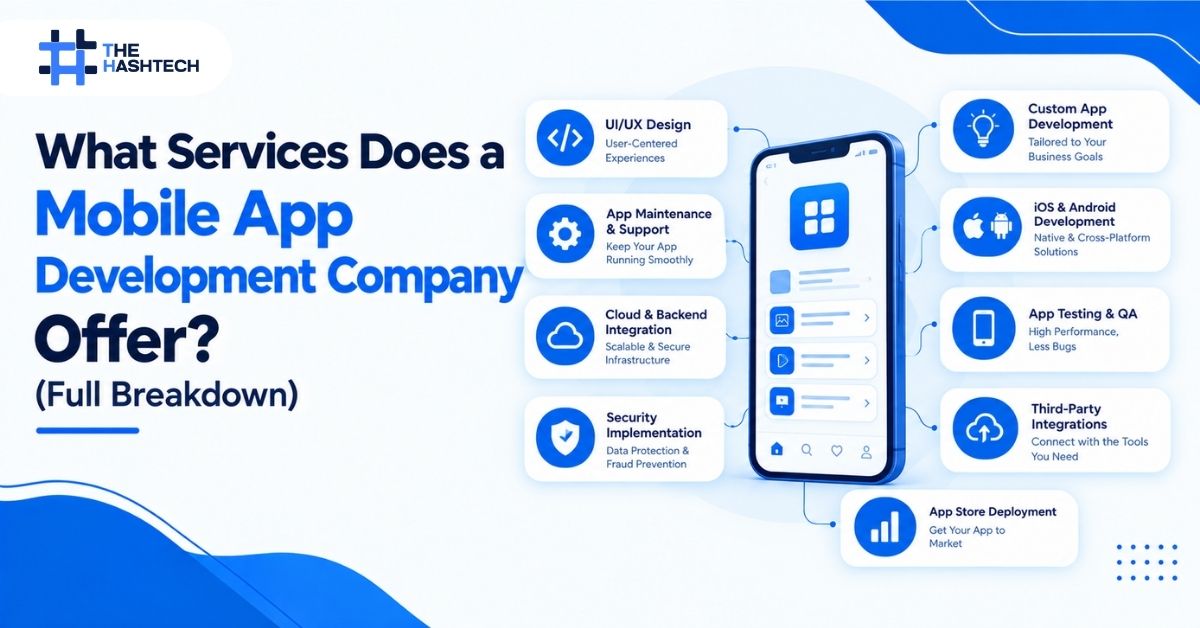
A full-service mobile app development company covers the entire lifecycle of an application strategy, design, native and cross-platform engineering, backend and cloud infrastructure, security and compliance, QA, app store deployment, and post-launch support — not just “writing the code.” Most comparisons stop at that surface-level list. This breakdown goes further into what each service actually includes, plus several services that get left out of most overviews entirely: wearable/IoT development, app store optimization, DevOps infrastructure, and the engagement models that determine how you’re actually billed.
Core Development Services
iOS App Development Services.
Native iOS builds using Swift and SwiftUI, optimized for App Store performance standards and Apple’s Human Interface Guidelines. This covers everything from architecture decisions to App Store submission readiness, not just writing Swift code.
Android App Development Services.
Native Android builds using Kotlin and Jetpack Compose, engineered to handle Android’s device and OS fragmentation — a genuinely different technical challenge than iOS, given the number of screen sizes and manufacturer variations in active use.
Cross-Platform & Hybrid Development Services.
Flutter or React Native builds that share a single codebase across iOS and Android, reducing cost and timeline compared to two separate native builds, are the right choice for most projects that don’t need deep, platform-specific hardware access.
Custom Mobile Solutions.
Tailor-made applications built around a specific business workflow rather than a generic template, common for internal tools, industry-specific platforms, or products with unusual functional requirements a standard build wouldn’t fit.
MVP & Rapid Prototyping.
A scoped-down version of the full product, built fast to validate demand before committing to a larger build. This is a distinct service from a full custom build; the goal is speed and learning, not a finished product, and a company that treats every project as a full build regardless of stage isn’t serving early-stage founders well.
Design & Product Strategy
UI/UX Design. Wireframes, prototypes, and visual design built around how people actually behave on mobile, not a desktop layout scaled down. This includes user flow mapping and usability validation before development locks in. Product Discovery & Consulting. Market research, competitive analysis, and roadmap definition before any design or code work starts.
Our own mobile app development company process runs discovery as a formal first stage precisely because skipping it is where most timeline and budget overruns originate — not in development itself, but in requirements that were never clearly defined.
Backend, Integration & Infrastructure
API Integration & Backend Development.
Connecting the app to CRMs, ERPs, payment gateways, and cloud databases is the invisible engineering work that determines whether an app can actually do anything beyond display static screens.
Cloud Infrastructure & DevOps.
Setting up scalable hosting (AWS, Azure, or serverless architecture), continuous integration/deployment pipelines, and automated build processes. This is frequently left out of service lists entirely, but it directly determines whether an app can handle real user growth without a costly rebuild.
Payment Gateway & Third-Party Integrations.
Stripe, PayPal, and similar payment infrastructure, alongside integrations with shipping, mapping, authentication, and analytics providers, each one adds its own testing and edge-case handling work.
Analytics Integration.
Setting up usage tracking, conversion funnels, and crash reporting (tools like Firebase Analytics or Mixpanel) so the business actually has visibility into how the app performs after launch, not just whether it launched successfully.
Advanced & Emerging Technology
Enterprise App Development Services.
Employee portals, workflow automation tools, and secure internal data dashboards generally have higher security requirements and lower consumer-facing design polish than a public-facing app.
AI & Machine Learning Integration.
Recommendation engines, predictive features, and conversational AI built into the app’s core functionality rather than bolted on afterward.
IoT & Wearable App Development.
Companion apps for smartwatches, fitness trackers, and connected devices a genuinely specialized skill set most general-purpose app shops don’t actually have deep experience in, despite listing it as a capability.
AR/VR and Blockchain Integration.
Augmented reality features and blockchain-based functionality (crypto payments, NFT integration, decentralized identity) for products specifically built around those technologies are worth confirming real prior experience here, since this is one of the most commonly overstated capabilities in agency portfolios.
Security & Compliance
Security deserves to be its own service line, not a footnote under development. This includes data encryption in transit and at rest, secure authentication (MFA, OAuth), OWASP-aligned code review practices, and for regulated industries, specific compliance work: HIPAA for healthcare apps, PCI-DSS for anything handling payment data, and GDPR/data-residency requirements for apps serving international users. A vendor that treats this as an optional add-on rather than a baseline architecture decision is a real warning sign, not a cost-saving feature.
Quality Assurance & Testing
Mobile App Testing.
Functional, performance, and device/OS compatibility testing across a real range of hardware, not just the newest flagship devices used in a sales demo. This should run throughout development, not get compressed into the final week before launch.
Security & Penetration Testing.
For apps handling sensitive data, structured testing against common attack vectors before launch, distinct from standard functional QA and often priced and scoped separately.
Deployment & App Store Management
App Store & Play Store Submission.
Handling the actual submission process, including compliance with each platform’s review requirements and managing resubmission if the app is initially rejected — a service that’s commonly assumed to be included but should be explicitly confirmed.
App Store Optimization Services (ASO).
Optimizing the store listing itself — title, keywords, screenshots, and description — for discoverability. A technically excellent app with a weak store listing still struggles to get downloaded, which makes ASO a genuine service line, not a marketing afterthought unrelated to development.
Post-Launch Services
Maintenance & Support. Ongoing bug fixes, OS-compatibility updates (both Apple and Google release major annual updates that can break existing apps), and performance monitoring. This should be scoped with specifics, not left as a vague “we’ll be around if needed.”
App Modernization & Legacy Migration. Rebuilding or updating an existing app moving from Objective-C to Swift, migrating an outdated framework, or re-architecting a backend that can no longer scale.
Feature Enhancement & Iteration. Ongoing development based on real user feedback and usage data post-launch is the difference between a company that disappears after launch and one that stays involved in the product’s evolution.
You can see this full lifecycle applied to a real project in our case studies, including both new builds and post-launch iteration work.
How Engagement Models Actually Work
Services are one half of the picture; how you’re billed for them is the other, and it’s rarely explained clearly:
- Fixed-price: a set cost for clearly defined scope; works well when requirements are locked before development starts.
- Time and materials: billed by actual hours/effort; suits projects where requirements are expected to evolve.
- Dedicated team — a team embedded with your business for ongoing, continuous development, common for products with a long-term roadmap rather than a single launch.
- Staff augmentation: individual specialists added to your existing internal team for a specific skill gap, rather than outsourcing the whole project.
Which model fits depends on how defined your project is and how long you expect the relationship to last. A vendor should recommend one based on your situation, not default to whichever is easiest for them to sell.
Frequently Asked Questions
What’s included in a full-service mobile app development engagement?
Strategy and discovery, UI/UX design, native or cross-platform development, backend and API integration, security implementation, QA testing, app store deployment, and post-launch maintenance, ideally scoped as distinct stages, not bundled into one vague total.
Do mobile app development companies handle backend and cloud infrastructure too? Full-service firms do; this includes API development, database architecture, and cloud hosting/DevOps setup, not just the mobile front-end. Confirm this explicitly, since some firms are frontend-only and outsource or exclude backend work.
Is app store optimization part of app development services, or separate?
It should be offered, even if lightly; a well-built app with a weak store listing still underperforms on downloads.
What’s the difference between maintenance and app modernization?
Maintenance covers ongoing bug fixes and compatibility updates for an existing, healthy app. Modernization is a larger undertaking, rebuilding outdated architecture or migrating legacy code, typically needed when an app’s original technical foundation can no longer support current requirements.
How do I know which engagement model (fixed-price, dedicated team, etc.) is right for my project?
Fixed-price suits clearly defined, one-time builds. Dedicated team or staff augmentation suits ongoing, continuously evolving products. A good vendor will ask about your project’s stage and long-term plans before recommending one, rather than defaulting to a single model for every client.
Talk to our team for a stage-by-stage breakdown of exactly which of these services your specific project needs, not a bundled quote covering things you may not require.