How Much Does a Food Delivery App Development Cost? Full Breakdown by Role


30 September, 2026
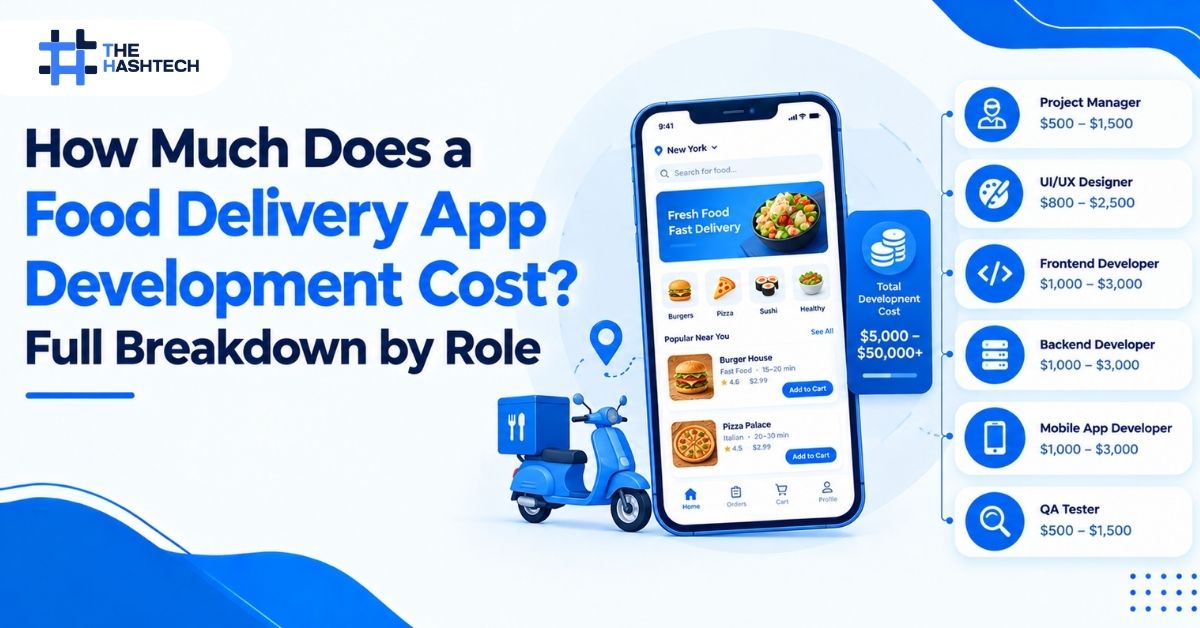
Food delivery app development cost typically ranges from $30,000 to $150,000+ for a custom platform, while larger multi-city systems can exceed $200,000. The final budget depends on whether you need customer, driver, restaurant, and admin applications, plus features such as real-time tracking, payments, dispatch, analytics, integrations, and AI.
A food delivery platform is not simply one mobile application. It is a connected digital ecosystem where customers place orders, restaurants manage menus and fulfillment, drivers accept and deliver orders, and administrators control the entire operation.
That distinction is important when estimating the budget.
A basic restaurant ordering application may require a relatively modest investment. A multi-vendor marketplace similar in operational structure to major food delivery platforms requires considerably more because several applications, backend services, APIs, dashboards, payment systems, maps, notifications, and real-time processes must work together.
Current industry estimates show a wide range because the term “food delivery app” can describe anything from a single-restaurant MVP to a four-sided marketplace. Recent development estimates place lean MVPs around 30,000–60,000, mid-market platforms around 60,000–120,000, and larger enterprise builds around 120,000–200,000 or more. These should be treated as planning ranges rather than fixed quotes.
What Is Food Delivery App Development?
Food delivery app development involves designing and building a digital platform that connects customers, restaurants, delivery personnel, and administrators through mobile applications and web-based management systems.
A full food delivery ecosystem generally contains four major components:
| Component | Primary Users | Main Purpose |
| Customer app | Customers | Search restaurants, order food, pay, and track deliveries |
| Driver app | Delivery personnel | Accept orders, navigate routes, and complete deliveries |
| Restaurant app/panel | Restaurants | Manage menus, orders, availability, and fulfillment |
| Admin dashboard | Business operators | Manage users, restaurants, drivers, orders, payments, and analytics |
This four-sided structure is one of the biggest reasons food delivery app development cost can become substantial.
For example, DoorDash reported more than 3.2 billion total orders in 2025, demonstrating the operational scale that a mature marketplace can reach. Its platform also combines consumer marketplaces with merchant-focused commerce services, showing how modern delivery businesses extend beyond a simple ordering application.
How Much Does a Food Delivery App Cost?
The cost depends primarily on the scope of the platform.
| Development Level | Estimated Cost | Approximate Timeline | Typical Scope |
| Basic MVP | 30,000–60,000 | 3–5 months | Core ordering and delivery workflow |
| Mid-level platform | 60,000–120,000 | 5–8 months | Four roles, payments, tracking, analytics |
| Advanced platform | 120,000–200,000+ | 8–12+ months | Advanced logistics, integrations, automation |
| Enterprise/multi-city | 200,000–350,000+ | 12–18+ months | Large-scale infrastructure, AI, complex operations |
These are planning estimates, not universal market prices. Development estimates vary considerably based on location, technology stack, team composition, integrations, and product complexity.
The most useful way to estimate your budget is therefore not to ask only, “How much does a food delivery app cost?” Instead, businesses should first define their required mobile app development services and then estimate each component of the platform.
How Much Does a Customer Food Delivery App Cost?
The customer application is the consumer-facing part of the platform. It normally receives a significant portion of the development budget because customers interact with many different workflows.
A basic customer app may cost approximately 10,000–25,000, while a more sophisticated application can move toward 25,000–50,000+, depending on functionality, design complexity, platform coverage, and integrations.
Typical customer features include:
- Registration and login
- Location detection
- Restaurant discovery
- Search and filters
- Restaurant profiles
- Digital menus
- Food customization
- Cart
- Checkout
- Multiple payment options
- Promo codes
- Order confirmation
- Live order status
- Delivery tracking
- Push notifications
- Ratings and reviews
- Order history
- Favorite restaurants
- Customer support
- Loyalty or membership features
The cost increases when the application needs personalized recommendations, sophisticated search, multiple currencies, multiple languages, subscription memberships, advanced loyalty programs, or AI-driven experiences.
For an MVP, it is generally more practical to prioritize restaurant discovery, menu browsing, cart, checkout, payment, order tracking, and basic support rather than launching every possible feature.
How Much Does a Driver Delivery App Cost?
The driver application manages the last-mile delivery workflow.
A basic driver application may cost around 8,000–20,000, while an advanced courier application can reach 20,000–40,000+ depending on navigation, dispatch, communication, verification, and automation requirements.
Important driver features include:
- Driver registration
- Identity verification
- Profile management
- Availability toggle
- Order notifications
- Order acceptance/rejection
- Pickup information
- Restaurant location
- Customer location
- GPS navigation
- Route tracking
- Delivery status updates
- Earnings dashboard
- Delivery history
- Proof of delivery
- In-app communication
- Customer calling
- Support
- Ratings
- Incentives and bonuses
Real-time location is particularly important because the driver application has to communicate continuously with backend services while the customer sees delivery progress.
Route optimization can add another layer of technical complexity. If the platform needs to assign multiple orders intelligently, calculate routes, support batching, or dynamically adjust delivery assignments, the backend architecture becomes more sophisticated.
How Much Does a Restaurant App or Panel Cost?
Restaurants need their own operational interface for receiving and managing orders.
A restaurant application or web panel may cost approximately 8,000–30,000+, depending on whether it is a simple order management interface or a full restaurant management system.
Core features can include:
- Restaurant registration
- Business verification
- Restaurant profile
- Menu management
- Category management
- Item customization
- Pricing management
- Availability controls
- Incoming order alerts
- Order acceptance
- Order rejection
- Preparation-time updates
- Order status management
- Promotions
- Coupon management
- Sales reports
- Customer reviews
- Operating hours
- Multiple locations
- Inventory integration
- POS integration
A restaurant portal becomes considerably more complex when the business needs integration with existing POS systems, inventory software, accounting systems, kitchen displays, or multiple branches.
For a startup launching in one city, a web-based restaurant dashboard may be sufficient initially. A dedicated restaurant mobile application can be introduced when operational requirements justify it.
How Much Does the Admin Panel Cost?
The admin dashboard is the control center of the food delivery platform.
It may cost approximately 10,000–40,000+, depending on the operational complexity of the marketplace.
An admin system commonly includes:
- Customer management
- Restaurant management
- Driver management
- Order management
- Delivery monitoring
- Payment management
- Refund management
- Commission management
- Coupon management
- Content management
- Location management
- User permissions
- Notifications
- Analytics
- Revenue reports
- Driver payouts
- Restaurant settlements
- Dispute management
- Support tools
The admin panel can look relatively simple from the outside, but it becomes one of the most important components as order volume grows.
A marketplace operator may need to investigate failed orders, issue refunds, change restaurant commissions, review driver activity, resolve disputes, monitor delivery delays, and analyze revenue from the same system.
What Is the Cost Breakdown by Customer, Driver, Restaurant, and Admin?
A useful planning model is to divide the development budget according to the four major components.
| Platform Component | Estimated MVP Cost | Mid-Level Cost | Advanced Cost |
| Customer app | 10,000–20,000 | 20,000–40,000 | 40,000–70,000+ |
| Driver app | 7,000–15,000 | 15,000–25,000 | 25,000–40,000+ |
| Restaurant panel | 6,000–12,000 | 12,000–25,000 | 25,000–45,000+ |
| Admin dashboard | 7,000–13,000 | 13,000–25,000 | 25,000–45,000+ |
| Backend & integrations | 10,000–20,000 | 20,000–35,000 | 35,000–60,000+ |
The numbers above are planning estimates and should not simply be added together without considering shared backend architecture, design systems, reusable components, and development methodology.
The total budget can therefore be lower or higher than the sum of individual module estimates depending on how the platform is architected and developed.
What Features Increase Food Delivery App Development Cost?
Features influence the budget more than the basic idea of “food delivery.”
The following components commonly increase development effort.
Real-Time GPS Tracking
Customers expect to know where their order is.
Implementing location tracking requires mobile permissions, mapping services, location updates, backend processing, driver coordinates, route information, and customer-facing status updates.
Mapping services also create ongoing operating costs. Google Maps Platform, for example, uses pay-as-you-go pricing based on billable events and offers different pricing categories and subscription options.
Online Payments
A delivery platform may support credit and debit cards, digital wallets, bank transfers, local payment methods, or cash on delivery.
Payment integration itself is only one part of the work. The platform also needs payment status handling, failed transactions, refunds, restaurant settlements, driver payouts, and transaction reconciliation.
Payment providers charge their own processing fees in addition to development costs. For example, Stripe currently lists standard domestic card pricing at 2.9% + 30¢ per successful transaction in its standard U.S. pricing. Actual rates vary by market, payment method, account, and contract.
Smart Delivery Dispatch
Basic delivery assignment is relatively straightforward.
Advanced dispatch can involve:
- Driver proximity
- Current driver workload
- Restaurant preparation time
- Estimated delivery time
- Traffic
- Delivery zones
- Multiple orders
- Driver availability
- Priority rules
The more variables the system considers, the more sophisticated the backend logic becomes.
Restaurant and POS Integrations
Restaurants may already use point-of-sale systems, inventory software, accounting systems, kitchen display systems, or other operational tools.
Every integration introduces additional API work, authentication requirements, error handling, testing, and maintenance.
AI Features
AI can be introduced for:
- Restaurant recommendations
- Personalized food suggestions
- Customer support
- Demand forecasting
- Fraud detection
- Delivery-time prediction
- Driver assignment
- Menu optimization
- Review analysis
- Marketing automation
AI should not automatically be included simply because it is available. It should solve a defined business problem.
The number and complexity of these features should be defined before development begins. Businesses planning a complete food delivery app development project can use this scope to determine which capabilities belong in the MVP and which should be introduced later.
What Is the Food Delivery App Development Process?
A structured development process helps control scope and avoid unnecessary spending.
1. Define the Business Model
Decide whether the platform will be:
- A single-restaurant application
- A multi-restaurant marketplace
- A restaurant-owned delivery system
- A third-party logistics platform
- A white-label solution
- A city-specific marketplace
- A multi-city or national marketplace
The business model directly affects architecture and cost.
2. Define User Roles
Document what customers, drivers, restaurants, administrators, support staff, and other users need to accomplish.
This prevents features from being added randomly during development.
3. Define the MVP
Separate essential launch functionality from future features.
For example, an initial MVP may include:
Customer: search, menu, cart, checkout, payment, tracking.
Restaurant: menu, order management, availability.
Driver: order acceptance, navigation, delivery status.
Admin: users, restaurants, drivers, orders, payments, reports.
4. Design UX/UI
Design the customer experience first, followed by operational interfaces.
Food delivery applications need quick navigation because customers generally want to discover food, place an order, and track it without unnecessary friction.
5. Develop the Backend
The backend connects the four major platform components.
It manages:
- Authentication
- Users
- Restaurants
- Menus
- Orders
- Payments
- Drivers
- Locations
- Notifications
- Promotions
- Reviews
- Analytics
- APIs
6. Develop the Applications
Customer, driver, restaurant, and admin interfaces can then be developed against the defined backend architecture.
Cross-platform technologies can sometimes reduce duplicated development work when the product requirements are appropriate for them.
7. Integrate Third-Party Services
Typical integrations include:
- Maps
- Payment gateways
- SMS
- Push notifications
- Analytics
- Social login
- POS
- CRM
- Customer support
8. Test the Platform
Testing should cover individual features as well as the entire order lifecycle.
A useful scenario is:
Customer places order → restaurant accepts → restaurant prepares → driver receives assignment → driver picks up → customer tracks delivery → driver completes delivery → payment and settlement are recorded.
9. Launch
Deployment includes app-store submission, production infrastructure, monitoring, security configuration, analytics, backups, and operational support.
10. Improve Using Real Data
After launch, use actual order data and customer behavior to determine which features deserve further investment.
This is often more efficient than trying to build every advanced capability before the product has real users.
How Long Does It Take to Build a Food Delivery App?
A basic food delivery MVP can take approximately 3–5 months.
A mid-level multi-role platform can require 5–8 months, while advanced multi-city systems can take 8–12 months or longer.
| Project Scope | Estimated Timeline |
| Single restaurant MVP | 2–4 months |
| Multi-restaurant MVP | 3–5 months |
| Four-role platform | 5–8 months |
| Advanced delivery marketplace | 8–12+ months |
| Enterprise multi-city platform | 12–18+ months |
The timeline depends on team size, platform count, integrations, approval cycles, feature complexity, and how quickly requirements are finalized.
Development time is also not the same as calendar time. A larger team can work on several modules simultaneously, although increasing team size does not automatically reduce the timeline because architecture, communication, QA, and dependencies still have to be managed.
What Technology Stack Is Used for Food Delivery Apps?
A modern food delivery platform usually requires several layers rather than one technology.
A typical architecture may include:
| Layer | Common Technology Options |
| Mobile apps | Flutter, React Native, Swift, Kotlin |
| Backend | Node.js, Python, Java, .NET |
| Database | PostgreSQL, MySQL, MongoDB |
| Cloud | AWS, Google Cloud, Azure |
| APIs | REST or GraphQL |
| Maps | Google Maps Platform or similar services |
| Payments | Stripe, PayPal, regional gateways |
| Notifications | Firebase Cloud Messaging, APNs |
| Analytics | Firebase, Mixpanel, custom analytics |
The right stack depends on the required platforms, expected traffic, integrations, development team, and long-term maintenance strategy.
How Does Development Location Affect Food Delivery App Cost?
Developer rates vary substantially between markets, which means the same product specification can receive very different quotes.
| Development Market | General Cost Pattern |
| North America | Higher development rates |
| Western Europe | Higher development rates |
| Eastern Europe | Mid-range development rates |
| South Asia | Low-to-mid development rates |
| Middle East | Rates vary by country and vendor |
However, hourly rate should not be used as the only selection criterion.
A lower hourly rate can become expensive if requirements are misunderstood, architecture needs to be rebuilt, QA is weak, or the project requires extensive rework.
A more useful comparison considers the total cost of ownership, including development, infrastructure, third-party services, maintenance, support, and future feature development.
What Are the Hidden Costs of a Food Delivery App?
The initial development quote is not necessarily the complete first-year investment.
Additional expenses can include:
- Cloud hosting
- Database infrastructure
- Maps and location APIs
- Payment processing
- SMS
- Push notification infrastructure
- App-store fees
- Security monitoring
- Analytics
- Customer support
- Maintenance
- Bug fixes
- New operating-system compatibility
- Marketing
- Restaurant acquisition
- Driver onboarding
- Legal and compliance requirements
Infrastructure and third-party services should therefore be included in the financial plan from the beginning rather than treated as unexpected expenses after launch.
How Much Does It Cost to Maintain a Food Delivery App?
A common planning approach is to budget approximately 15%–25% of the initial development cost annually for software maintenance and ongoing improvements, although this is not a universal rule.
Maintenance can include:
- Bug fixes
- Security updates
- OS compatibility
- Server management
- Database optimization
- API updates
- Performance improvements
- Minor feature enhancements
- Monitoring
- Technical support
For example, if a platform costs $80,000 to develop, an organization might initially plan around 12,000–20,000 per year for software maintenance and incremental improvements. This is a planning estimate, not a fixed industry fee.
Third-party service costs should be budgeted separately.
How Can You Reduce Food Delivery App Development Cost?
Reducing cost does not necessarily mean removing important functionality.
The objective should be to reduce unnecessary development while protecting the core ordering and delivery experience.
Start With One Market
Launching in one city can simplify:
- Delivery zones
- Restaurant onboarding
- Driver operations
- Payment requirements
- Customer support
- Marketing
- Logistics
After validating the model, additional locations can be introduced.
Build the Core Four-Sided Workflow First
Prioritize the features required to complete an order successfully.
Customer → Restaurant → Driver → Customer.
Everything that does not contribute directly to that workflow can potentially be evaluated for a later phase.
Use a Cross-Platform Approach When Appropriate
If the product requirements support it, cross-platform development can reduce duplicated work across iOS and Android.
However, native development may still be appropriate for specific performance-sensitive or platform-specific requirements.
Integrate Instead of Building Everything From Scratch
Maps, payments, messaging, analytics, and other commodity services can often be integrated through established providers.
Building every infrastructure component internally can increase both initial development cost and long-term maintenance requirements.
Use a Phased Roadmap
Instead of spending the entire budget before launch:
Phase 1: Core marketplace
Phase 2: Advanced analytics and promotions
Phase 3: AI and automation
Phase 4: Multi-city expansion
Phase 5: Advanced logistics and personalization
This approach lets product decisions be informed by actual customer and order data.
How Much Should You Budget for a Food Delivery App in 2026?
For practical planning, consider these three scenarios.
Scenario 1: Local MVP — 30,000–60,000
Suitable for a startup testing a food delivery concept in a limited market.
Likely scope:
- Customer app
- Basic restaurant panel
- Basic driver app
- Admin dashboard
- Online payments
- Basic location tracking
- Push notifications
- Order management
Scenario 2: Regional Platform — 60,000–120,000
Suitable for a business preparing to operate across multiple areas.
Likely additions:
- More sophisticated restaurant management
- Better driver management
- Advanced tracking
- Promotions
- Ratings
- Analytics
- Multiple payment methods
- Better customer support
- More integrations
Scenario 3: Advanced Marketplace — 120,000–200,000+
Suitable for a business requiring a larger operational ecosystem.
Potential features:
- Advanced dispatch
- Route optimization
- Multi-city management
- Multiple restaurant locations
- POS integrations
- Advanced analytics
- AI recommendations
- Fraud detection
- Loyalty programs
- Subscription memberships
- Automated operations
- Scalable cloud infrastructure
Enterprise platforms can move substantially beyond $200,000 when they require extensive custom infrastructure, advanced AI, large-scale integrations, and multi-region operations.
Why Choose The Hashtech for Food Delivery App Development?
The Hashtech approaches food delivery products as complete digital ecosystems rather than treating the customer application as the entire project.
Businesses can also review relevant mobile app development case studies to understand how different digital products are approached from planning through development and deployment.
The development scope can be planned around customer, driver, restaurant, and administrative workflows, with the backend connecting these components through APIs and real-time services.
A food delivery project may require mobile application development, UI/UX design, backend engineering, payment integration, location services, notifications, analytics, testing, deployment, and post-launch maintenance. The right combination depends on the business model and launch requirements.
The Hashtech can also structure development in phases so a business does not have to build every advanced feature before validating the core marketplace.
For startups, this can mean beginning with a focused MVP. For established businesses, the roadmap can include more sophisticated integrations, automation, analytics, and scalable infrastructure.
The most important part of estimating food delivery app development cost is defining the actual operational model before development begins. A detailed discovery phase can turn a broad idea into a feature-level scope, technology plan, timeline, and budget.
What Should You Ask a Food Delivery App Development Company Before Hiring?
Before comparing development proposals, ask:
- Does the estimate include customer, driver, restaurant, and admin components?
- Is backend/API development included?
- Which payment gateways are included?
- Are maps and GPS tracking included?
- Which third-party API costs are separate?
- Does the quote include UI/UX design?
- Is QA and testing included?
- Does the company provide deployment support?
- What happens when requirements change?
- Is post-launch maintenance included?
- Who owns the source code and intellectual property?
- How will the platform scale if order volume increases?
- What security measures are included?
- How will restaurant and driver settlements work?
- What analytics will be available after launch?
A detailed answer to these questions can make competing development proposals easier to compare because two agencies may quote the same total price while offering very different scopes.
Final Thoughts
Food delivery app development cost is determined by much more than the number of screens in a mobile application. A complete delivery marketplace connects customers, restaurants, drivers, and administrators through a shared backend, payment infrastructure, location services, notifications, analytics, and operational workflows.
A realistic starting budget for a custom food delivery MVP is often around 30,000–60,000, while a more complete four-sided marketplace can move into the 60,000–120,000 range. Advanced or enterprise systems can reach 120,000–200,000+, particularly when they include sophisticated logistics, AI, multi-city operations, and extensive integrations. These figures are planning ranges rather than fixed market prices.
The best way to control the budget is to define the business model first, identify the four user roles, separate MVP functionality from future features, and estimate third-party and post-launch costs separately.
A successful food delivery product also needs to be designed around the complete order lifecycle rather than individual screens. When the customer, restaurant, driver, and admin workflows are properly connected, development decisions become easier to scope and the budget becomes more predictable.
If you are planning a food delivery platform, food delivery app development can be scoped around your required user roles, features, integrations, timeline, and target market before development begins.
Frequently Asked Questions
How much does it cost to develop a food delivery app?
Food delivery app development can cost approximately 30,000–150,000+ for a custom platform, depending on scope. A basic MVP may fall around 30,000–60,000, while a complete multi-role marketplace can cost 60,000–120,000 or more. Advanced enterprise platforms with AI, complex logistics, and multi-city operations can exceed $200,000.
How much does it cost to build a DoorDash-like food delivery app?
A DoorDash-style platform requires substantially more than a basic restaurant ordering app because it needs customer, merchant, driver, and administrative systems plus backend services, payments, location tracking, dispatch, analytics, and operational tools. A serious custom implementation can therefore move from the tens of thousands into six figures depending on the desired scope and scale.
How long does it take to build a food delivery app?
A basic MVP can take approximately 3–5 months, while a four-role platform commonly requires around 5–8 months. Advanced multi-city systems can take 8–12 months or longer. The actual timeline depends on feature complexity, integrations, design requirements, development team size, testing, and how quickly business requirements are finalized.
What is the most expensive part of food delivery app development?
There is no single component that is always the most expensive. The customer application, backend, driver logistics, restaurant management, and administrative systems can each represent substantial portions of the budget. Advanced features such as real-time tracking, route optimization, POS integrations, AI, and multi-city operations can significantly increase the overall development effort.
How much does it cost to maintain a food delivery app?
A common planning estimate is around 15%–25% of the original development cost per year for software maintenance and ongoing improvements. For example, an $80,000 development project could lead to a preliminary maintenance budget of approximately 12,000–20,000 annually. Hosting, payment processing, maps, SMS, analytics, and other third-party services should be budgeted separately.