
How Long Does It Take to Build an App in Riyadh?


5 October, 2026
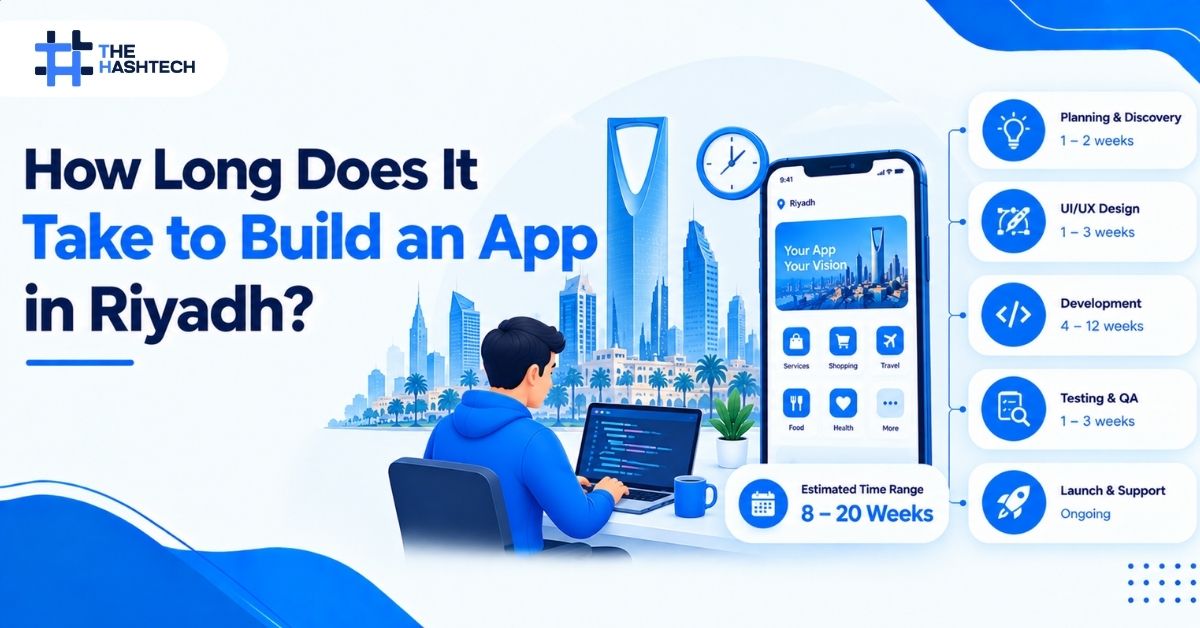
Every client in Riyadh asks the same question in the first call: “Realistically, when can we launch?” In other words, how long does it take to build an app in Riyadh? The honest answer is almost never a single number. Most apps here take 3 to 6 months, simple MVPs can land in 2-3 months, and anything touching SAMA compliance, government API integration, or enterprise-grade security commonly runs 6-12+ months. The gap between those numbers isn’t about how fast a team can type code. It’s about how much of the timeline sits outside the development team’s hands entirely — something I explain to almost every client before we sign anything.
Why I Walk Clients Through This Differently in Riyadh
When I scope a project anywhere else, the timeline conversation is mostly internal: design cycles, sprint counts, QA passes. In Riyadh, a meaningful share of the projects I take on touch financial services, government-adjacent platforms, or enterprise systems. That changes the conversation from day one, because those projects come with external review steps that no amount of overtime can simply work around. I’d rather tell a client “this part depends on SAMA’s timeline, not mine” in the first meeting than explain it as an excuse in month four.
This is the conversation our mobile app development company in Riyadh team has with nearly every client before any contract gets signed because a timeline nobody explained properly is the fastest way to lose trust halfway through a build.
The First Call: Defining What We’re Actually Building
Before I give anyone a number, I need real answers to a few questions. What does this app actually need to do on day one, versus what’s a “nice to have” for version two? Does it touch payments, personal data, or government services in any way? Who’s the end user, and what device conditions are they actually using because Riyadh’s audience skews toward newer, higher-end devices more than some neighboring markets, which affects how much device-fragmentation testing I budget for.
This conversation alone can take a week or two if the client hasn’t thought it through yet, and that’s fine. Rushing past it is exactly what causes the timeline blowouts nobody wants.
Timeline by Project Type
| Project Type | Timeline | What Adds Time |
| Simple MVP | 2-3 months | Minimal, mostly design and core feature build |
| Mid-Complexity App | 3-6 months | Multiple integrations, custom UI, moderate backend work |
| SAMA-Compliant / Fintech | 6-9 months | Compliance review, audit trail architecture, security testing |
| Government-Adjacent Platform | 8-12+ months | External API approval timelines, data residency setup |
Phase One: Planning and Architecture
This is where I decide whether we’re building something that just needs to work, or something that needs to pass an external audit someday. For a standard app, planning runs one to three weeks, defining scope, mapping user flows, picking the tech stack. For anything SAMA-adjacent, I extend this phase deliberately, because the architecture decisions made here determine whether compliance later is a smooth review or a painful retrofit.
If a client is weighing whether they even need a fully custom build at this stage, I usually point them toward our breakdown of custom mobile app development because not every idea needs the full build I’m about to describe, and it’s a fair question to ask before committing months of budget.
I also settle the tech stack here, not later. Flutter or React Native cover most business apps efficiently and keep both iOS and Android moving on roughly the same timeline. For anything performance-critical, a fintech app processing real-time transactions, for instance, I’ll usually recommend native Swift or Kotlin instead, even though it means running two parallel development tracks rather than one shared codebase. That decision alone can shift the development phase by several weeks in either direction, which is exactly why I make it during planning instead of discovering the need for it mid-build.
Phase Two: Design
Wireframes and prototypes come next, typically two to five weeks depending on how many screens and flows the app actually has. I test these against real user behavior before a single line of production code gets written, because a design flaw caught here costs an afternoon to fix. The same flaw caught during QA costs a sprint.
Phase Three: Development Where Most of the Clock Runs
This is the biggest phase on any timeline, usually eight to thirty-plus weeks depending on feature count and backend complexity. For a Riyadh-based fintech or government-adjacent build specifically, I’m not just writing features; I’m building audit trails, structuring data handling to match SAMA’s expectations, and architecting cloud infrastructure around data residency requirements from the start rather than bolting them on later.
This is also the phase where I push back hardest on scope creep. Every feature a client adds mid-build resets part of the clock, and in a compliance-heavy project that reset is more expensive than it would be on a simple consumer app, because compliance-related code often touches more of the system than a typical feature would.
I also keep communication structured during this phase rather than sporadic. Weekly builds, not just status updates, so the client sees working software instead of taking my word for progress. Clients who stay engaged with these check-ins catch misalignments early, when they cost a day to fix. Clients who disappear for a month and reappear expecting a finished app are the ones most likely to be unhappy with where we ended up, through no fault of the development itself.
Phase Four: Testing and QA
Three to six weeks, scaling with how sensitive the data is. For a standard app, this covers functional testing, device compatibility, and performance. For anything handling payments or personal government data, I add a real security testing pass: penetration testing, access control verification, the kind of review that a SAMA auditor or a client’s internal security team will eventually ask about anyway. Doing it properly here saves a much worse conversation later.
Phase Five: The Part I Can’t Speed Up
This is the phase I’m most upfront about, because it’s the one clients struggle to accept. SAMA compliance review and government API approval for platforms like Absher or Tawakkalna run on the regulator’s schedule, not mine. I can prepare a clean, well-documented submission that moves through review as fast as possible, but I can’t promise a specific number of days, because that number isn’t mine to promise.
What I can do is start this process in parallel with development instead of waiting until the app is finished. Clients who begin their approval conversations early consistently launch faster than clients who treat it as a final step because by the time development wraps, the approval is already moving instead of just starting.
I’ve seen both versions of this play out. One client treated government API approval as a final checkbox and ended up waiting nearly two extra months after development was otherwise complete, watching a finished product sit unused. Another client started that same conversation in month two of a five-month build, and by launch, approval had already cleared. Same type of integration, same regulatory process; the only difference was when the clock started.
Phase Six: Launch and What Comes After
App Store and Play Store submission takes one to three weeks on top of everything above. I budget for at least one rejection cycle even on clean submissions, because Apple and Google both flag things that a test environment never catches: a permission that isn’t justified clearly enough, a data disclosure form that needs another pass. Clients who expect same-day approval are usually the ones most frustrated by a completely normal one-week delay.
Then the real work of maintaining a live app begins: monitoring, bug fixes, and responding to the first wave of real user behavior, which almost always surfaces something the test environment didn’t catch. I tell every client this upfront: launch is a milestone, not a finish line, and the apps that stay healthy are the ones where someone keeps watching after week one.
If budget planning matters as much as timeline for your project, I’ve written a companion piece on how much mobile app development costs in Riyadh, and the two usually move together. The same compliance requirements that extend a timeline tend to be the ones that raise the budget.
What I Tell Clients to Do Early to Protect Their Timeline
A few decisions matter more than anything that happens mid-build:
- Confirm your compliance requirements before development starts, not after. Retrofitting SAMA compliance into an app that wasn’t architected for it from day one is slower and more expensive than planning for it upfront.
- Start any government API approval process in parallel with development. Waiting until the app is “basically done” to begin approval conversations is the single most common cause of launch delays I see in Riyadh specifically.
- Lock your MVP scope and defend it. Every added feature resets part of the clock, true everywhere, but more costly here given how much compliance-related architecture a single change can touch.
- Work with a team that’s already been through this. A developer who has shipped SAMA-compliant or government-adjacent apps in Riyadh plans around these steps automatically, because they’ve been burned by skipping them before. A team encountering this for the first time learns that lesson on your project’s timeline, not their own.
Frequently Asked Questions
How long does it take to build an app in Riyadh?
Most apps take 3 to 6 months from planning to launch. Simple MVPs can land in 2-3 months, while SAMA-compliant or government-adjacent projects commonly run 6-12+ months depending on external review timelines.
How long does a simple app take to build in Riyadh?
A simple MVP with core features and standard UI typically takes 2-3 months from planning to launch.
Why do SAMA-compliant apps take longer to build in Riyadh?
SAMA compliance requires a formal review process, audit-trail architecture, and specific security standards steps that run on the regulator’s timeline and add real time beyond standard development and testing.
Does government API integration always delay a project?
It adds time in most cases, since approval for integrating with platforms like Absher or Tawakkalna sits outside the development team’s control. Starting this process early, alongside development, minimizes the impact on the overall timeline.
Can a Riyadh app development timeline be shortened without cutting corners?
Yes, mainly by locking scope early, starting any required regulatory or API approval processes in parallel with development, and choosing a team with direct experience in Riyadh’s compliance landscape.
How does Riyadh’s timeline compare to other Saudi cities?
Riyadh timelines often run longer on average because a larger share of projects involve SAMA compliance or government-adjacent integration requirements that are less common in more commercial, SME-driven markets elsewhere in the Kingdom.
If You’re Ready to Scope This Properly
Every number in this guide is a starting point, not a quote. If you’re still asking how long it takes to build an app in Riyadh for your specific project, that’s not a question a blog post can fully answer; it depends on compliance, integrations, and scope we haven’t discussed yet. That’s the first conversation I have with every client before we touch a single wireframe.
Our mobile app development company in Riyadh team has been through SAMA review and government API approval enough times to plan around it from day one, rather than discovering it mid-project.
We don’t hand off a plan and disappear either. The same team that scopes your timeline in week one is the team still answering questions in month five, which matters more than it sounds when a regulator’s review window shifts and someone needs to explain why, honestly, without passing the question to a project manager who wasn’t in the original planning call.
You can see how this plays out on real, delivered projects in our case studies.
Talk to our team about your launch date; we’ll tell you honestly which parts of your timeline we control, and which parts depend on a regulator’s schedule instead of ours.