
Application Development Outsourcing in Saudi Arabia: How to Find the Right Development Partner
- Blogs
- >
- Application Development Outsourcing in Saudi Arabia: How to Find the Right Development Partner


19 October, 2026
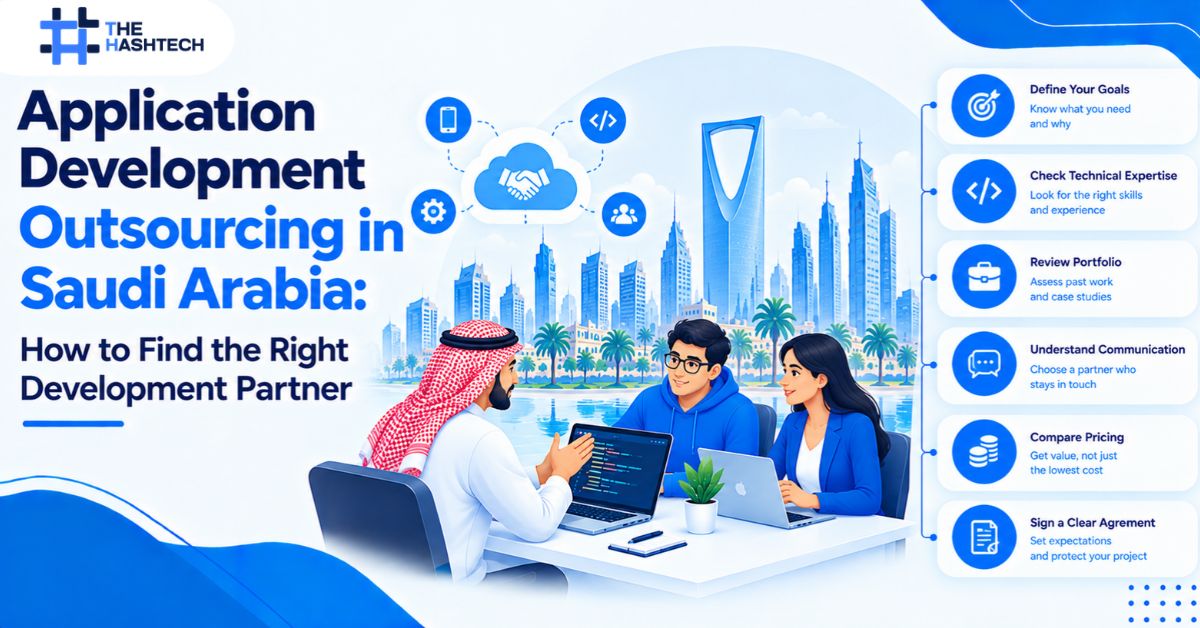
Key takeaways:
- Choose an outsourcing partner on technical capability, security, regulatory readiness, delivery evidence, and long-term fit, not on hourly rate alone.
- Pick an onshore, GCC-based, offshore, or hybrid model according to your data sensitivity, control needs, budget, and scalability requirements.
- Plan roughly SAR 60,000 to SAR 1,000,000+ per project depending on complexity, and compare vendors on the total cost of governance and compliance.
- Treat PDPL compliance, NCA and SAMA requirements, IP ownership and exit planning as core parts of the outsourcing strategy, not afterthoughts.
Outsourcing application development in Saudi Arabia is no longer just a way to add developers or trim costs. The decision shapes how personal data is handled, whether you stay on the right side of the Kingdom’s regulators, who owns your intellectual property, and how quickly you can recover when a critical system fails.
That changes the question from “Which vendor can build this?” to “Which partner can safely own part of this delivery responsibility inside the Saudi regulatory environment?”
The context makes the question urgent. Vision 2030 has pushed digital transformation into almost every sector, from government services and banking to healthcare, retail and logistics. Organisations are launching new digital products, modernising legacy platforms and adding AI capabilities faster than most can hire and train engineers. At the same time, localisation rules and a competitive talent market make it hard to build large in-house teams quickly.
This guide offers a practical framework for shortlisting, vetting and governing an application development outsourcing partner in Saudi Arabia.
Why Are Businesses Outsourcing Application Development in Saudi Arabia in 2026?
Saudi organisations outsource application development to close skills gaps, add capacity on demand and modernise legacy platforms without freezing day-to-day operations. The benefit only holds when governance, security and data handling are designed in from the start.
Access specialised skills. Cloud, cybersecurity, data engineering, AI and legacy modernisation skills are hard to build internally at short notice. A capable partner can fill the gap in weeks rather than months.
Scale capacity without permanent hiring. External developers, architects, testers and DevOps engineers can be added around your core team when delivery demand spikes, then scaled back when it eases.
Navigate workforce localisation more flexibly. Saudization quotas under the Nitaqat programme continue to widen across sectors. In 2026, for example, a 30% Saudization rate was introduced for 46 engineering professions from 30 June for firms with five or more workers in scope. Outsourcing part of the build lets you keep your permanent hiring focused on strategic roles while a partner supplies specialist capacity.
Modernise legacy systems faster. Ageing core systems slow every change request and raise operational risk. Specialist teams can re-platform in stages.
Speed up releases for a fast-moving market. Saudi consumers are highly digital, and competitors launch quickly. A dedicated external team working alongside your product leaders can shorten cycles without disrupting your roadmap.
Turn fixed costs into predictable delivery spend. Recruitment, onboarding, visas, housing and tooling costs compound quietly. Outsourcing converts them into spend tied to defined scope and outcomes.
How to Find an Application Development Outsourcing Partner in Saudi Arabia
Partner selection works best when it resembles technology due diligence rather than a simple vendor comparison. The goal is to establish whether a provider can manage the technical, commercial, regulatory, and operational consequences of the work after the contract is signed.
Step 1: Define Outcomes, Constraints and Risk
Classify the application first. Is it customer-facing? Does it process personal, financial or health data? Does it support a critical national or business operation? Will it integrate with government platforms? Will developers need production access?
The answers determine how much scrutiny a supplier needs, and which Saudi regulators will care about the project.
Step 2: Build the RFP Around Evidence
Do not only ask providers what they can do. Ask any mobile app development company in Saudi Arabia to show how it has done it. Request:
- Relevant case studies and references, ideally from Saudi or GCC clients
- Architecture examples and security controls
- Team structures and CVs of the people who will actually work on the project
- Delivery metrics and testing approach
- Incident management processes
- Evidence of Arabic and right-to-left (RTL) product experience
- Experience with Saudi integrations such as Nafath, Mada, and other national platforms
Step 3: Use a Weighted Scorecard
Price belongs in the selection, but it should not dominate it. Filter responses with a weighted scorecard based on your priorities. For example:
- Security and regulatory compliance: 30%
- Technical capability: 25%
- Delivery track record: 20%
- Sector and Saudi market experience: 15%
- Commercial transparency: 10%
Disqualify providers that fail your regulatory baseline, whatever the price advantage.
Step 4: Conduct Technical Due Diligence
Review the proposed architecture before signing. Look at integration patterns, identity management, data flows, hosting location, observability, testing, disaster recovery, and deployment controls. Ask who will make architecture decisions once delivery begins.
If your application will handle regulated data, confirm early which cloud regions the provider will use and whether they are in-Kingdom.
Step 5: Run a Paid Pilot or Discovery Sprint
A short, paid engagement reveals more than several rounds of presentations. It shows how the provider communicates, documents decisions, handles ambiguity, and reacts when the first technical assumption proves wrong.
Step 6: Negotiate the Contract Around Risk
The agreement should cover service levels, data handling and residency, audit rights, IP and source-code ownership, breach notification, subcontracting, termination and knowledge transfer. Governing law and jurisdiction deserve attention too. For banks, SAMA’s outsourcing rules indicate a preference for Saudi governing law and jurisdiction in outsourcing contracts.
Step 7: Establish Governance Before Development Starts
Agree decision rights, reporting cadence, escalation routes, and measurable outcomes. A workable operating chain looks like this:
Business owner → Product leadership → Architecture and security → Delivery lead → Engineering team
That structure keeps technical decisions tied to business priorities.
Outsourcing Models: Which One Fits Your Situation?
The right model depends on how much control you need, where sensitive work can be performed, and how predictable the scope is. The important point is not where every developer sits, but whether the operating model gives you enough visibility and control.
| Criteria | Onshore (Riyadh, Jeddah, Dammam) | GCC / nearshore | Offshore | Hybrid / dedicated team |
| Cost | Higher | Medium | Lower to medium | Medium to high |
| Control | High | Medium to high | Medium | High |
| Compliance complexity | Lower for in-Kingdom delivery | Medium | Higher, especially for personal data | Depends on delivery structure |
| Time-zone and work-week overlap | High | High | Lower to medium | High with a local lead |
| Best fit | Regulated sectors, government-linked work, close collaboration | Regional delivery and specialist capability | Scale, defined workloads, cost-sensitive builds | Enterprise transformation and long-term products |
Two practical notes for Saudi buyers. First, the Saudi working week runs Sunday to Thursday, so confirm that offshore teams will actually overlap with your core hours. Second, any model that moves personal data outside the Kingdom triggers PDPL transfer rules, covered below.
What Can You Outsource in Application Development?
Outsourcing can cover almost the whole product lifecycle, from early discovery to ongoing application management. What you outsource depends on what your internal team considers strategic. Many teams buy an android app development service for a first release and add iOS once the product is proven.
| Application area | What can be outsourced |
| Product discovery | Requirements, roadmap, technical feasibility |
| Design | UX research, UI design, Arabic and English design systems, RTL support |
| Development | Web, mobile, enterprise and custom applications |
| Integration | APIs, ERP, CRM, payments (such as Mada), identity (such as Nafath), e-invoicing and other third-party systems |
| Cloud | Migration, architecture, optimisation within approved in-Kingdom regions |
| Data and AI | Data platforms, analytics, ML and generative AI use cases |
| Quality engineering | Functional, automation, performance and security testing |
| DevOps | CI/CD, infrastructure automation, monitoring |
| Legacy modernisation | Migration, re-platforming, refactoring |
| Application management | Support, enhancements, performance and maintenance |
AI can sit across several of these areas, but it needs a defined business purpose. The PDPL applies whenever an AI system is trained on, tuned with, or run against personal data, so a partner building AI features must still handle consent, minimisation, impact assessments for high-risk uses and conventional engineering discipline such as testing, access control, monitoring and human review.
How Much Does Application Development Outsourcing Cost in Saudi Arabia?
Costs vary widely because scope, architecture, team composition, security requirements and integration complexity all change the economics. Published market ranges are inconsistent. Different sources quote anything from about SAR 30,000 for a very basic app to well over SAR 1,000,000 for complex enterprise or AI-driven platforms, which is a reminder that a quote is only as meaningful as the scope behind it.
For planning purposes, the following ranges are a reasonable starting point:
| Project type | Indicative range |
| Small application or MVP | SAR 60,000 to SAR 150,000 |
| Mid-complexity business application | SAR 150,000 to SAR 350,000 |
| Enterprise application | SAR 350,000 to SAR 1,000,000+ |
| Complex modernisation or multi-system programme | SAR 1,000,000+ |
These are planning ranges, not fixed market prices. A regulated application with national-platform integrations, security testing and data migration can cost considerably more than a standalone app with limited integrations.
The main cost drivers include:
- Number and seniority of engineers
- Application complexity and feature scope
- Arabic and English UX, including RTL design
- Integrations with government and payment platforms
- In-Kingdom cloud hosting requirements
- Data migration
- Cybersecurity testing and compliance audits
- AI or machine learning requirements
- Support and maintenance
- Delivery location and team structure
A useful commercial assessment looks at total cost of ownership, not just the quoted build fee. A low initial quote loses its advantage if the app needs heavy remediation, has poor documentation or becomes hard for your team to maintain.
Which Pricing Model Should You Choose?
| Pricing model | Suitable when | Main consideration |
| Fixed price | Scope is well defined | Changes can increase cost |
| Time and materials | Requirements evolve | Needs strong governance |
| Dedicated team | Long-term development | Utilisation and management effort |
| Milestone-based | Large enterprise programmes | Clear acceptance criteria |
| Managed service | Ongoing application operations | SLA and service scope |
For uncertain requirements, time and materials or a dedicated team offers more flexibility. Fixed pricing fits best when scope, acceptance criteria, and technical requirements are genuinely stable.
Compliance Considerations When Outsourcing Application Development in Saudi Arabia
Outsourcing does not outsource accountability. Which frameworks apply depends on your sector, but the underlying question is constant: can you prove control over a supplier you do not employ?
Personal Data Protection Law (PDPL) and Cross-Border Transfers
The PDPL is Saudi Arabia’s core data protection law, regulated by the Saudi Data and AI Authority (SDAIA), and it has been in full enforcement since September 2024. It also reaches beyond the Kingdom’s borders, applying to the processing of personal data of individuals residing in Saudi Arabia by entities outside the country.
For outsourcing, the most important piece is the Regulation on Personal Data Transfer Outside the Kingdom, issued in 2024. It permits transfers only when specific conditions and safeguards are met, such as approved standard contractual clauses or binding corporate rules, and SDAIA’s 2025 risk assessment guideline expects a structured assessment of the risks of each transfer.
The practical questions to ask every vendor are therefore:
- Where will data be stored, and where will it be accessed from?
- Where are support and engineering staff located?
- Can subcontractors see production data?
- Which transfer mechanism and risk assessment cover offshore access?
- How quickly will a breach be reported to you, so that you can notify SDAIA and affected individuals within the required timelines?
NCA Essential Cybersecurity Controls
The National Cybersecurity Authority (NCA) sets mandatory baseline requirements for government entities and critical national infrastructure operators through the Essential Cybersecurity Controls (ECC-2:2024). Its Domain 4 specifically covers third-party and cloud cybersecurity, including vetting vendors before onboarding, embedding cybersecurity requirements in contracts, and monitoring suppliers over time.
Cloud-heavy projects may also touch the Cloud Cybersecurity Controls (CCC-2:2024) and Data Cybersecurity Controls (DCC-1:2022). Even if you are a private company outside these mandates, many Saudi enterprise buyers will ask suppliers to evidence alignment.
SAMA Requirements for Financial Services
Banks, insurers, finance companies and payment providers regulated by the Saudi Central Bank (SAMA) face an additional layer. The SAMA Cyber Security Framework includes a dedicated third-party domain, and SAMA’s Rules on Outsourcing require comprehensive contracts, data confidentiality, audit access and business continuity planning. Material outsourcing arrangements require SAMA approval, and outsourcing to providers located overseas calls for extra justification and controls.
If you are a technology supplier to a SAMA-regulated entity, you may not be regulated directly, but you will still be asked to prove your controls.
Government Work, Local Content and the RHQ Rule
If your application serves government entities, procurement rules matter. Since January 2024, Saudi government bodies have generally been barred from contracting with multinationals that lack a Saudi regional headquarters, although exemptions have since been introduced, including for small contracts of SAR 1 million or less. Larger government tenders can also bring local content and local investment obligations. Always verify the current thresholds with your legal adviser, as these rules have been adjusted repeatedly.
How to Manage an Outsourced Application Development Team
Successful outsourcing requires active ownership. The external team handles engineering delivery, but business priorities, risk appetite, architecture, and critical decisions must stay clearly assigned on your side.
Define ownership and IP clearly. The contract should specify ownership of source code, documentation, designs, models, data, and infrastructure configuration.
Set measurable SLAs and KPIs. Track outcomes rather than activity: release frequency, defect rates, incident response, uptime, cycle time, security findings, and agreed product outcomes.
Address security and audit rights. Define who can access production, how privileged access is approved, and how incidents are reported.
Control subcontracting. Know who is actually doing the work, whether that is a large vendor or a small team of custom mobile app developers. Require disclosure and written approval for subcontractors, including offshore ones.
Plan for language and culture. Align on working hours (Sunday to Thursday), public holidays such as Eid and National Day, and the expectation of Arabic-first user experiences.
Build an exit and knowledge-transfer plan. Exit planning is not a sign the partnership will fail. It is basic operational risk management. Document architecture, infrastructure, deployment processes, credential ownership, and technical decisions throughout the engagement.
Top 10 Application Development Outsourcing Mistakes to Avoid
| Mistake | Pain it creates | Fix |
| Choosing a provider on hourly rate | Rework, turnover, and hidden management costs erase the savings | Compare total cost of delivery, including governance effort |
| Starting development before defining architecture | Mid-programme rebuilds and integration surprises | Fund a paid architecture sprint first |
| Treating security as a post-development task | Late findings delay launch and raise breach risk | Embed threat modelling and testing in every sprint |
| Ignoring data location and developer access | PDPL transfer exposure and uncontrolled production access | Define residency, masking and access rules in the contract |
| Not checking subcontractors | Unvetted parties handle your code or data | Require disclosure and written approval |
| Letting the vendor own critical technical decisions | Lock-in and architecture shaped by vendor convenience | Keep an internal architect with decision rights |
| Leaving IP and source-code ownership vague | Disputes and blocked transitions at exit | Assign IP in the agreement and hold source in your repository |
| Having no exit strategy | Dependence on one vendor, costly migration later | Agree handover terms before the build begins |
| Treating Arabic and RTL as an afterthought | Poor adoption among Saudi users | Design bilingual and RTL from day one |
| Treating AI-generated code as production-ready | Hidden vulnerabilities and licence risk | Mandate human review, scanning and provenance checks |
A Practical Partner Evaluation Checklist
Use this checklist to compare shortlisted partners. Ask for evidence against every question rather than accepting verbal assurances.
| Evaluation area | Questions to ask |
| Business fit | Does the provider understand the business outcome? |
| Technical capability | Can it architect and build at enterprise scale? |
| Industry experience | Has it delivered in comparable Saudi or GCC environments? |
| Security | Can it demonstrate controls and independent assurance? |
| Compliance | Can it meet PDPL, NCA and, where relevant, SAMA requirements? |
| Data residency | Can it host and support in-Kingdom when required? |
| Localisation | Does it have Arabic, RTL, and Saudi integration experience? |
| Delivery | Is there a proven delivery methodology? |
| Team | Who will actually work on the project? |
| Governance | Who owns technical and product decisions? |
| Commercials | Is the pricing model transparent? |
| IP | Who owns source code and project assets? |
| Continuity | What happens if the engagement ends? |
| Support | What happens after launch? |
One question deserves extra attention: “Who will still be accountable when something goes wrong?” The answer should be specific. You should know who owns the decision, who responds to the incident, and who has the authority to act.
When Should You Outsource Application Development?
Outsource when:
- Internal teams lack specialised capabilities
- Delivery timelines are tight
- Legacy modernisation needs niche expertise
- The product needs multidisciplinary engineering
- You need extra capacity quickly
- Long-term application support needs to scale
Keep work in-house when:
- The capability is strategically differentiating
- Sensitive knowledge must stay tightly controlled
- You already have sufficient engineering capability
- External dependency would create unacceptable operational risk
The answer can also be mixed. Many Saudi enterprises retain product strategy, architecture, and security governance internally while outsourcing engineering, testing, or AI development. A mixed model often gives the best balance of control and capacity.
The Hashtech: Your Trusted Application Development Outsourcing Partner in Saudi Arabia
Are you prepared for the next wave of technological growth in Saudi Arabia? If not, The Hashtech is your true partner in this shift. Our expert app development team builds intelligent, scalable applications designed to help you lead in the nation’s transformative Vision 2030 future.
Work with a premier mobile app development company in Saudi Arabia. Our proficient app developers create reliable, high-performance Android and iOS apps that help businesses grow and innovate. Leveraging cutting-edge technology, we support digital transformation across industries, making your business more efficient and competitive in the Saudi market.
Start Your Journey with Us!
FAQs
Is onshore or offshore development better for regulated industries in Saudi Arabia?
Neither is automatically better. The right choice depends on data location, access controls, supplier risk, regulatory obligations and your ability to govern the arrangement. Banks and other SAMA-regulated entities in particular should expect closer scrutiny of any overseas element.
Can I outsource AI-enabled application development safely?
Yes, provided AI features are governed like any other production capability. Assess data access, PDPL obligations, model behaviour, security, human oversight, testing, IP, and monitoring before deployment.
How do I avoid vendor lock-in?
Keep ownership of source code, data, infrastructure configuration, documentation and architecture decisions. Use open interfaces where practical and maintain a documented knowledge-transfer and exit process.
What does it cost to build an app through an external vendor in Saudi Arabia?
There is no single reliable average. A simple MVP may start around SAR 60,000, while enterprise applications with integrations, security requirements, and complex workflows can reach SAR 1,000,000 or more. For Arabic-first products, look at arabic app development cost separately, because RTL layouts, bilingual content, and localised testing all add effort.
What should I check before outsourcing app development in Saudi Arabia?
Check architecture capability, security practices, relevant Saudi experience, team structure, pricing model, IP terms, data handling and residency, support model, and exit provisions. For regulated applications, review everything against your specific PDPL, NCA, and SAMA obligations before signing.