Next-Generation Mobile Apps for Saudi Businesses: AI, Super Apps, Payments, and Arabic-First UX
- Blogs
- >
- Next-Generation Mobile Apps for Saudi Businesses: AI, Super Apps, Payments, and Arabic-First UX


22 October, 2026
Saudi users already pay, order, and sign in from their phones. In 2025, electronic payments made up 85% of retail payment transactions by individuals in the Kingdom, up from 79% in 2024, according to the Saudi Central Bank (SAMA). That changes what mobile apps for Saudi businesses need to be. A simple app with a product list and a contact form no longer competes.
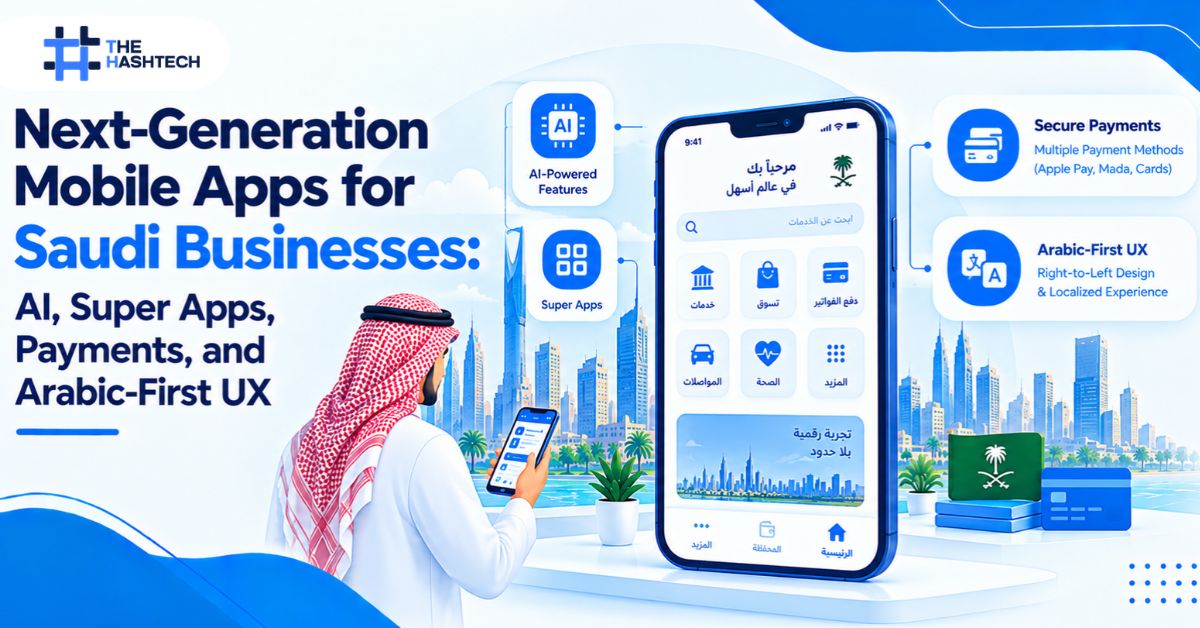
Next-generation mobile apps for Saudi businesses share four key traits: an Arabic-first design, integrated payment solutions, AI that understands Arabic, and the potential to evolve into super apps. This guide explores each trait, explains its role across different industries, and outlines how to plan a successful app development project.
Why Saudi Businesses Are Rebuilding Their Apps Now
Saudi users compare every app with the best ones on their phones. Absher and Tawakkalna set a high bar for identity and government services. Delivery and payment apps set a high bar for speed. A business app that feels slow, foreign, or hard to pay in loses attention fast.
At the same time, the building blocks have matured. Local payment rails are strong. Arabic AI models now exist. Super-app habits are growing. Together, these shifts make 2027 a practical moment to rebuild or upgrade mobile apps for Saudi businesses instead of patching old ones.
What “Next-Generation” Means for Saudi Businesses
Next-generation mobile apps for Saudi businesses go beyond screens and features. They handle local payments natively, speak Arabic in layout and language, use AI for real tasks, and have an architecture that can add new services without a rebuild.
The phrase sounds like marketing, so here is the practical test. A next-generation app meets four standards:
- Payments are native. Users pay with the methods they already use, inside the flow.
- Arabic is the base language. RTL layouts, Arabic typography, and local formats are built in from the first wireframe.
- AI does real work. It answers customers, personalizes content, or processes documents. It is not a decoration.
- The architecture can grow. One login and one wallet can support more services later.
Working with a mobile app development company in Saudi Arabia that plans for all four from discovery avoids expensive rebuilds later.
Payments: Build Checkout Around How Saudis Actually Pay
SAMA reported about 14.6 billion electronic payment transactions in 2025, up from 12.6 billion in 2024. The national mada network drives much of that growth, especially at point-of-sale and in e-commerce.
For your app, that means checkout is a core feature, not a final screen. Support the methods your users expect:
| Payment method | Why it matters | Build note |
| mada | The national debit network behind most card payments | Make it the first and default option |
| Apple Pay and Google Pay | Fast one-tap payment; SAMA added Google Pay through mada in 2025 | Offer both wallets on checkout |
| Buy now, pay later (Tabby, Tamara) | Popular for higher-value carts | Add for retail and ecommerce apps |
| SADAD | Bill and invoice payments | Include for service and utility apps |
Use a SAMA-regulated payment gateway, and test payment failures as carefully as successes. A declined card, a timeout, and a duplicate charge all need clear Arabic error messages.
Checkout Details That Build Trust
Small details decide whether users finish a payment.
- Save cards with tokenization. Users avoid retyping, and your app never stores raw card numbers.
- Show prices clearly in SAR. Include VAT lines where they apply.
- Handle failures well. Offer a retry or another payment method, with a clear Arabic message.
- Show refund status in the app. Users should not need to contact support to ask.
- Send Arabic receipts and notifications. Confirm invoice requirements for paid services during planning.
If your app moves money or stores financial data, SAMA compliance shapes the architecture. Our mobile app development company in Riyadh team plans those requirements during discovery, so compliance work does not collide with design later.
AI That Understands Arabic
Arabic AI is now a local capability. SDAIA’s National Center for AI built ALLaM, an Arabic large language model. In August 2025, HUMAIN launched HUMAIN Chat, an Arabic conversational app powered by ALLaM 34B. In August 2026, HUMAIN and Microsoft announced plans to make ALLaM available through Microsoft Foundry for business customers.
SDAIA also published its AI Adoption Framework in November 2025. It covers governance, accountability, transparency, and human oversight. Businesses should design AI features with those principles in mind.
Where AI Fits in a Business App
- Arabic customer support. A chatbot answers common questions in Arabic and English, then escalates complex cases to a person.
- Personalization. The app recommends products, courses, or content based on behavior.
- Document handling. The app reads, sorts, and summarizes forms and invoices.
- Smart search. Users find items with natural Arabic queries, including mixed Arabic-English text.
AI Rules That Save Rework
- Start with one use case. Prove value before adding more.
- Decide where data lives. Some projects need Saudi-hosted infrastructure for sensitive data.
- Keep a human in the loop. Add escalation paths for low-confidence answers.
- Test with real Arabic. Dialects, typos, and mixed language expose weak models quickly.
- Plan the running cost. AI services add usage-based fees on top of the build.
Super Apps: One App, Many Services
Demand for super apps is rising. A 2025 Redseer analysis found that over 70% of Saudi digital consumers expressed high interest in super app solutions, drawn by one-stop convenience and unified payments.
Saudi users already live inside large multi-service apps. Google Play data shows Absher at roughly 48 million installs and Tawakkalna at roughly 20 million. Delivery platforms are also widening their scope. HungerStation, for example, extended beyond restaurant orders into groceries and household items.
You do not need to build a super app on day one. You need a super-app-ready foundation:
- One identity. A single login across every service.
- One wallet. Shared payment methods, balance, and loyalty points.
- Modular services. Each feature runs as its own module, so you can add services without rewriting the core.
- Open integrations. Clean APIs connect partners, vendors, and internal systems.
This backend work often involves custom enterprise software behind the app. Our software development company in Saudi Arabia team builds those platforms alongside the mobile front end, so the two grow together.
When Not to Build a Super App
Skip it if you have one service and no proven demand. Start with a focused app that does one job well. Then add services as users ask for them. Many strong super apps began as single-purpose apps.
Arabic-First UX: The Foundation Under Everything
Arabic-first design is not a translation step. It affects layout, navigation, typography, numbers, and dates. A few essentials:
- Use right-to-left layouts and mirror direction-based icons.
- Choose fonts with strong Arabic support, and avoid letter spacing.
- Decide on numerals and Hijri dates early.
- Test mixed Arabic-English text, since real content contains both.
- Localize notifications, emails, receipts, and store listings too.
Build these rules into the first sprint. Adding Arabic later costs far more than designing for it from the start.
What Next-Generation Looks Like by Industry
Each sector uses these four traits differently.
| Industry | Next-generation features |
| Retail and ecommerce | mada, Apple Pay, and BNPL checkout; Arabic search; AI recommendations; live inventory |
| Fintech and banking | SAMA-aware architecture; biometric login; instant transfers; Arabic AI support |
| Healthcare | Appointment booking; Arabic symptom chat with human escalation; careful data handling |
| Education | Bilingual learning platform; progress tracking; Arabic content delivery |
| Logistics and delivery | Live tracking; customer, driver, and admin roles; Arabic notifications |
| Tourism and hospitality | Bilingual booking; multilingual support; payments built into the flow |
A Practical Roadmap for Your Build
Follow this order to keep the project focused.
- Discovery. Define the business goal, users, languages, and compliance needs.
- Arabic-first design. Create Arabic and English layouts together.
- Core build. Ship one strong use case with native payments.
- AI pilot. Add one AI feature, measure results, then expand.
- Platform growth. Add modules and partners on top of the shared identity and wallet.
Treat each step as a decision gate. If a step does not show value, fix it before you add the next one.
Timing matters most for seasonal businesses. Jeddah’s tourism, hospitality, and shipping economy makes bilingual, multi-role apps especially common there, and launches often depend on peak periods. Our mobile app development company in Jeddah team plans builds backward from those dates.
Common Mistakes to Avoid
- Chasing trends without a use case. AI and super apps help only when they solve a real problem.
- Treating Arabic as a final translation step. This is the most expensive mistake.
- Adding payment methods late. Checkout shapes the whole flow.
- Ignoring compliance in discovery. Financial and personal data need planning from day one.
- Building every service at launch. Start narrow, then grow.
- Skipping real-device and real-Arabic testing. Clean sample text hides bugs.
Final Thoughts
The best mobile apps for Saudi businesses in 2027 will not be the ones with the most features. Those will be the ones that match how Saudi users already behave. They pay with Mada and wallets, read and type in Arabic, and expect fast, helpful answers. And they are ready to use one app for many tasks.
Start with one clear use case. Build payments and Arabic UX in from day one. Add AI where it solves a real problem. Then grow the platform step by step. That order protects your budget and gives your users something worth opening every day.
Frequently Asked Questions
What makes a mobile app next-generation in Saudi Arabia?
A next-generation app uses native Saudi payments, Arabic-first design, practical AI, and an architecture that can add services later. Features alone do not make an app next-generation. Fit with local user behavior does.
Do mobile apps for Saudi businesses need Arabic AI?
Not always. AI helps most in customer support, personalization, search, and document handling. If Arabic users are your main audience, choose AI that handles Arabic dialects and mixed text well, and test it with real conversations.
Which payment methods should a Saudi app support?
Start with mada. Add Apple Pay and Google Pay, then consider buy now, pay later providers such as Tabby and Tamara for higher-value purchases. Add SADAD where bill payments matter.
Should my business build a super app?
Only if you already offer several related services and see demand. Most businesses should launch a focused app first, with shared login and wallet, and add modules later.
How much does a next-generation app cost in Saudi Arabia?
Cost depends on scope, payments, AI features, Arabic localization, and compliance. Our Riyadh page lists projects starting around SAR 50,000. AI, financial compliance, and multi-service platforms push the budget higher. Request a scoped estimate for your project.
Do I need to host data inside Saudi Arabia?
It depends on the data and your sector. Financial, government, and sensitive personal data often need extra care. Review your obligations under Saudi data protection rules during discovery, before you choose infrastructure.
Statistics in this guide come from public sources, including SAMA’s 2025 retail payments announcement, the Saudi Press Agency, AGBI, Redseer, and AppBrain Google Play data. Install counts are cumulative Google Play figures. Check each source for the latest numbers.
Ready to Plan a Next-Generation App for Your Saudi Business?
Tell us your users, languages, and goals. Talk to our team and we will help you decide which of these four traits your first release needs.