What Does SAR 50k, 150k and 500k Buy in Mobile App Development?


16 November, 2026
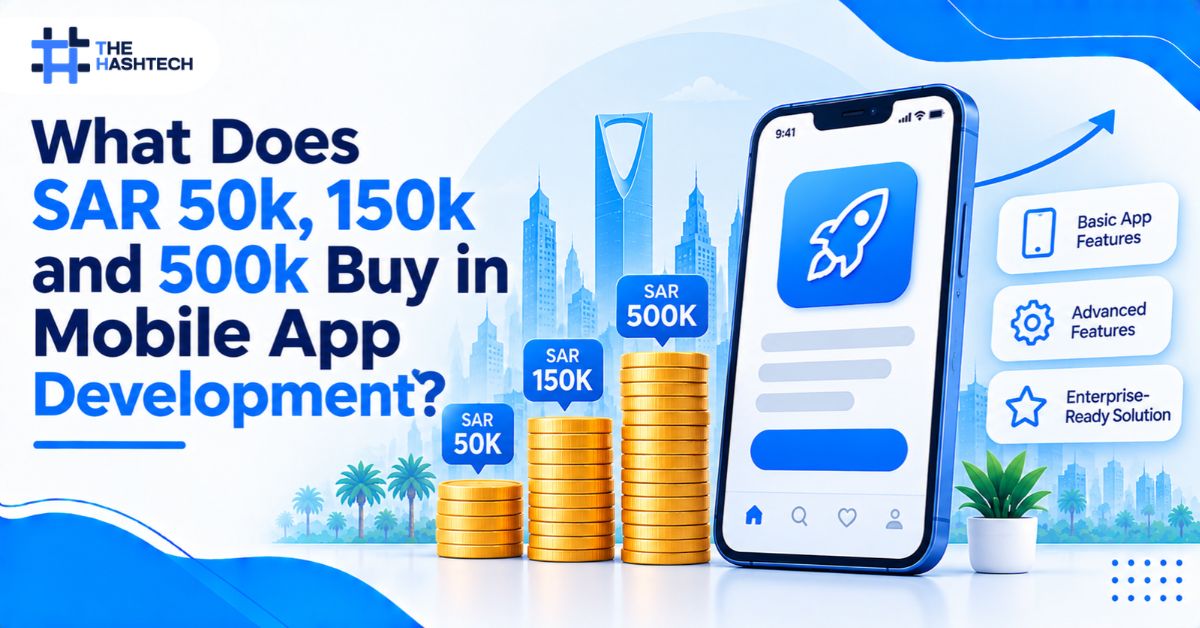
Quick answer: app development cost in Saudi Arabia, SAR 50,000 (about USD 13,300) typically buys a simple MVP with core features; SAR 150,000 (about USD 40,000) buys a polished iOS and Android app with a custom backend, payments, and an admin panel; and SAR 500,000 (about USD 133,000) or more buys a complex, secure, scalable platform with multiple user roles and deep integrations. These are indicative market ranges, not fixed quotes. Add 15% VAT and budget roughly 15 to 20 percent of the build cost per year for maintenance.
Most founders ask about price before they ask about features, yet the two cannot be separated. A budget only makes sense when you know what it covers. This guide explains, in plain terms, what each of the three most common budget levels delivers in the Saudi market, where the money actually goes, and how to pick the right level for your business.
How much does it cost to build a mobile app in Saudi Arabia?
Most projects land between SAR 40,000 and SAR 600,000, but the spread is wide because an app is not a single product. A booking app with five screens and a super app with live tracking, wallets, and government integrations are different engineering efforts. Price is driven by scope, platforms, design depth, integrations, security requirements, and the experience of the team. Local rates also tend to be higher than offshore markets because Saudi-based teams carry compliance knowledge, Arabic expertise, and on-the-ground support. Treat the three budget levels below as typical packages rather than guarantees.
What does SAR 50,000 buy in app development?
SAR 50,000 buys a focused minimum viable product. The goal at this level is to test your idea with real users, not to serve thousands of customers on day one. You can expect one core user flow, a clean but template-based interface, user registration, basic push notifications, a simple backend, and a small admin dashboard. The app is usually built with a cross-platform framework such as Flutter or React Native so that one codebase covers both iOS and Android, which keeps the cost down.
What you should not expect at this level is just as important. Custom animations, complex payment flows, advanced analytics, multi-vendor logic, and heavy integrations are generally out of scope. Arabic and English support is possible, but a fully tuned right-to-left design may be limited. This budget suits startups validating a concept, small businesses digitizing a single service, or companies that want a working demo to show investors. If you push this budget beyond its limits by adding too many features, quality and testing are the first things to suffer.
What does SAR 150,000 buy in app development?
SAR 150,000 buys a market-ready product. Here you move from validating an idea to launching a competitive app. A typical scope includes native-quality iOS and Android apps, a custom UI and UX design process with user research, a scalable backend and database, secure user accounts, integration with Mada, Apple Pay, or other local payment methods, push notifications, an admin panel with reporting, and structured quality assurance across devices.
This tier is where Arabic-first design becomes realistic, with proper right-to-left layouts, bilingual switching, and testing with native speakers. It also leaves room for compliance work such as consent flows aligned with the Personal Data Protection Law and ZATCA-ready invoicing where needed. Most retail, delivery, appointment booking, education, and service marketplace apps fit comfortably at this level. Because quality here depends heavily on who builds it, it helps to hire an experienced mobile app development company in Saudi Arabia that can show similar live projects and explain exactly which features your budget covers.
What does SAR 500,000 buy in app development?
SAR 500,000 and above buys a platform rather than just an app. At this level, you are building something that must handle high traffic, strict security, and several user groups at once. A typical scope includes separate apps or modules for customers, vendors, drivers, or staff, a web dashboard, real-time features such as live tracking and chat, advanced personalization, complex business logic, and multiple third-party integrations. These can include Nafath for identity, Absher or Tawakkalna connections, credit scoring, open banking APIs, and enterprise systems like ERP and CRM.
The budget also covers the invisible work that large apps need: cloud architecture built for scale, load testing, penetration testing, detailed documentation, DevOps pipelines, and often alignment with National Cybersecurity Authority controls. Fintech, healthcare, logistics, on-demand platforms, and government-facing products usually belong here. A team at this level typically includes a dedicated project manager, business analyst, UX researchers, multiple developers, QA engineers, and security specialists, which is why the cost rises sharply compared with the lower tiers.
What factors push the price of an app up or down?
Six factors of explain most price differences. The first is feature count, because every extra screen and rule adds design, development, and testing time. The second is platform choice, since native iOS plus native Android costs more than one cross-platform build. The third is design depth, where custom illustrations, animations, and extensive user research cost more than template-based interfaces. The fourth is integrations, because each third-party system needs setup, testing, and ongoing monitoring. The fifth is security and compliance, which increases effort for regulated sectors. The sixth is team location and seniority, as senior in-house specialists cost more than juniors or freelancers but reduce rework. To see how these variables combine into real numbers, a detailed breakdown of app development cost in Saudi Arabia can help you benchmark quotes before negotiating.
What costs are not included in the quoted budget?
The build quote is rarely the total cost of ownership. Five items often catch first-time buyers by surprise. VAT at 15 percent applies to the development invoice. Apple and Google developer accounts carry annual or one-time fees. Cloud hosting, SMS and email services, maps and payment gateways create monthly running costs that grow with your user base. Maintenance, which covers operating system updates, bug fixes, and security patches, usually runs 15 to 20 percent of the original build cost each year. Finally, marketing and user acquisition are separate from development, yet a great app with no launch budget struggles to gain users. Ask every vendor to list what is included and excluded so these costs do not appear later as change requests.
Which budget level should you choose?
Choose the budget that matches your stage, not your ambition. You have not yet proven that customers want your product,;SAR 50,000 is usually the smartest start, because you learn quickly and risk little. If you have validated demand and need a reliable launch, SAR 150,000 is the sweet spot for most app development cost in Saudi Arabia businesses. If you already operate at scale, face regulatory demands, or plan a platform with several user types, SAR 500,000 or more is realistic and often cheaper than rebuilding a weak foundation later.
A good strategy is phased delivery. Start with a lean first release, measure usage, and invest further based on real data. This approach protects cash and keeps the product focused on features that users actually value. Phasing also helps if your team is in the Western Region and prefers face-to-face collaboration, since a partner offering app development services in Jeddah can run workshops on site and test the app with local users before each release.
How do you get an accurate quote?
An accurate quote depends on a clear brief. Write down your target users, your top five must-have features, the platforms you need, the integrations required, and any compliance obligations. Share competitor apps you admire. Ask each vendor for a written estimate that separates discovery, design, development, testing, deployment, and project management, and ask whether the price is fixed or time-and-materials. Compare at least three proposals and be careful with any quote far below the rest, because it often leaves out testing, security, or post-launch support. Finally, confirm that you will own the source code and the app store accounts once the project is paid for.
Final thoughts
SAR 50,000, SAR 150,000, and SAR 500,000 do not just buy different sizes of the same app. They serve different purposes: testing an idea, launching a competitive product, or running a scalable platform. Define your goal first, match it to a realistic budget, and demand a written breakdown from every vendor. When you are ready to compare proposals, speak with a team that offers app development in Riyadh or another major Saudi city and can show exactly what your budget will deliver.
Frequently Asked Questions
Is SAR 50,000 enough to build a mobile app in Saudi Arabia?
Yes, but only for a simple MVP. SAR 50,000 can cover a single core user flow, basic registration, notifications, and a small admin panel. Usually built with a cross-platform framework. It is not enough for complex payments, multi-vendor logic, or heavy integrations.
Why do app development quotes in Saudi Arabia differ so much?
Quotes differ because of scope, team seniority, design depth, security needs, and what each vendor includes. One company may price only coding while another includes research, design, testing, project management, and support. Always compare line items, not totals.
Does the app development cost in Saudi Arabia include VAT?
Not always. Saudi Arabia applies 15 percent VAT to services. So ask each vendor whether the quote is inclusive or exclusive of VAT. A written estimate that states it clearly prevents a surprise on the final invoice.
How much does it cost to maintain an app after launch?
Plan on roughly 15 to 20 percent of the original development cost each year. This covers updates for new iOS and Android versions, bug fixes, security patches, monitoring, and minor improvements. Hosting, third-party services, and store fees are additional.
Is it cheaper to build an app with a freelancer than with a company?
A freelancer is often cheaper upfront, but the risk is higher. A company typically provides a full team, project management, quality assurance, legal accountability, and continuity if someone leaves. For business-critical apps, the added structure usually saves money by reducing rework and delays.