AI Chatbot Development Cost: Website, App, Support, Knowledge Bots


18 September, 2026
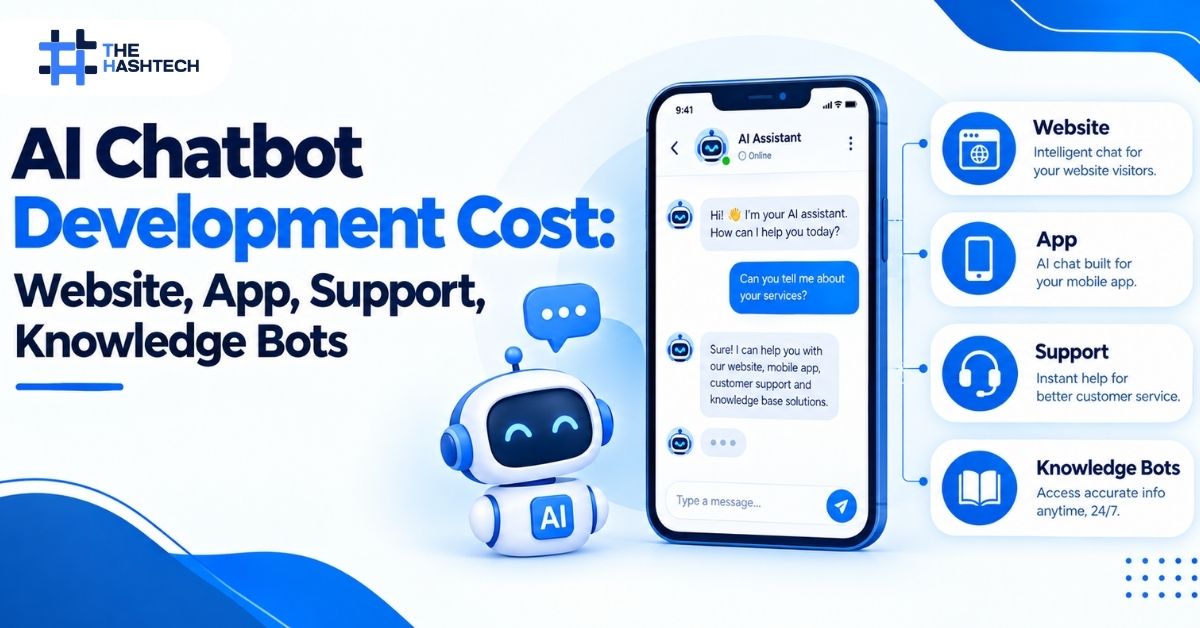
Not all AI chatbot development costs the same, because not all chatbots are doing the same job. A basic FAQ bot answering “what are your hours” is a $2,000-$10,000 project. A support bot resolving real customer issues with natural language understanding runs $20,000-$60,000. An internal knowledge bot trained on your company’s documents costs $25,000-$70,000+. And a full enterprise agentic system that takes actions, not just answers questions, runs $80,000-$250,000+. The type of bot is the single biggest driver of cost, more than any other factor.
Cost by Bot Type
| Bot Type | Cost Range | What It Actually Does |
| Website FAQ bot | $2,000-$10,000 | Answers predefined questions, reduces basic inbound inquiries |
| App-integrated bot | $10,000-$40,000 | Embedded in a mobile app, tied to user accounts and in-app actions |
| Customer support bot (NLU) | $20,000-$60,000 | Understands free-text input, resolves common issues, escalates complex ones |
| Internal knowledge bot (RAG) | $25,000-$70,000+ | Retrieves answers from company documents, product manuals, internal systems |
| Enterprise agentic system | $80,000-$250,000+ | Takes actions: books appointments, updates records, executes workflows |
Website Bots: The Entry Point
A website chatbot answering FAQs and routing basic inquiries is the cheapest, fastest build in this list, often live within 2-3 weeks. The scope is intentionally narrow: predictable questions that fit a decision tree, or a lightly AI-enhanced layer on top of that. This is the right starting point if you’re validating chatbot ROI before committing to a bigger build, or if your support volume doesn’t yet justify more sophistication.
App-Integrated Bots: Where Context Changes the Build
A chatbot embedded inside a mobile app is a different build than one sitting on a website, because it usually needs access to the user’s account data, order history, or in-app state to be genuinely useful “Where’s my order” only works well if the bot can actually see the order. This tighter integration with your app’s backend and user authentication is what pushes cost above a comparable standalone website bot.
Support Bots: Where Natural Language Actually Matters
This is where most businesses land when a basic FAQ bot stops being enough. A customer support bot with real natural language understanding processes free-text input not just button clicks or exact keyword matches, and resolves common issues before escalating anything genuinely complex to a human agent. This tier typically uses a large language model (GPT-4/5, Claude, Gemini) rather than pure rule-based logic, which is what separates it structurally, and in cost, from a basic website bot.
Knowledge Bots: RAG Is the Architecture That Matters Here
An internal knowledge bot — the kind employees or customers use to search documentation, policies, or product manuals — is built on Retrieval-Augmented Generation (RAG): the bot retrieves relevant chunks from your actual documents and generates an answer grounded in that retrieved content, rather than relying purely on what the underlying model already knows. This matters because it directly reduces hallucination risk on company-specific information the base model was never trained on.
Cost here scales with your knowledge base size and structure: a small, well-organized document set is inexpensive to index; hundreds of documents from multiple sources, needing hybrid search and re-ranking to retrieve accurately, add real cost on top of the base build.
How the Architecture Actually Works
Every serious chatbot build, regardless of type, involves the same core architectural pieces, just at different levels of sophistication:
- Language model layer: the underlying LLM (GPT, Claude, Gemini) handling language understanding and generation.
- Retrieval layer (for knowledge/support bots): a vector database storing your documents as embeddings, retrieved based on relevance to each query.
- Integration layer: connections to your CRM, ticketing system, app backend, or e-commerce platform, so the bot can access real data, not just answer generically.
- Orchestration/action layer (for agentic systems): logic that lets the bot actually execute tasks — booking, updating records, triggering workflows — rather than only returning text.
- Monitoring and guardrails: logging, escalation triggers, and content filters that catch when the bot is uncertain or heading toward an inappropriate response.
A basic website bot only needs the first layer. A knowledge bot adds the second and third. An enterprise agentic system needs all five, which is exactly why the cost gap between tiers is so large.
Security: Non-Negotiable Once the Bot Touches Real Data
Any chatbot connected to customer accounts, internal documents, or business systems should be built with encryption, OWASP-aligned code review practices, and access controls scoped so the bot can only retrieve or act on data it’s actually authorized to touch. This matters even more for chatbots than typical apps, since a poorly scoped bot can inadvertently surface information across permission boundaries in a single conversation. Bias and hallucination testing against real edge cases, not just clean demo scenarios, should happen before launch, and ongoing monitoring should track when the bot escalates versus answers confidently but incorrectly.
The Ongoing Costs Most Quotes Leave Out
The build price is the beginning, not the total cost. Budget for:
- LLM API fees typically $50-300/month for moderate volume, scaling with conversation count and model choice (premium models cost meaningfully more per conversation than lighter ones).
- Vector database and RAG infrastructure roughly $50-500/month for knowledge-base retrieval at moderate scale.
- Knowledge base maintenance: someone needs to keep the underlying documents current; stale source documents degrade answer quality over time regardless of how good the initial build was.
- Annual maintenance typically 15-20% of initial build cost per year for bug fixes, model updates, and platform changes.
A bot quoted at $30,000 to build that then runs $400-800/month in infrastructure and content upkeep is not a bot that actually cost $30,000; plan the full first-year number, not just the build line item.
Frequently Asked Questions
How much does a basic AI chatbot cost?
A basic FAQ or rule-based website chatbot typically costs $2,000-$10,000, depending on the number of question types it needs to handle and how much design/branding work is involved.
What’s the difference in cost between a support bot and a knowledge bot?
Support bots ($20,000-$60,000) focus on understanding free-text customer queries and resolving common issues. Knowledge bots ($25,000-$70,000+) focus on retrieving accurate answers from your specific documents via RAG. The overlapping range reflects that many real projects need both capabilities together.
Does adding the chatbot to a mobile app cost more than a website-only bot?
Generally yes. App-integrated bots typically need access to user account data and in-app actions, which requires backend integration work that a standalone website FAQ bot doesn’t need.
What ongoing costs should I budget for after the chatbot is built?
Plan for LLM API fees ($50-300/month for moderate volume), vector database/RAG infrastructure ($50-500/month if applicable), and annual maintenance around 15-20% of the initial build cost; these are commonly left out of the initial quote.
When does a business need an enterprise agentic chatbot instead of a standard support bot?
When the bot needs to actually execute tasks — booking appointments, updating account records, processing transactions — rather than only answering questions. This capability requires an orchestration/action layer that standard support or knowledge bots don’t include, which is why enterprise agentic systems cost significantly more.
Talk to Someone Who’s Actually Built These
Our AI development team builds chatbots across all four tiers above, from simple website FAQ bots through full agentic systems, with the same security and monitoring practices applied regardless of project size.
You can see applied AI work in a sensitive, real-world context in our AI-powered mental health case study, which required the same RAG-grounded accuracy and monitoring discipline described in this guide.
If you’re not sure which tier your business actually needs, book a free consultation; we’ll tell you honestly if a $5,000 no-code tool covers your use case before quoting a custom build.