
eCommerce App Development Cost: Storefront, Checkout, Inventory, Integrations


7 September, 2026
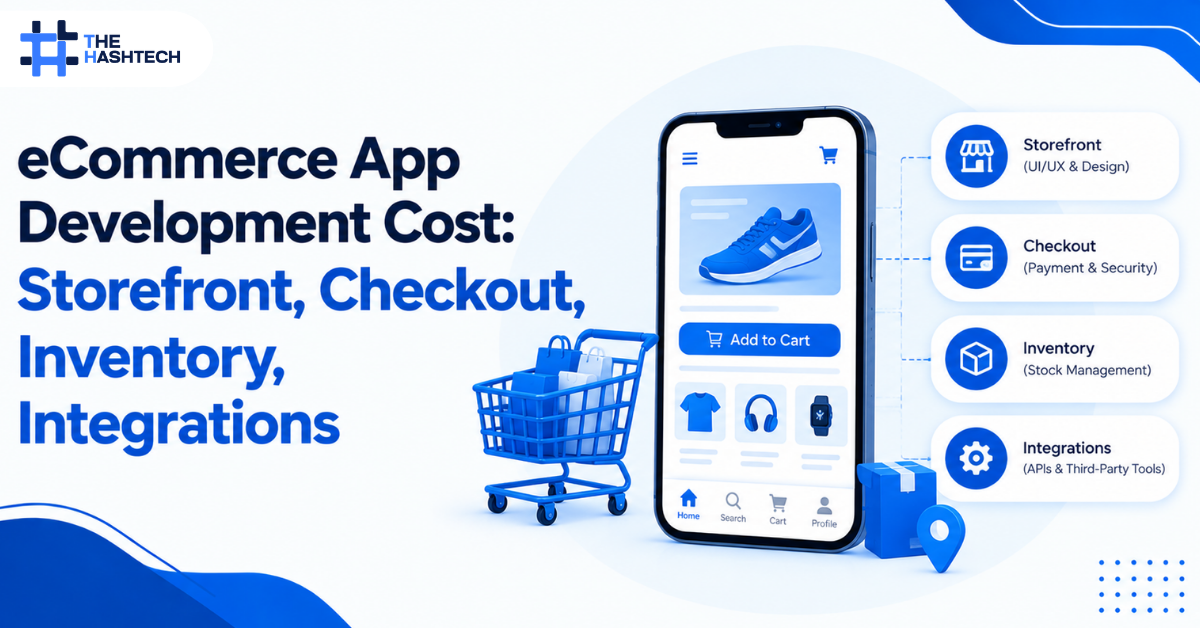
eCommerce app development typically costs $15,000-$40,000 for a basic MVP, $50,000-$150,000 for a mid-tier app, and $150,000-$500,000+ for an enterprise or multi-vendor marketplace, based on current industry estimates. The number that matters for your project depends less on “an app” in general and more on four specific cost drivers: storefront complexity, checkout/payment setup, inventory management depth, and how many external systems it needs to talk to.
Quick Answer: Cost by Complexity Tier
| Tier | Estimated Cost | Timeline | What’s Included |
|---|---|---|---|
| Basic MVP | $15,000-$40,000 | 2-4 months | Product catalog, cart, standard checkout, basic user accounts |
| Mid-Tier | $50,000-$150,000 | 4-7 months | Custom UI/UX, personalization, multiple payment methods, CRM integration |
| Enterprise / Marketplace | $150,000-$500,000+ | 8-14 months | Multi-vendor support, ERP integration, AI personalization, advanced analytics |
These are industry-standard estimate ranges based on current market data, not a fixed quote — actual cost depends on your specific feature scope. Get a project-specific estimate from a discovery session rather than relying on any general range.
Cost Breakdown by Feature Area
Storefront
The product catalog, search, filtering, and browsing experience is usually where UI/UX investment concentrates. A basic storefront with standard category browsing sits at the lower end of the budget; AI-driven personalization (recommendations based on browsing and purchase behavior), advanced filtering, and a Progressive Web App version for faster mobile load times push this toward the mid-to-upper range.
Checkout
One-click checkout, guest checkout, and saved payment profiles reduce cart abandonment but add development complexity. Budget increases further with multiple payment methods (credit cards, digital wallets, Buy Now Pay Later, cash on delivery) and PCI-DSS-compliant payment gateway integration (Stripe, PayPal) — security and compliance work here alone commonly adds $10,000-$40,000 on top of base checkout development, according to industry security-cost estimates.
Inventory
Real-time stock alerts, bulk product upload, and multi-vendor inventory sync are where backend complexity — and cost — scale fastest. A single-vendor catalog is straightforward; a multi-vendor marketplace with per-seller inventory dashboards, commission engines, and split-payment automation requires more backend architecture work meaningfully.
Integrations
Connecting the app to ERP systems (SAP, Oracle), CRM platforms (Salesforce), and logistics providers via custom API development is one of the most variable cost factors. Each integration adds its own development and testing time — a single payment gateway integration is inexpensive; syncing inventory, orders, and customer data in real time across multiple enterprise systems is a significant part of what pushes enterprise-tier projects toward the top of the range.
Factors That Move Your Cost Up or Down
- Business model — B2C apps are generally the least expensive to build; multi-vendor marketplaces and complex B2B platforms (custom catalogs, tiered pricing, bulk ordering) cost more due to additional roles, permissions, and workflow logic.
- Native vs. cross-platform development — building separately for iOS and Android roughly doubles platform-specific work compared to a shared Flutter or React Native codebase.
- AI features — personalization engines, AI-driven product recommendations, and predictive inventory forecasting add meaningful development time but can measurably increase average order value.
- Security and compliance depth — PCI-DSS compliance, end-to-end encryption, multi-factor authentication, and fraud detection are non-negotiable for handling payment data, and typically add a defined chunk of budget rather than being a flat “include everything” line item.
- Team location — US-based development typically runs higher hourly rates than offshore teams, though this often trades off against communication ease and time-zone alignment.
- Ongoing maintenance — commonly overlooked in initial budgeting: annual maintenance (bug fixes, OS compatibility updates, security patches) typically runs 15-20% of the initial build cost per year and should be planned for from day one, not treated as a surprise.
Frequently Asked Questions
How much does a basic eCommerce app cost?
A basic MVP with product catalog, cart, standard checkout, and user accounts typically costs $15,000-$40,000 and takes 2-4 months to build.
What’s the most expensive part of eCommerce app development?
Backend and integration work — particularly multi-vendor inventory systems, ERP/CRM integrations, and PCI-compliant payment processing — typically account for the largest share of the budget, more than the visual design layer.
Does adding AI features significantly increase cost?
It adds meaningfully to development time, but AI-driven personalization and recommendations are often worth the investment since they directly impact average order value and customer retention.
How much should I budget for ongoing maintenance after launch?
Plan for roughly 15-20% of your initial development cost annually for bug fixes, security patches, and OS compatibility updates — this is frequently left out of initial budget planning.
Is it cheaper to build a B2C app or a multi-vendor marketplace?
B2C apps are significantly less expensive, generally in the $50,000-$150,000 mid-tier range. Multi-vendor marketplaces require additional infrastructure — vendor dashboards, commission engines, split payments — that pushes cost into the $150,000-$500,000+ enterprise range.
Where The Hashtech Fits
Our eCommerce app development services team builds B2C, B2B, and multi-vendor marketplace apps with PCI-DSS compliant payment integration, AI-driven personalization, and ERP/CRM connectivity handled as standard, not a separate upsell.
You can see how this played out on a real project in our grocery delivery app case study, covering the same catalog-browse-checkout-track experience core to most eCommerce apps.
Get a project-specific estimate — we scope cost against your actual feature list after a discovery session, not a generic industry range.