How Much Does App Development Cost in Jeddah


10 July, 2026
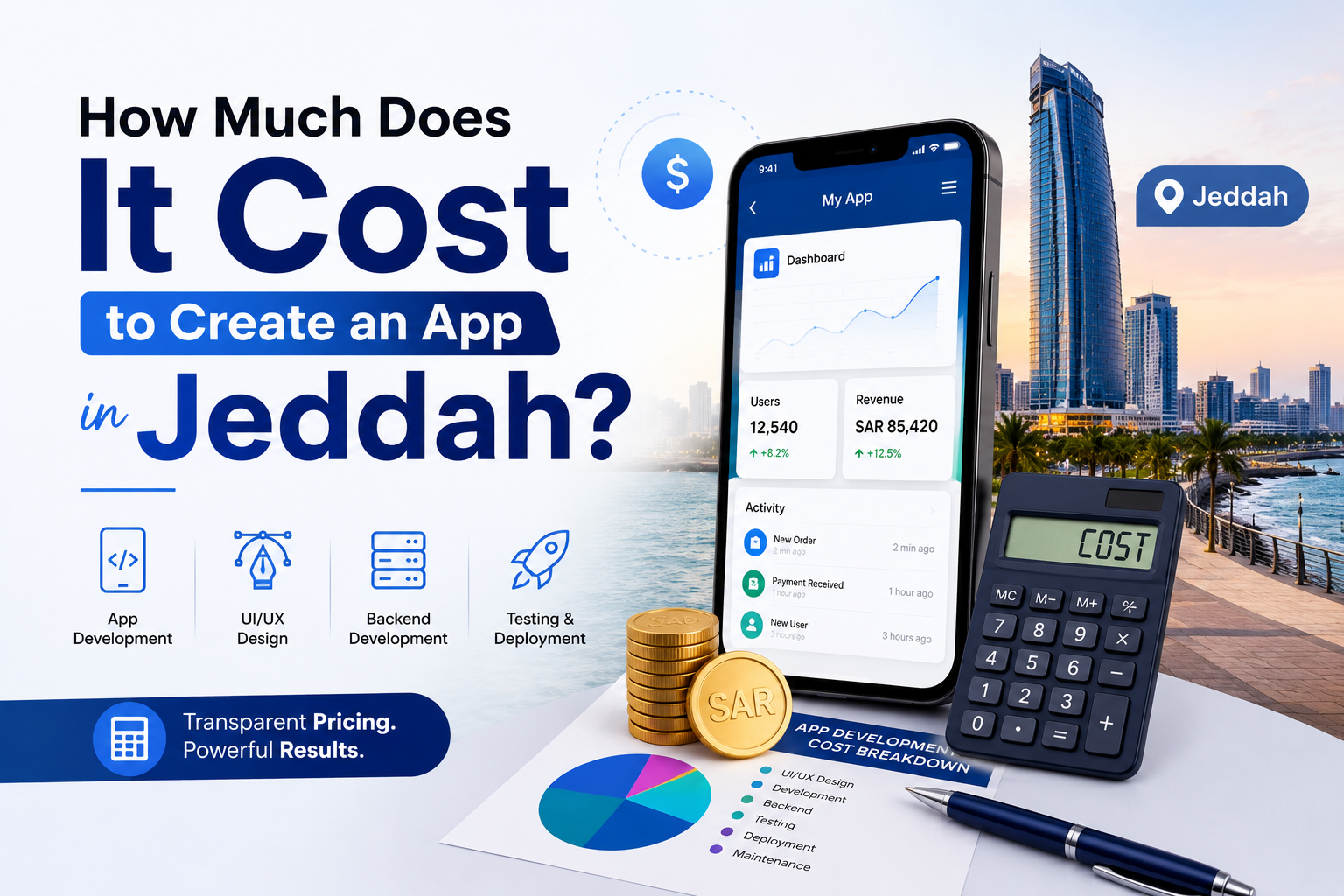
If you believe the Internet, you might think Jeddah is the single best place to build your website. There are good reasons for that. I’ve written about them before and will do so here. But if you are contemplating building a mobile app, the most important question you have to ask is this: How much does app development cost in Jeddah? And not just in terms of ballpark figures though you’ll see a few ranges here they’ll be accurate when I say they are ballpark figures: the actual cost you’ll pay can be significantly different from what you find online.
What I will do is try to target the details, including how much you might pay for an app build here in Jeddah, a comprehensive look at the going rates here, and factors to consider when planning your app build in Jeddah.
Why Jeddah Pricing Looks Different From Riyadh
It is very important to remember the app dev market is not uniformly priced across the Kingdom. And it does not really matter if you are within Riyadh or in Jeddah: the price you pay for app development whether that be a prototype or a retail app will be driven to a significant extent by the fundamentals of each of these cities, as opposed to the fundamentals of the business or use case. So if you want to accurately estimate app development cost in Jeddah, you need to get to grips with understanding the underlying differences in the fundamental cost drivers between Jeddah and Riyadh.
And in short: Jeddah is not Riyadh. It has a quite different economic and cultural pulse. However you might feel about the notion of subtle economic over/undershoot which entrepreneurs are generally comfortable with. This presents a genuine, real, and practical genuine vs. theoretical reason why building an app here could cost slightly less than building it in Riyadh, for the same output.
App Development Cost in Jeddah by Complexity
The single biggest factor influencing the app development cost in Jeddah is complexity. Here’s how the market breaks down in 2026.
Simple Apps / MVPs SAR 25,000 to 60,000 (~$6,500–$16,000)
This covers basic informational apps, single-purpose booking tools, or a minimum viable product (MVP) built to test an idea before scaling. Expect:
- Simple login and profile management
- Basic navigation and content screens
- Minimal backend logic
- Light UI/UX design
Timeline: 1–2 months. This is the right starting point if you want to validate demand before investing heavily.
Mid-Complexity Apps SAR 60,000 to 250,000 (~$16,000–$67,000)
This is where most Jeddah businesses actually land, and it’s the range that best represents the average budget for a real, functioning product. Typical features include:
- User accounts with role-based access
- Payment gateway integration (mada, STC Pay, etc.)
- Push notifications
- Admin dashboard for managing content/orders/users
- Moderate third-party integrations (maps, SMS/WhatsApp APIs, CRM)
Timeline: 3–5 months.
Complex / Enterprise Apps SAR 250,000 to 750,000+ (~$67,000–$200,000+)
If your startup is a multi-vendor marketplace, a fintech platform, a logistics and delivery system or if you need AI features, real-time data processing, and SAMA/PDPL compliance this is the most expensive tier. This is by far the highest tier, and for good reason.
Timeline: 6–10+ months.
Android App Development Cost vs. iOS App Development Cost in Jeddah
Platform choice is always underestimated as a cost driver, so we’ve created our own breakdown of this topic. Android app development are often a little cheaper to start building in Jeddah, mainly because Android users make up a bigger percentage of the Saudi population than iOS users. Agency creatives and developers often focus on building Android first. However, Android’s broad device and OS fragmentation in the Android space usually translates into a commensurately higher QA and testing overhead as the project scales. Another factor to be considered is that iOS apps tend to be priced a little higher per hour of development, reflecting a few factors:
Apple’s less fragmented device space, a more strict app review process, and a profile of users who tend to spend a little more money on apps. That being said, if your target audience is more in line with the typical iOS user living in Jeddah and you want to prioritize cost-effectiveness, investing in an iOS might have more justification. To build natively for both platforms doubles the engineering effort, which is why most agencies, including us, tend to recommend using a cross-platform development kit like Flutter or React Native in most situations.
Using a cross-platform development kit like Flutter or React Native can reduce the combined app development cost by approximately 30-40% with no meaningful detriment to performance or user experience for most business use cases. If you want ISO-specific numbers, we’ve estimated a price breakdown for native vs. cross-platform apps, and published assessments of the differences in publishing cost on the Play Store versus the App Store.
What Actually Drives the App Development Cost in Jeddah Up or Down
Beyond complexity and platform, several other factors shape the final number.
1. Design and Arabic/RTL Localization
Keeping the UI/UX polished with proper right-to-left Arabic support means adding SAR 20,000–70,000 in top of core development. There is no option for this in the Saudi market. You can have the best app in the world, but if your app does not behave naturally on our devices, you will find yourself losing local users in droves. Any accurate estimate of app development cost in Jeddah will need aka a fully RTL ready app from the beginning.
2. Backend and Third-Party Integrations
Every integration payment gateways, maps, SMS/OTP verification, CRM, ERP connections, or delivery/logistics APIs needed in your application adds to the development hours needed and always increases the final bill. This is often the single biggest hidden multiplier in project quotes.
3. Compliance and Security
If you’re building anything in fintech or healthcare, or anything that handles user data at scale, PDPL and SAMA compliance requirements can add on 10–30% to your total budget. It’s a lot cheaper to plan for compliance during your architecture phase than retrofitting it after launch.
4. Feature Depth
AI-powered feature recommendation engines, chatbots, and predictive analytics can add anywhere from SAR 50,000 to SAR 500,000+ depending on scope. Furthermore, any real-time features such as live tracking and/or in-app messaging add other forms of backend work and engineering.
5. Team Structure: Local vs. Offshore vs. Hybrid
This is one of the biggest levers on your final budget, and it’s worth understanding the trade-offs clearly:
- Fully local Jeddah/Saudi teams best market fit, fastest communication, strongest understanding of local user behavior and compliance. Sits at the higher end of pricing.
- Offshore teams (South Asia, Eastern Europe) can cut costs by 30–60%, but often come with timezone friction, communication gaps, and less understanding of the Saudi market, which can lead to costly revisions later.
- Hybrid teams local project management and market understanding, paired with efficient offshore or regional execution. This tends to give Jeddah businesses the best balance of cost control and quality, often saving 15–30% versus a fully local build without sacrificing communication or market fit.
Development Process and How It Affects Your Budget
Understanding how a project is actually structured helps explain where your money goes, phase by phase:
- Discovery & Research (5–10% of budget): Market research, competitor analysis, requirement gathering, technical specs.
- UI/UX Design (15–20%): Wireframes, prototypes, design iterations, Arabic/RTL localization.
- Development (50–60%): Frontend, backend, API integrations, database architecture.
- QA & Testing (10–15%): Device testing, security testing, performance testing.
- Deployment & Launch (5%): App Store/Play Store submission, server setup, go-live support.
Skipping or underfunding any of these phases doesn’t reduce your real cost it just shifts it downstream into expensive post-launch fixes.
Hidden and Ongoing Costs Most Businesses Forget
A lot of businesses budget only for the initial build and get caught off guard six months later. When you’re calculating the true total cost of your app, factor in:
- App Store / Play Store fees, one-time developer registration plus annual renewal fees
- Hosting and cloud infrastructure: AWS, Azure, or STC Cloud, scaling with your user base
- Maintenance typically 15–25% of your original build cost, every year
- Post-launch updates: OS compatibility updates, bug fixes, and new feature requests
Planning for these upfront is the difference between a sustainable app and one that quietly drains your budget after launch.
How to Reduce Your App Development Cost in Jeddah Without Cutting Corners
If your budget is tight, there are smart ways to bring your total spend down without ending up with a weak product:
- Start with an MVP. Launch with core features only, validate demand, then expand.
- Go cross-platform. Flutter or React Native covers both Android and iOS from one codebase.
- Prioritize your feature list ruthlessly. Not every feature needs to ship on day one.
- Choose a hybrid development team. You get local market understanding without paying a full local-only premium.
- Plan compliance and integrations early. Retrofitting always costs more than building it in from the start.
Sample Budget Scenarios in Jeddah
When listed in numbers, though, headcount and pricing can help you build a quick, ballpark budget. Here’s a quick look at how a typical five-person app development team and a typical average built-with-avg pricing may work out, within the range of development costs in Jeddah. This is with no other complexity to the pub date, no products to order, no HIPAA or PCI Compliance, and no complex admin roles or multi-client configurations. (Those are all ranked by their development efforts in order of least to most). And, while this is simply meant to provide guidance, and not offer prices for services, this as a First Hundred K project costs may help to understand how specific components can turn a 100,000 SAR project into an enterprise project and the costs they command in terms of complexity.
Questions to Ask Before You Accept a Quote
Not all quotes are built the same way, and two agencies can price the same app very differently depending on what’s included. Before signing off on any proposal, ask:
- Does this quote include UI/UX design, or is that billed separately?
- How many rounds of revisions are included before extra charges apply?
- Is Arabic/RTL localization included, or an add-on?
- What happens if the scope changes mid-project is there a change-request process?
- Does the price include App Store and Play Store submission and setup?
- What’s covered in the post-launch support window, and for how long?
- Who owns the source code and design files once the project is complete?
Getting clear answers to these upfront avoids a lot of the budget disputes that come up later in the project, and gives you a much more honest picture of the real cost before you commit.
Quick Cost Snapshot: App Development Cost in Jeddah (2026)
| App Type | Cost (SAR) | Cost (USD approx.) | Timeline |
| Simple / MVP | 25,000 – 60,000 | $6,500 – $16,000 | 1–2 months |
| Mid-complexity | 60,000 – 250,000 | $16,000 – $67,000 | 3–5 months |
| Complex / Enterprise | 250,000 – 750,000+ | $67,000 – $200,000+ | 6–10+ months |
How to Get an Accurate Quote (Not Just a Guess)
Keep in mind that this can never be the complete picture. Even the most comprehensive list of features will only give you ranges for each and every one. See yourself in the following position: you want it to be perfect, you want to build your app around the relatively low cost estimate, and you want everything else to be done throughout the next decade.
For that, you need the real number. And that only comes from a scoped estimate based on your feature list, app integrations, target platform, and launch deadlines. We, at The Hashtech, do that for businesses looking to build in Jeddah, Saudi Arabia, and the rest of the Gulf States. We map out your app’s feature set and, above all, come up with a clear schedule and ROI. If you want that, too, call us. Your project is in good hands.
If you’re ready to build an app in Jeddah, reach out to the Hashtech a free and no obligation scoping and budget breakdown tailored to your specific project.
Final Thoughts
We help you budget for what kind of app you need. Budgetting for an app in Jeddah shouldn’t be throwing a dart at a dartboard in the dark. You should have a reasonable sense for where your project fits and how much you can afford. If you’re testing out an idea, lean on the low side. If you’re building for the long haul from day one, plan for a mid-to-enterprise range. Don’t skip on compliance, security, or Arabic/ RTL exclusively to save money upfront — those costs tend to compound when you have to fix or redo them later on. But the businesses that get the most bang for their buck are the ones that put plans in place before even writing the first line of code. That’s how you get to the end of this pricing guide, and be able to honestly say, “I’ve got an app that actually looks and works like this.”
Frequently Asked Questions
What is the average app development cost in Jeddah in 2026?
Most Jeddah businesses spend between SAR 60,000 and SAR 250,000 for a mid-complexity, market-ready app. Simple MVPs start around SAR 25,000, while complex or enterprise-grade apps can exceed SAR 750,000.
Is the app development cost in Jeddah cheaper than Riyadh?
Generally yes. Jeddah’s more commercial, SME-friendly market keeps agency pricing more competitive than Riyadh’s enterprise-heavy landscape, while still offering access to strong local and regional talent.
Is Android app development cost lower than iOS app development cost in Jeddah? Android development is often slightly cheaper to start due to a larger local user base and fewer platform restrictions, but device fragmentation can add testing costs. iOS app development tends to cost more per hour due to stricter guidelines, but can be worth it depending on your target audience.
How long does it take to build an app in Jeddah?
A simple MVP takes 1–2 months. A full-featured mid-complexity app usually takes 3–5 months. Complex, enterprise-grade apps can take 6–10+ months.
What ongoing costs should I budget for after launch?
Plan for annual maintenance (15–25% of your build cost), hosting/cloud fees, and app store renewal fees. These are recurring, not one-time.