How to Choose a Mobile App Development Company: 15 Questions to Ask Before Hiring


14 August, 2026
The wrong choice of the mobile app development company is an expensive mistake because it not only means that you waste your money but also lose precious time and end up with something that doesn’t really work for you. As a person who’s currently trying to choose the best vendor, you definitely know that the market is saturated. Any agency will assure you that they are top-rated and trusted by more than 500 clients.
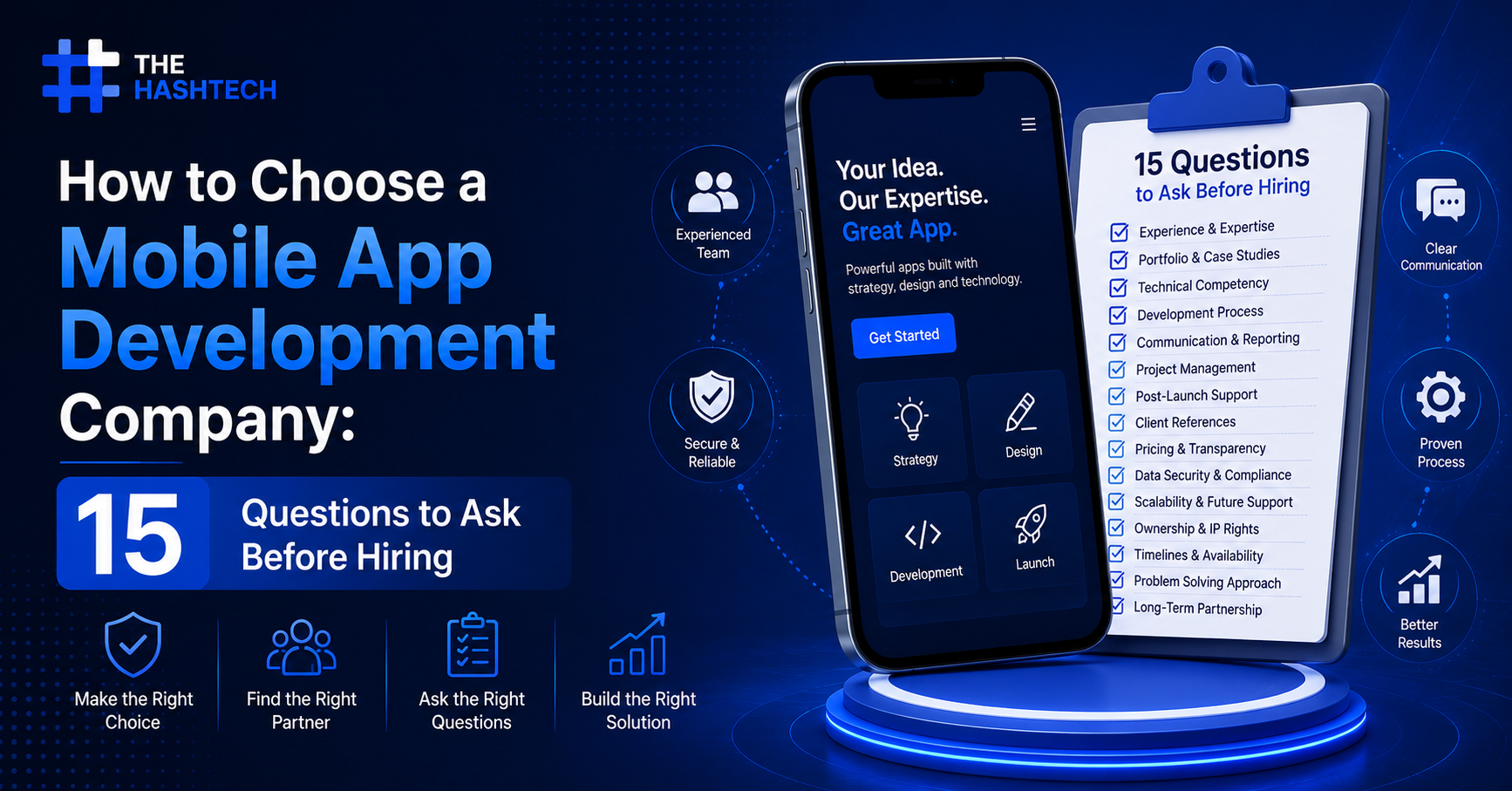
The following guide contains 15 questions you should ask the potential partner in order to get a better understanding of what kind of results to expect from working with him.
Why the Selection Process Matters More Than the Pitch
While most buyers judge app development companies the same way as they would evaluate any other service provider – through looking at their portfolio, prices, and timelines- those criteria are secondary. The app development companies that produce high-quality work usually stand out for their internal processes related to discovery scoping, handling change requests within sprints, who will be working with your code, and post-launch support.
Better questions lead to finding the right company from the start.
The 15 Questions to Ask Before Hiring
1. What does your discovery phase actually produce?
Meeting will definitely work: this is a bad sign of a generic answer. A decent software development cycle begins with a discovery phase. Before designing the first screen of an app, it takes into consideration the reasons behind this project, who it will serve, and its value proposition within the market. You have to figure out what the deliverables at the end of discovery are: requirements doc, tech scope, or roadmap with timelines. This means that if you do not extract a deliverable from the output of your guesses about your project.
2. Who will actually be working on my project?
Salespeople sell, developers develop. Depending on your needs, specify in-house or subcontracting and check the staff organization of your developers, designers, QA specialists, and project managers. If an agency uses a lot of outsourced or rotating freelancers, there will be a smaller amount of stability through such several-month building periods.
3. Can I see case studies in my specific industry or app category?
Generic portfolios are easy to compile. What you are interested in is proof that the agency has done something similar before: developed a healthcare app with compliance requirements, a marketplace with real-time synchronization, or an AI-powered app with model integration. Relevant case studies give much more valuable information than polished video reels.
4. What’s your native vs. cross-platform recommendation, and why?
A well-seasoned agency will have a ton of questions for you about budget, timeline, and functional specification before they even suggest native development (Swift or Kotlin), Flutter, or React Native. That agency will push it in either direction for your particular utilitarian, which means some folks are more familiar with the rest.
5. How do you structure pricing, and what’s included?
Ask for the pricing model in writing: fixed-price, time and materials, milestones. Clarify what is included in the quoted range and what makes you pay extra: integration of additional services, scope changes, or additional platform support. Prices for full-scale development of the custom app depend significantly on the level of functionality and vary over a wide range: from apps with basic auth and navigation functionality up to apps with real-time synchronization, AI capabilities, and multiplatform compatibility. If the price you receive is too low, try to find out why.
6. What does your development methodology look like week to week?
Agile provides more visibility and early course-correction opportunities since it is a development approach with short sprint cycles (with regular check-ins along the way). When an agency tells you about a “build it all, show you at the end” experience, then that means you’ll have zero visibility into progress until it’s too late and way too expensive to turn back.
7. How do you handle QA and testing?
Query properly what is included in the testing: functional cross-device and OS version testing, performance testing, security validation etc. Any agency that treats QA like a last-check box instead of a continuous journey throughout development is more likely to ship bugs in production.
8. What security practices do you follow by default?
At a bare minimum, these data practices include some sort of encrypted data handling as well as secure tracking of API communication and knowledge of frameworks such as OWASP for common vulnerabilities. If your app deals with payments, health data, or any personal information, inquire about how they manage industry-specific compliance requirements.
9. Do you sign an NDA before discussing project details?
This should definitely be a yes without any negotiation. Anything that an agency who was unwilling to sign a Non-Disclosure Agreement (NDA) before hearing your idea in detail is not the one you want to hold your intellectual property down the line.
10. What happens after launch?
You are not finished with the app at launch: that just represents an end to your role in hands-on application building. Ask what support they offer post-launch, such as bug fixes, server & API maintenance, performance monitoring, and scoping future feature enhancements. When the agency launches, does your agency turn off the lights and leave you in no-man’s-land, singing Show Me What to Do, and What is my update now?
11. Does the agency have dedicated Android expertise, or is it outsourced?
Are your Android builds in-house by a team that knows how to converse in Kotlin, Jetpack Compose, and today’s Android Studio toolchain, or are they outsourced? Android app development companies like these will look for screen sizes, OS versions, and even device fragmentation, which are some of the major sources of Android-specific bugs. If the agency views Android as a backup to their iOS stuff, then expect more launch support burn.
12. What’s your typical timeline for a project like mine?
Timelines vary based on the complexity of apps: An average app may take 6-10 weeks to be developed, while a feature-rich build with multiple integrations can have timelines running into a few months. Get a proper range based on your specific requirements, but not a marketing number.
13. What’s their process for building on iOS specifically?
iOS has its own requirements too, including App Store submission requirements, review criteria, Swift and SwiftUI development guidelines, and platform-specific performance criteria. You need to understand their process of submission, possible issues related to rejections, and their experience in staying compliant with Apple’s policies. A decent iOS app development agency should be ready to show you their submission history and not only showcase their design work.
14. Who owns the code and IP once the project is complete?
This should be clearly stated in writing from the very beginning. You need to have full code and asset ownership after delivery, not some licensing agreement.
15. What does ongoing scalability look like as my user base grows?
How do they plan for scalability? What kind of cloud solutions will they implement? What kind of architecture do they use in the app? When an app works perfectly well for 500 users, but falls apart at 50,000, it means there was no scalable development in the first place.
What Good Answers Actually Sound Like
The finest organizations provide specifics to answer these questions. The organizations use frameworks by name, numbers, case study examples, and ownership language. On the contrary, when the language is vague, deflective, or very polished, it indicates that they are hiding something.
Where The Hashtech Fits
These are all questions that we get asked during the vast majority of our discovery calls, which is why our mobile app development services process has been developed using a very detailed and specific six-step process involving discovery, planning, design, development, QA, and post-launch services rather than a simple build-and-ship model. We go into more detail about our mobile app development case studies process with actual examples of our case studies in areas such as artificial intelligence mobile apps, real-time logistics applications, and consumer apps.
If you’re looking at various vendors now, going through these 15 questions with them will tell you much more in one call than one week’s worth of looking at their portfolios.
Receive a project estimate and discuss your project specifics right away.