How to Choose an iOS App Development Company: 50 Questions to Ask Before Hiring


24 August, 2026
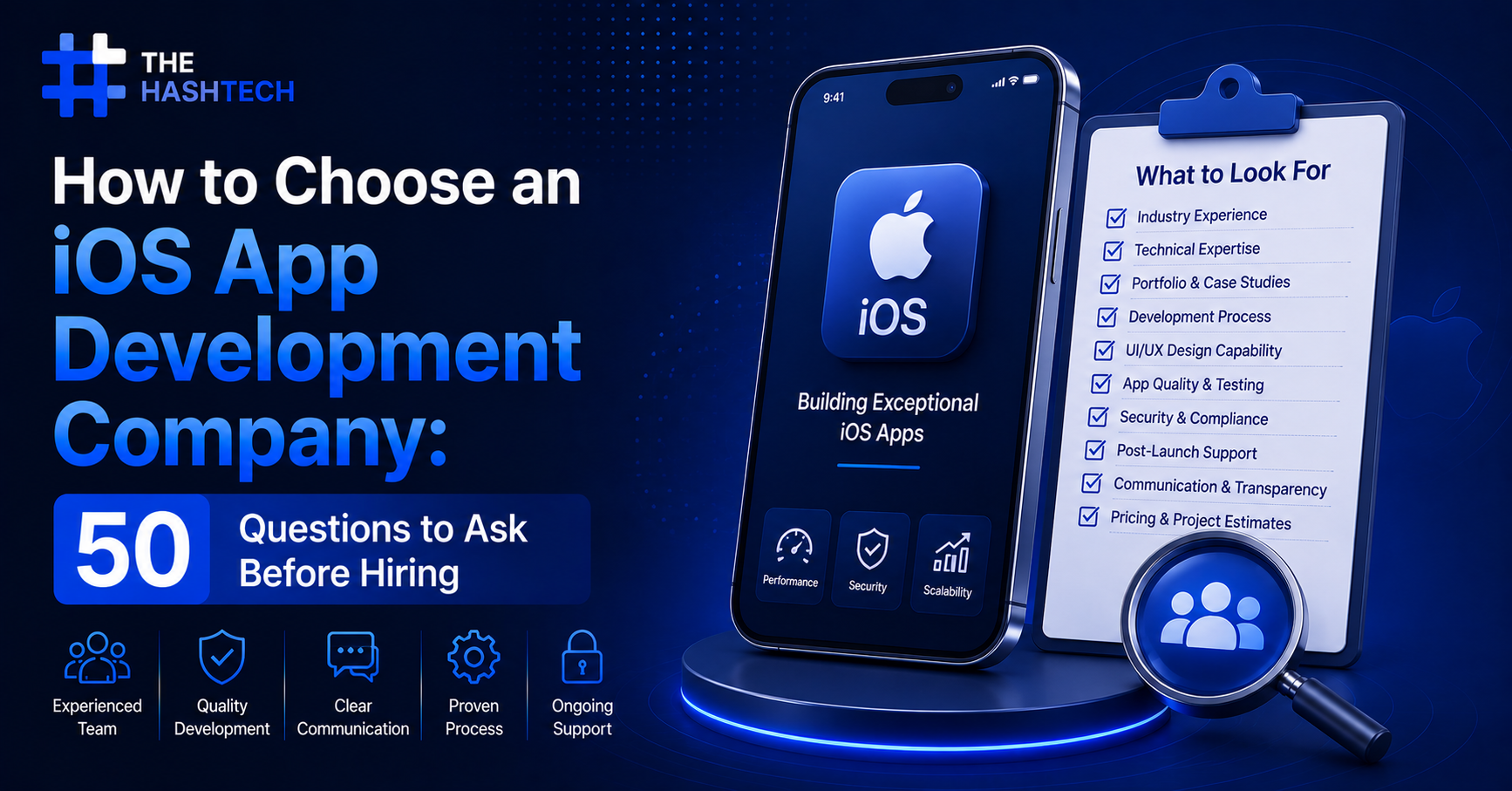
Choosing an iOS app development company is not simply about finding developers who know Swift. The right partner should understand your business goals, technical requirements, target users, budget, security needs, App Store realities, and what your product needs long after launch. Before signing a contract, asking the right questions can help you compare vendors on substance rather than sales pitch, surface technical risk early, and choose a team that can support your app through Apple’s constantly shifting platform requirements.
If you’re comparing an iOS app development agency or preparing to hire iOS app developers, this guide walks through 50 questions worth asking before you make a decision.
What Should You Look for in an iOS App Development Company?
A strong iOS app development company combines Apple-platform expertise with business understanding, transparent communication, a reliable development process, disciplined quality assurance, App Store submission experience, and genuine post-launch support.
Don’t judge a company by its website or portfolio alone. Look at whether previous projects demonstrate genuinely relevant experience, whether developers can explain technical decisions in language you understand, how the team handles testing and security, who owns the source code once the project ends, and what actually happens after your app reaches the App Store.
iOS itself is broader than “iPhone.” Apple’s current platform spans iPhone, iPad, Apple Watch, Apple TV, and Mac, each with different interface conventions, screen behaviors, and technical constraints. A team that thinks only in terms of one iPhone screen size is thinking too narrowly for most serious projects, and it shows in the final product.
50 Questions to Ask an iOS App Development Company Before Hiring
Relevant Experience
- Have you built apps with functionality similar to ours?
Start with experience relevant to your specific project, not a generic count of apps shipped. Ask to see examples with similar features, industry requirements, integrations, or user volume, and what specifically the team contributed to each one. - Can you show projects in our industry or with similar compliance requirements?
Healthcare, fintech, and other regulated industries carry constraints that generic apps don’t. A team that has already navigated HIPAA-adjacent data handling or financial compliance will move faster and make fewer costly mistakes than one encountering it for the first time. - What was the most technically difficult iOS project your team has shipped?
This question tends to get past rehearsed sales answers. Listen for specifics on what made it hard, how the team solved it, and what they’d do differently next time. - Have you launched apps that required App Store resubmission, and how did you handle it?
Nearly every experienced iOS team has hit a rejection at some point. What matters is whether they can explain the cause and their resubmission process clearly, rather than claiming a flawless record. - Do you have client references we can actually speak with?
Testimonials on a website are curated. A short call with a past client about communication, reliability, and post-launch support tells you more than any portfolio page. - What’s an example of a project that didn’t go as planned, and what did you change afterward?
Every agency has had a rough project. Teams that can discuss this honestly tend to be more trustworthy than those that insist every project has gone perfectly.
Team Composition
- Who specifically will work on our project: a dedicated team or shared across multiple clients?
Ask this directly. Teams stretched thin across several concurrent projects tend to produce slower iteration and less consistent quality than a team dedicated to yours. - Will the senior developers on this call remain involved after the contract is signed?
It’s common for senior talent to run the sales process and then hand the project to a more junior team. Confirm who is actually writing your code. - Do you have in-house UI/UX designers familiar with Apple’s Human Interface Guidelines?
Generic design skill doesn’t automatically translate to iOS-native design sense. Ask specifically about HIG familiarity, not just design portfolio breadth. - Is QA a dedicated role on the team, or is it handled informally by developers themselves? Developers testing their own code tend to miss the same blind spots repeatedly. A dedicated QA function, even a small one, catches more before your users do.
- Who is our single point of contact once development starts?
You want one accountable person, not a rotating cast that requires you to re-explain context every time something needs attention. - What’s the size and structure of the team assigned to our project?
Ask for a role-by-role breakdown of developers, designers, QA, and project managers so you know exactly who’s touching your app and in what capacity.
Technical Stack & Architecture
- Do you build natively in Swift and SwiftUI, or rely primarily on cross-platform frameworks?
Neither answer is automatically wrong, but the reasoning matters. A vendor should recommend an approach based on your project’s needs, not their team’s default comfort zone. - How do you decide between SwiftUI and UIKit for a given screen or feature?
Experienced iOS teams mix both deliberately: SwiftUI for speed and modern UI, UIKit where mature control or legacy compatibility matters. A team that only knows one is limited. - What’s your approach to app architecture, MVVM, Clean Architecture, or another pattern, and why?
The specific pattern matters less than whether the team can justify it against your project’s complexity and long-term maintainability needs. - How do you handle offline functionality and local data persistence?
Apps that assume constant connectivity fail users in real conditions. Ask how the team handles local caching, sync conflicts, and offline-first behavior if relevant to your use case. - What’s your process for integrating Apple frameworks like Core ML, HealthKit, or ARKit if the project needs them?
These frameworks carry their own learning curve and App Store scrutiny. Confirm the team has hands-on experience, not just theoretical familiarity. - How do you manage dependencies and third-party libraries?
Ask how the team evaluates, updates, and audits third-party code. Outdated or poorly maintained dependencies are a common source of both bugs and App Store rejections. - What’s your approach to API design and backend integration?
Whether you’re using an existing backend or building one alongside the app, ask how the team structures API contracts and handles versioning as your product evolves.
Design & UX for Apple Platforms
- How do you adapt designs across iPhone, iPad, and other Apple device sizes?
Ask for specifics on responsive layout handling rather than a one-size-fits-all design that’s simply scaled up or down. - How do you handle Dark Mode, Dynamic Type, and accessibility requirements?
These aren’t optional extras. Apple expects apps to support them well, and users notice when they’re an afterthought. - What’s your process for prototyping and validating key user flows before development starts?
Prototyping and user testing before code is written catch expensive design mistakes early, when they’re still cheap to fix. - Do you design specifically for Apple’s Human Interface Guidelines, or apply a generic cross-platform design system?
Apps that ignore HIG conventions tend to feel foreign to iOS users even when they function correctly. This affects retention more than most teams expect. - How do you handle multitasking and split-view behavior on iPad, if relevant to our app?
If iPad support matters to your product, this needs a specific answer. iPad’s multitasking model is genuinely different from iPhone’s single-focus interface. - How do you approach onboarding and first-time user experience design?
First impressions drive retention. Ask how the team designs and tests onboarding flows specifically, not just the app’s core functionality.
Process & Project Management
- What does your discovery phase actually produce: a document, a prototype, or both?
A vague answer here is a warning sign. You want a concrete deliverable that defines scope before development pricing is finalized. - What’s your sprint structure, and how often do we see a working build?
Regular, working builds, not just status updates, are what let you catch problems early and keep the project aligned with your expectations. - How are change requests scoped and priced mid-project?
Get this process in writing before starting. Ambiguity here is one of the most common sources of budget disputes later. - What project management tools do you use for visibility into progress?
Shared boards, ticketing systems, or regular demos all work; what matters is that you have real visibility, not just their word that things are on track. - How do you handle scope creep without derailing the timeline?
Ask for a specific example of how they’ve managed this on a past project, not just a theoretical answer. - How will you keep us informed if the project is running behind schedule?
Teams that surface delays early, with a plan, are far easier to work with than ones that go quiet until launch is at risk.
Testing & QA
- What’s your testing coverage: unit, integration, UI, performance, security?
Ask which of these your project will actually receive, not just which ones the company is theoretically capable of. - How do you test across multiple iOS versions and device models?
iOS fragmentation is smaller than Android’s, but it’s not zero; older devices and iOS versions still need verification, especially for performance-sensitive apps. - Do you use TestFlight for beta testing before public release, and how is that managed?
TestFlight is standard practice for pre-launch validation. Ask how feedback from beta testers gets triaged and fed back into development. - How do you handle performance testing on older iPhone and iPad hardware, not just current-gen devices?
An app that runs smoothly on the newest iPhone can lag badly on older, still widely used hardware. Confirm this is actually tested, not assumed. - What’s your process for regression testing after a feature change?
New features shouldn’t silently break existing functionality. Ask how the team catches this before it reaches users. - How do you track, prioritize, and verify bug fixes?
A defined bug-tracking workflow, even a simple one, indicates a team that treats quality as a process rather than a hope.
App Store Submission & Compliance
- What’s your track record with App Store approval, any history of rejections, and why?
An honest answer with specifics is more reassuring than a claim of a perfect record. Every experienced team has hit a rejection at some point. - How do you handle Apple’s Privacy Nutrition Labels and App Tracking Transparency requirements?
These are frequent rejection triggers when handled carelessly. A team with real App Store experience will have a specific, practiced process for this. - Who manages the App Store Connect listing for us, or you?
Clarify this upfront, including who has admin access during and after the engagement. - How do you handle in-app purchase and subscription review requirements, if relevant?
Apple scrutinizes monetization flows closely. Confirm the team has shipped apps with in-app purchases successfully, not just standard free apps. - What’s your process if the app gets rejected?
How fast can you resubmit? Rejections happen even to good teams. What matters is turnaround speed and whether they can diagnose the actual cause quickly. - How do you keep the app compliant as Apple’s App Store guidelines change over time?
Apple updates its review guidelines regularly. Ask whether ongoing compliance monitoring is part of a support agreement or left entirely to you. - Will you handle App Store Optimization basics, like listing metadata and screenshots?
Not every agency includes this, but a good one should at least advise on it, since a technically excellent app with a poor listing still struggles to get downloads.
Business Terms, Security & Post-Launch
- What’s included in your quoted price, and what triggers additional costs?
Get a clear breakdown of what’s covered versus what counts as a change request or add-on before you sign anything. - Who owns the source code, Apple Developer account, and App Store Connect access after delivery?
This should be unambiguous in the contract. You want full ownership transferred to you, not an ongoing dependency on the agency to make basic changes. - How do you handle secure data storage and API communication for sensitive information?
Ask specifically about encryption in transit and at rest, secure authentication, and how credentials are managed. Vague reassurance isn’t a real answer. - Do you sign an NDA before discussing project details in depth?
This should be a non-negotiable yes for any serious vendor conversation involving your product idea or proprietary data. - What does post-launch support cover: crash monitoring, OS update compatibility, bug fixes?
Launch is the start of the app’s lifecycle, not the end of the relationship. Get specifics on what’s included versus what’s billed separately. - What happens when a new iOS version breaks something in our app six months after launch?
Apple’s annual OS updates routinely surface compatibility issues in existing apps. Ask how quickly the team responds and whether that’s covered under a support plan or treated as new work.
How to Evaluate an iOS App Development Company
Once you’ve asked the 50 questions, compare vendors using consistent criteria rather than price alone.
| Evaluation Area | What to Examine |
| Relevant experience | Similar apps, industries, App Store submission history |
| Technical expertise | Swift/SwiftUI fluency, architecture reasoning, Apple frameworks |
| Design capability | HIG compliance, cross-device adaptation, accessibility |
| Development process | Milestone visibility, communication, sprint cadence |
| Testing rigor | Device/OS coverage, TestFlight process, regression discipline |
| App Store readiness | Submission track record, rejection recovery speed |
| Pricing transparency | What’s included, what triggers extra cost |
| Post-launch support | OS update handling, monitoring, and maintenance terms |
Don’t automatically choose the cheapest quote. A low estimate that skips proper testing or App Store preparation tends to become more expensive later through rework, delayed launches, and rejected submissions. The most expensive option isn’t automatically the best, either. You’re looking for the strongest combination of relevant expertise, process transparency, and long-term reliability.
Choosing the Right Engagement Model
| Engagement Model | Works Well When | Main Consideration |
| Fixed price | Scope is clearly defined upfront | Changes may require new estimates |
| Time and materials | Requirements may evolve during the build | Requires active budget monitoring |
| Dedicated team | Long-term, continuous product development | You manage an ongoing team budget |
| Hybrid | Different phases need different structures | Contract terms need clarity upfront |
The right model depends on how clearly your product is defined and how likely requirements are to change during development.
Technical Validation Criteria for iOS App Development
Before signing a contract, ask shortlisted vendors to walk through their technical approach in more depth than a sales conversation typically covers.
Architecture should be built around maintainability and testability, not just getting the first version working. Ask how the team structures code to make future feature additions easier rather than progressively harder.
Testing should focus on the parts of the app that carry real risk: core business logic, navigation flows, API integrations, authentication, and payment handling, if applicable. A team that can name these specifically, rather than gesturing vaguely at “thorough testing,” is more likely to deliver a stable product.
Security should be validated early, not audited after the fact. Ask about secure communication practices, dependency update discipline, and how authentication credentials are protected in storage and transit.
Finally, ask how the app is designed to handle future iOS versions and device form factors. An app built only for today’s requirements tends to need expensive rework within a year or two of Apple’s next major OS release.
Red Flags to Watch For Before You Commit
Be cautious if a vendor:
- Quotes a price or timeline before properly understanding your requirements
- Can’t clearly name who will actually work on your project
- Has no specific answer for App Store rejection history or resubmission process
- Treats security or Privacy Nutrition Labels as a late-stage afterthought
- Can’t clearly explain source code and Apple Developer account ownership
- Has no defined process for handling iOS version updates after launch
- Avoids technical questions or gives vague, deflective answers
- Pressures you to sign before the scope and contract terms are fully settled
One red flag on its own isn’t necessarily disqualifying. Several together are worth taking seriously.
Why App Store Review Deserves Its Own Conversation
Unlike some platforms, Apple’s App Store review process is strict about specific, recurring things: privacy disclosure accuracy, in-app purchase handling, and interface consistency with the Human Interface Guidelines. A vendor who has shipped multiple apps through review will have specific, practiced answers about Privacy Nutrition Labels, App Tracking Transparency prompts, and how they structure submissions to reduce rejection risk in the first place. A vendor who treats App Store submission as a minor final step is more likely to cost you a launch delay when Apple sends the app back for revisions.
This matters more than most first-time app buyers expect, because a rejection doesn’t just cost time; it can cost a planned launch date, a marketing push already scheduled around it, or a client demo that was supposed to showcase a live product. Ask any shortlisted vendor to walk through their last rejection in specific detail: what triggered it, how long resubmission took, and what changed in their process afterward. Teams that can answer this clearly have almost certainly been through App Store review enough times to have a genuinely practiced approach, not just a theoretical one.
When Should You Hire an iOS App Development Company?
Consider hiring a professional partner when your application needs specialized Swift/SwiftUI expertise, custom backend integrations, App Store-ready polish, security-sensitive handling of user data, or a scalable architecture built to support growth rather than just an initial launch.
If you already have an internal product team, an external iOS company can also supplement specific phases of design, a technically demanding feature, or App Store submission expertise you don’t have in-house.
If your roadmap also includes Android, it’s worth evaluating that decision alongside this one rather than sequentially, since shared architecture decisions early on can save significant rework later.
How to Choose the Best iOS App Development Company for Your Project
The best iOS app development company isn’t necessarily the one with the longest portfolio, the lowest quote, or the most polished website.
Start by defining your business objectives and a clear minimum viable product. Then shortlist companies with genuinely relevant experience and ask each one the same 50 questions above. Compare their technical reasoning, communication style, timeline realism, pricing transparency, testing discipline, security practices, ownership terms, and post-launch support side by side.
Pay particular attention to how clearly a company communicates technical decisions. A strong partner should be able to explain complicated trade-offs in a way that helps you make an informed business decision, not in a way designed to end the conversation quickly.
Before signing anything, make sure scope, milestones, responsibilities, code ownership, payment terms, the change-request process, support terms, and delivery expectations are all documented in writing. Verbal assurances during a sales call carry no weight once a dispute arises.
The right partner should feel like a long-term technology collaborator, not simply a vendor that writes code and disappears after delivery.
Final Thoughts
Choosing an iOS development partner is a business decision as much as a technical one. The right company should understand your product, challenge weak assumptions instead of agreeing with everything you say, explain technical trade-offs in plain language, manage App Store risk proactively, and stay involved after launch rather than disappearing once the app goes live.
Use these 50 questions when interviewing potential vendors, compare their answers against the same criteria for every company on your shortlist, and weigh evidence, references, specific process details, and honest answers about past mistakes over polished promises. The goal isn’t finding the cheapest quote or the flashiest portfolio; it’s finding a partner whose value holds up across the full lifecycle of the product, not just the first release.
Frequently Asked Questions
How much does it cost to hire iOS app developers?
Cost depends on feature complexity, integrations, design requirements, and team structure. Request a scoped estimate tied to your actual requirements rather than relying on a generic market range.
How long does iOS app development typically take?
Most standard projects run 8-14 weeks from discovery to launch; apps with complex integrations, custom backend work, or multiple Apple frameworks can take longer.
Should I choose native Swift development or a cross-platform framework?
Native Swift/SwiftUI generally suits performance-critical or deeply Apple-integrated apps best; cross-platform frameworks make sense when you also need Android from a shared codebase and want to reduce cost and timeline.
Why do apps get rejected from the App Store?
Common reasons include privacy disclosure mismatches, incomplete in-app purchase implementation, and interface elements that don’t meet Apple’s Human Interface Guidelines. An experienced vendor should prevent most of these before submission.
Do I own the Apple Developer account and source code after the project is done?
You should confirm this in writing before development starts, including who retains admin access to App Store Connect after launch.
What makes the best iOS app development company different from an average one?
The strongest partner combines relevant Apple-platform expertise with transparent pricing, disciplined testing, a real App Store submission track record, and dependable post-launch support, not just a polished portfolio.
Should I choose a fixed-price or dedicated development team model?
Fixed-price works well when requirements and scope are clearly defined upfront. A dedicated team suits products needing continuous development or frequent changes. Time-and-materials arrangements offer flexibility when requirements are expected to evolve during the build.
How do I know if an iOS development company is actually reliable?
Review genuinely relevant portfolio work, speak with client references directly, ask about their development process in specific detail, and confirm they’re willing to discuss project risks honestly rather than promising a flawless outcome.
Where The Hashtech Fits
Our iOS app development services team builds in Swift and SwiftUI with Apple’s Human Interface Guidelines applied by default, not bolted on at the end of the project.
If you’re weighing Android alongside iOS, our guide on how to choose an Android app development company covers the same evaluation depth for that side of the decision.
You can see how this plays out on real projects in our mobile app case studies, including apps built across both Apple and Android ecosystems.
Reviewed by The Hashtech iOS Engineering Team. Last updated August 24, 2026. Reviewed quarterly for current App Store policy, pricing, and process accuracy.