
Mobile App Development Company vs Freelancer vs In-House Team


31 August, 2026
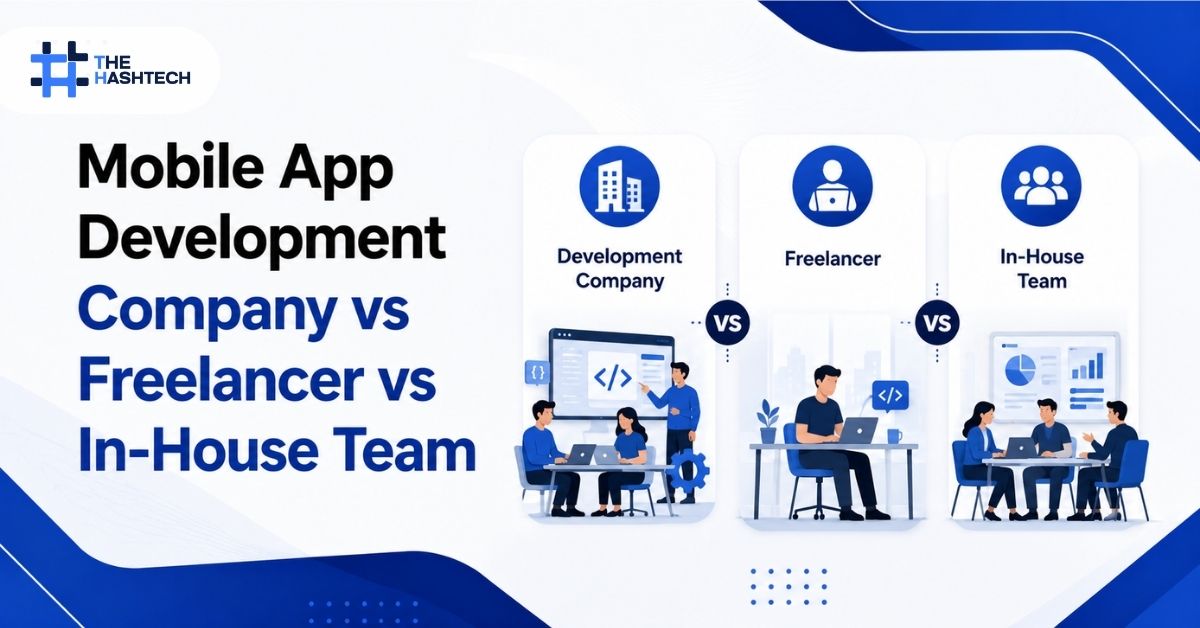
This isn’t really a quality question; it’s a stage question. A funded startup building its first MVP, a mobile app development company with a validated product needing continuous feature development, and a founder testing a simple idea on a tight budget are not choosing between “good” and “bad” options. They’re choosing the option that fits where their business actually is right now. Get the stage wrong, and even the best freelancer, agency, or in-house hire will feel like the wrong decision six months in.
Quick Comparison
| Factor | Freelancer | Development Company | In-House Team |
| Typical cost | Lowest upfront | Mid-range, project-scoped | Highest (salaries, benefits, tools) |
| Best for | Prototypes, simple projects, under ~$30K | Production MVPs, most funded startups, $50K+ budgets | Continuous product development at scale |
| Speed to start | Fast | Fast (existing team, process) | Slow hiring takes months |
| Quality consistency | Varies by individual | Most consistent structured process | Depends entirely on who you hire |
| Full-service capability | Usually single-skill | End-to-end (design, dev, QA, PM) | Depends on hiring depth |
| Long-term ownership | Weak — depends on one person | Contractual, but external | Full internal control |
| Ongoing cost after launch | Ad hoc, re-hire per task | Retainer or support contract | Fixed, whether or not there’s active work |
Freelancer: When It Actually Makes Sense
A freelancer is an independent developer working alone, usually specializing in one part of the stack: frontend, backend, or full-stack. The appeal is obvious: lower upfront cost and direct, unfiltered communication with the person actually writing the code.
Freelancers fit prototypes, simple internal tools, and clearly-scoped projects generally under roughly $30,000, where the work is technically straightforward and you can tolerate the risk of relying on one person. They’re also a reasonable choice if you already have an in-house team and just need extra hands on a specific, well-defined task.
The trade-off is real: no backup if that person gets sick, takes another contract, or simply disappears mid-project. Quality varies entirely by individual skill; there’s no QA function separate from the person who wrote the code, and unstructured workflows mean timeline estimates are less reliable than a team following a defined process.
Mobile App Development Company: When It Actually Makes Sense
A development company is a full-service agency with designers, developers, QA testers, and project managers working together under a structured process, typically Agile. You’re not hiring one person; you’re hiring a system built to catch what one person alone would miss.
This is the right fit for most funded startups building a production MVP, typically in the $50,000+ budget range with an 8-20 week timeline. It’s also the right choice for larger or long-term projects where reliability, structured QA, and full-service capability (UI/UX through deployment) matter more than the lowest possible price.
Quality consistency is the biggest practical advantage over a freelancer: agencies rely on repeatable processes rather than any one person’s individual skill, which makes outcomes more predictable across the life of the project. The trade-off is cost: you’re paying for structure and full-service capability, not just development hours.
In-House Team: When It Actually Makes Sense
An in-house team is a group of full-time employees working exclusively on your product, inside your organization, with full internal control over priorities, architecture, and long-term roadmap.
This makes sense once the app is core to how the business makes money and continuous, fast iteration is a genuine competitive advantage, not a nice-to-have. As a rough guideline, the economics shift toward in-house once you have enough continuous mobile development work to keep a full team productive year-round, which typically means an 18-24 month break-even point against ongoing agency costs.
What most comparisons leave out: the fully-loaded cost of even a small in-house team commonly runs $500,000-$750,000+ per year once you include salaries, benefits, tools, and management overhead, often higher than the cost of two full agency-built MVPs plus a year of post-launch support.
Decision Framework by Company Stage
Rather than comparing these three options in the abstract, the more useful lens is: what stage is your business actually in?
- Idea or pre-funding stage, tight budget: A freelancer for a narrow prototype or proof of concept. Don’t overcommit before you’ve validated demand.
- Funded startup, building first product or MVP: A development company. You need full-service capability and process reliability more than you need the lowest hourly rate, and you don’t yet have the continuous workload to justify in-house hiring.
- Post-product-market-fit, continuous roadmap, meaningful engineering budget: In-house becomes economically rational once you’re past roughly $1M ARR or comparable funding, and mobile development is a permanent, ongoing function rather than a discrete project.
- Established company with an in-house team, occasional overflow: A freelancer or a development company for specific overflow work, without expanding permanent headcount for temporary spikes.
The most common expensive mistake is building an in-house team too early before there’s enough continuous work to justify the fixed cost, or before the product itself has proven it’s worth that level of ongoing investment.
Hybrid Models Are Common and Often Underrated
These three options aren’t mutually exclusive. Plenty of companies run a lean in-house team for product ownership and architecture decisions, while using a development company or freelancers for peak capacity, specialized features, or platform expansion (adding Android to an iOS-only in-house build, for example). This avoids the two extremes: overpaying for permanent headcount you don’t consistently need, or relying entirely on external teams for a product that’s become core to the business.
Frequently Asked Questions
Is it cheaper to hire a freelancer or an app development company?
A freelancer typically has lower upfront cost, but a development company offers more consistent quality and full-service capability, which often reduces total cost once rework, QA gaps, and project management overhead are factored in.
When does it make sense to build an in-house mobile development team?
Generally, once the app is core to how the business makes money, you have continuous (not project-based) development work, and you’re past roughly $1M ARR or comparable funding, the fixed cost of an in-house team is hard to justify before that.
How long does it take to hire an in-house mobile developer?
Recruiting a single senior mobile developer typically takes 2-4 months in current market conditions, before accounting for onboarding time before they’re fully productive.
Can I switch between these models as my company grows?
Yes, and it’s common. Many companies start with a freelancer or agency to validate the product, then transition to in-house once there’s proven revenue and continuous development needs.
What’s the biggest risk with each option?
Freelancer: reliance on one person with no backup. Development company: less internal ownership of process and institutional knowledge. In-house: high fixed cost and slow hiring timelines relative to project-based needs.
Still Deciding Which Path Fits Your Project?
If you’re leaning toward working with a development company, our mobile app development team runs the structured, full-service process described above from discovery through post-launch support for startups at exactly the MVP stage this article describes.
For a deeper look at vendor evaluation once you’ve decided an agency is the right fit, our guide on what are the best practices in mobile app development? covers the specific questions worth asking.
You can see how this process has played out on real projects in our case studies.
Talk to our team about your specific stage and budget; we’ll tell you honestly if an agency is the right fit, or if you’d be better served another way.