
What Is Included in Professional Mobile App Development Services?


4 September, 2026
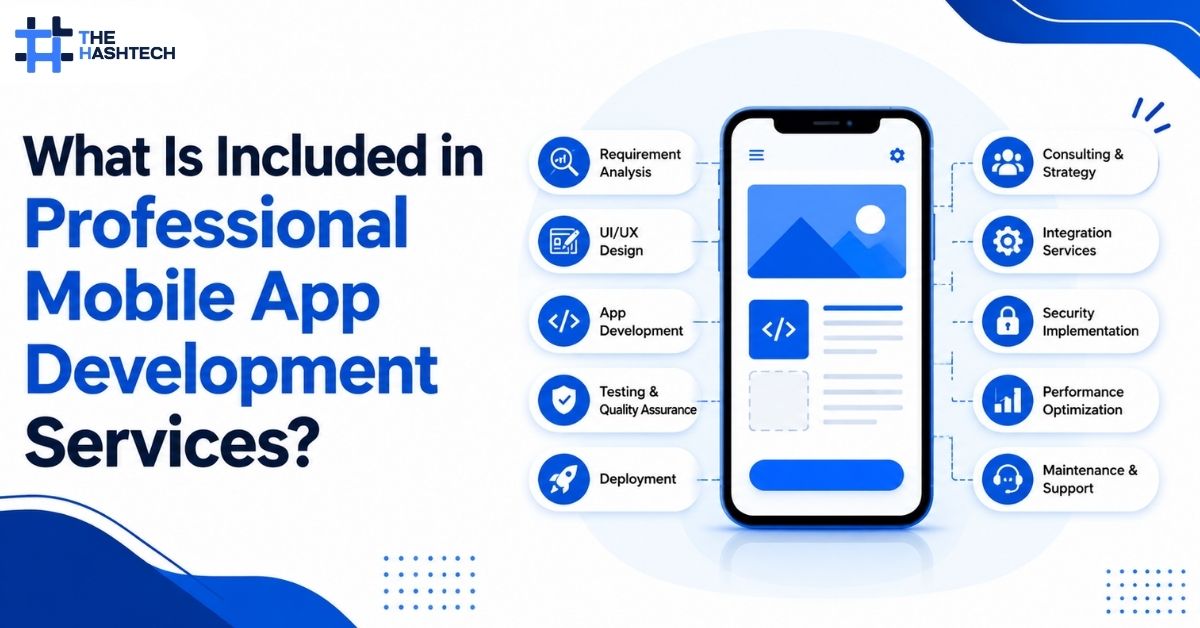
Full mobile app development services typically cover seven stages: discovery and strategy, UI/UX design, frontend and backend development, quality assurance, security implementation, deployment, and post-launch support. The problem is that “full-service” means different things to different vendors. Some quotes quietly exclude QA depth, security hardening, or anything past launch day. Knowing what should be included helps you spot a quote that’s missing something before you’ve already signed.
The 7 Stages of Real Mobile App Development Services
1. Discovery & Strategy
Before any design or code, this stage defines the actual problem being solved: target users, core features, technical requirements, and a roadmap tied to a measurable business outcome. Skipping this and jumping straight to development is one of the most common reasons projects run over budget.
2. UI/UX Design
Wireframes, prototypes, and visual design translate the strategy into something a user can actually navigate. This includes user flow mapping and interface design tailored to how people actually behave on mobile, not just how a desktop layout would look shrunk down.
3. Frontend & Backend Development
The actual build native (Swift/Kotlin) or cross-platform (Flutter/React Native) on the frontend, paired with backend architecture, APIs, and database design. Increasingly this includes cloud-native infrastructure (AWS, Azure, serverless) built to scale without requiring a rebuild as usage grows.
4. Quality Assurance & Testing
Functional testing, performance testing, and device/OS compatibility testing ideally running throughout development, not compressed into the final week before launch. This is one of the stages most likely to get quietly shortened in a rushed or underpriced quote.
5. Security Implementation
Enterprise-grade mobile app development services should include data encryption, secure API communication, multi-factor authentication where relevant, OWASP-compliant code review practices, and cloud data protection with backup strategy built into the architecture from the start, not bolted on before launch.
6. Deployment
App Store and Play Store submission, including store listing setup, compliance with platform-specific review requirements, and handling the resubmission process if the app is initially rejected.
7. Post-Launch Support
This is the stage most often underestimated in scope. Complete mobile app development services should include regular updates and bug fixes, server and API maintenance, performance monitoring and optimization, and feature enhancements based on real user feedback not a vague “we’ll be around if you need us.”
What’s Often Missing From a “Full-Service” Quote
A few gaps show up repeatedly in quotes that look complete but aren’t:
- QA treated as a final checkbox rather than an ongoing process across development, which tends to surface as post-launch bugs the client discovers instead of the vendor.
- Security as an afterthought. If encryption, secure authentication, and code review practices aren’t mentioned until you ask, they likely weren’t part of the original architecture planning.
- Post-launch support priced separately and vaguely, with no specifics on response time, what’s covered, or how bug fixes versus new feature work is billed.
- No mention of platform compliance handling who manages App Store/Play Store submission, and what happens if the app is rejected.
- Cloud infrastructure decisions made without a scaling conversation fine for a demo, expensive to fix once real user growth hits.
How to Vet Whether a Provider’s Services Are Actually Complete
- Ask for a stage-by-stage breakdown, not just a total price. If a vendor can’t clearly separate discovery, design, development, QA, and support into distinct scoped items, the estimate likely isn’t built on a real plan.
- Ask what security practices are standard, not optional add-ons. Encryption, secure API communication, and code review shouldn’t be an upsell.
- Ask exactly what’s included in post-launch support, and for how long. “Ongoing support” without specifics usually means minimal support.
- Ask who handles app store submission and rejection risk. This is commonly left ambiguous until it becomes a problem.
- Ask about cloud/backend scalability planning, especially if you expect meaningful user growth in year one.
Frequently Asked Questions
What’s typically included in mobile app development services?
A complete service scope includes discovery and strategy, UI/UX design, frontend and backend development, QA and testing, security implementation, app store deployment, and post-launch support.
Does post-launch support usually cost extra?
Often, yes but it should be scoped clearly upfront, whether included in the initial quote or billed as an ongoing retainer. Vague “we’ll help if needed” language is a sign the scope wasn’t properly defined.
Is security part of standard mobile app development services, or an add-on?
It should be standard. Encryption, secure API communication, multi-factor authentication, and OWASP-compliant code review practices are baseline architecture decisions, not optional extras especially for apps handling any sensitive user data.
Who handles App Store and Play Store submission?
This should be explicitly covered in your services agreement. Some providers handle the full submission and resubmission process; others expect the client to manage the store listing independently and confirm which applies before signing.
How do I know if a quote for mobile app development services is missing something?
Ask for a stage-by-stage breakdown rather than a single total. Quotes that bundle everything into one number without specifics on QA depth, security practices, or post-launch scope are the ones most likely to have gaps.
Looking for Mobile App Development Services That Actually Cover All Seven Stages?
Our mobile app development services are built around this exact seven-stage process including enterprise-grade security (encryption, MFA, OWASP-compliant reviews) and post-launch support covering updates, server maintenance, and performance monitoring as standard, not an upsell.
If you’re comparing providers before committing, our guide on best practices in mobile app development? covers the vendor-evaluation questions worth asking alongside this scope checklist.
You can see this full process applied on real projects in our case studies.
Get a scoped estimate that breaks down exactly what’s included at each stage no bundled, unexplained total.