Mobile App Marketing Trends 2026: 10 Shifts Every App Business Should Plan For


22 July, 2026
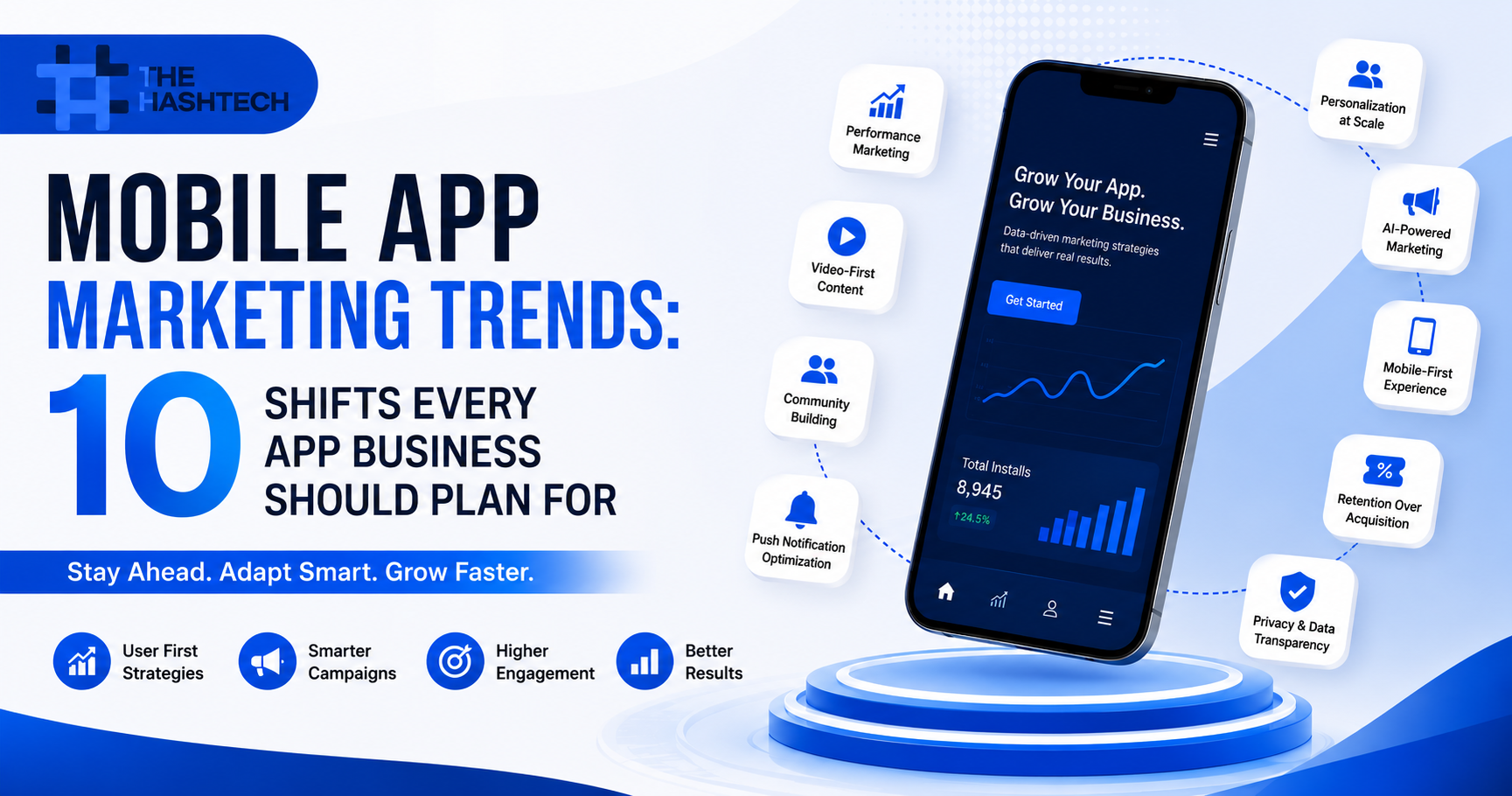
All of these factors, and many more, are going to make 2026 one of the most pivotal years for mobile app marketing since the mobile channel was born. Heavy paid acquisition, generic push notifications, and one-size-fits-all onboarding are quietly losing their effectiveness; as users develop a healthy sense of app ownership, they are becoming pickier about which of their devices they’ll honor with a permanent slot on their Home Screen. Meanwhile, privacy regulations have become stricter, AI tools have become smarter, and acquisition costs are climbing. Companies that understand where the industry is headed this year rather than reacting to last year’s playbook will build sustainable growth, while those that don’t will burn through their budgets chasing tactics that just aren’t working anymore.
This guide walks you through ten concrete shifts that are shaping mobile app marketing trends in 2026, from privacy-first data strategies to the rise of AI-driven personalization, so you know where to direct your marketing budget to maximize results. While some shifts will be more applicable depending on your app’s category and audience, the following points paint a fairly clear picture of where the industry is headed and what steps your business needs to take over the next year.
Privacy-First Marketing Is No Longer Optional
Why First-Party Data Now Drives the Whole Strategy
Privacy-focused data collection has already affected the advertising industry for Apple and Google as they wind down Third-Party tracking and expand restrictions on cookies. Marketing teams that built their acquisition strategy around highly familiar third-party tracking seen in browser history and data pooling need to re-establish their strategy around data collected directly from users, called First-Party Data. To show value to the user and to increase their Commerce and Entertainment focus, you need to give them a reason to sell or trade their data, rather than to hide it from public view. And that means giving them something in return.
Building Trust Through Transparency
Consumers are much more aware of how their data gets used (and misused) than they were a few years ago. And a big, new shift in the mobile app marketing space is transparency. If an app is quick to advertise what data it will collect and why, it can enjoy an easier time acquiring a permission request by hundreds of percentage points compared to a traditional permission request. Controllers seem to be more willing to try out a feature, even if they think they are aware of the risks. Some users will pause for a moment, but the vast majority still turn it on.
AI-Powered Hyper-Personalization Has Matured
From Basic Segmentation to Real-Time Adaptation
Among the shifts that moved fastest during the last year was AI-driven personalization. Rather than segmenting users into broad buckets and sending the same messaging to everyone in the same bucket, mature AI systems can now make decisions about content, offers, and even when to send push notifications based on the individual’s behavior pattern in near real time. Custom Android app development services, for example, can factor in a user’s daily step count, sleep schedule, and engagement dips to decide exactly when and what to send, rather than simply blast everyone with the same reminder at 6 am.
Where Personalization Still Needs a Human Touch
While, thanks to AI, the days of manually typing in customer segments and setting up messaging queues are behind us, there’s still a role for humans in the personalization process. Those who treat AI as a tool to nail down the heavy lifting of pattern recognition and message timing, as opposed to replacing strategic decision-making, tend to see stronger results, since totally automated personalization, without guardrails, can start feeling creepy rather than helpful. Striking the right balance is quickly becoming one of the most important skills within this year’s mobile app marketing trends.
The Rise of Community-Driven Growth
Users Marketing to Other Users
Another one of the trends that became more apparent in 2026 is the importance of in-app communities, which are now a real growth channel rather than simply a retention experience. Fully finished apps that build a place where businesses, users, or creators are able to help each other have found it easier to grow with this feature than they ever have before. This is not the passive social feed of years past but humans actively creating content, interacting, and sharing all within the boundaries of the app itself.
Turning Power Users Into Advocates
Another one of the trends that became more apparent in 2026 is the importance of in-app communities, which are now a real growth channel rather than simply a retention experience. Fully finished apps that build a place where businesses, users, or creators are able to help each other have found it easier to grow with this feature than they ever have before. This is not the passive social feed of years past, but humans actively creating content, interacting, and sharing all within the boundaries of the app itself.
Influencer Partnerships Are Becoming Performance-Based
Moving Away from Flat-Fee Sponsorships
Influencers remain a staple in many mobile marketing strategies, but their partnership structure has changed in recent years. Flat-fee sponsorship deals, where a creator is paid for one video but without regard for actual results, are being replaced by performance-based partnerships in which creators earn only when they get actual installs. This is good for the platform, the brand, and the right creator, as everyone benefits from a more motivated and engaged pool of users.
Micro-Influencers Outperforming Big Names
In the past four years, we’ve also seen the rise of a new trend of smaller, yet highly engaged creator circles outperforming just a handful of megastars. The popularity of both macro and micro-influencers pushes forward the notion that quality and relevance pay off rather than simply a number of followers or views. As a result, marketing budgets are now skewed in a very different way: dedicating smaller budgets to a much larger number of niche creators, but with engaged audiences. This approach works well for smaller brands and apps without multi-million-dollar paid media budgets.
Cross-Channel Measurement Is Now Essential
Users Move Across Devices Before Converting
What that means in practice is that a typical user today may see a banner ad on their mobile app, visit the website from their desktop, engage with the brand on Facebook, and ultimately walk into a store to buy the product. This kind of confused, multi-surface journey is the reason why cross-channel attribution, and subsequently a series of other big mobile app marketing trends, has been so technically challenging to implement well. It’s also the reason why companies still frequently determine budgets without a complete picture.
Investing in Unified Measurement Tools
In response, marketing teams are investing in measurement platforms that will stitch the full user journey together rather than just giving credit to the last channel touched before conversion. This requires more technical development across your technology stack than traditional single-channel tracking but actually produces a true picture of what is driving growth versus being a standalone source of credit for conversions that are, regardless, already going to occur.
Sustainability and Ethical Marketing Are Gaining Weight
Values-Driven Messaging Resonates With Younger Users
One of the most observable, less technical, and increasingly impactful shifts we are seeing is that messaging about ethics and sustainability is no longer a niche or differentiator. This is a feature these users factor into their app choices, their reasons for making those choices, and the judgements they make about an app. So every business should pay attention to this moment.
Avoiding Performative Messaging
The companies that have won with this trend have been the ones that back up their messaging with genuine practice, not just glossing over at surface level. Users are much more savvy to performative marketing, so if the actual behavior in practice doesn’t line up with the story you’re trying to tell, it’s always worse than not telling a story at all.
Push Notifications Are Getting Smarter, Not Louder
The End of Blanket Notification Blasts
Generic, one-size-fits-all push notifications are among the fastest-declining tactics in mobile marketing right now, largely because users have grown numb to irrelevant alerts and disable notifications entirely in response. The more effective approach in 2026 relies on behavioral triggers, sending a message only when it’s genuinely relevant to what a specific user is doing or likely to want, rather than pushing the same content to an entire user base at once.
Frequency and Timing as Strategic Levers
Marketers are beginning to realize that notification frequency and timing are not only key determinants of whether a user will disable notifications but should be strategic issues that can be tested. Apps that test and adjust notification frequency based on user engagement trends tend to retain permission a lot longer than apps that flood users or employ push settings that treat all users equally.
App Store Optimization Is Evolving With AI Search
How AI Overviews Are Changing Discovery
App store optimization remains a foundational growth channel for many businesses, but much like the rest of the discovery world, the mechanics behind ASO are shifting. As AI-powered search and recommendation systems come into their own, the art of keyword stuffing and the incentive to game the system in order to rank highly are on the decline. Businesses need to think less about how to optimize pages for keywords and more about how to convey trust and relevance to systems that can now use a much broader set of signals than just text match.
Reviews and Ratings Carry More Weight Than Ever
User reviews and ratings have become an even more powerful discovery signal. Both app stores and, more often, third-party AI search tools are taking genuine user sentiment into account when making recommendations. Businesses that actively encourage satisfied users to leave reviews and respond thoughtfully to negative reviews are starting to see its effect on discovery.
Retention Marketing Is Overtaking Pure Acquisition
Why Keeping Users Now Costs Less Than Acquiring Them
Since paid acquisition costs are rising across most categories, retention has become one of the most financially urgent mobile app marketing trends for 2026. Keeping an existing user engaged tends to cost a lot less than acquiring a new one. And not only does retention work better as a standalone function when gamified, but businesses that take a marketing-first approach to retention also tend to see stronger long-term unit economics than those pouring the majority of their budget into top-of-funnel acquisition alone.
Lifecycle Marketing as a Core Discipline
But to make retention marketing worthwhile in 2026 requires a full mapping of the user lifecycle and messaging specific to each stage. This means onboarding that occurs during the first session, then subsequent retention and loyalty emails the second or third day after install, then win-back campaigns for customers that are absent well past their purchase event. It’s more sophisticated, but also more rewarding than old retention efforts.
Choosing the Right Technology Partner to Execute These Trends
Using these mobile app marketing trends isn’t always something you can do with just your marketing team, since many of these strategies use personalization, new community features, or measurement infrastructure that require at least some work from your technical partners. For those growing businesses, figuring out how to build out community features, or an in-app social layer, often means working with a web application development service to build out the backend infrastructure that powers user dashboards, admin tools, and data syncing across platforms, even if these buttons, articles, or comments are surfaced in a mobile app. This is especially true if you need a robust web admin, or are building out cross-platform analytics dashboards.
Companies that are building or refining their Android experience to match the quality of the iPhone version have to account for the fact that Android is much more fragmented, and that building and testing a reliable, compelling notification system is much more difficult on that platform. Growing businesses also turn to Flutter development services to iterate on these marketing-driven features faster. Because a single codebase suggests that personalization, notifications, and other retention features would ship to both platforms at the same time, rather than a separate native development cycle.
Final Thoughts
Say hello to another year of mobile app marketing trends. Remember that time when those trends we bought into back in the beginning forever changed the way we think about, develop, and market mobile apps? Those were the good ol’ days. The predominant themes dominating this year’s list are no different. Consumers see value in return for their attention and their data. They want transparency, authenticity, privacy, and simplicity as standard fare. Businesses that gracefully adapt to these new expectations are baaack. Those that don’t are running last year’s playbook in a rapidly changing game. These ten shifts in the marketing ecosystem aren’t something to cherry-pick from the menu; they’re pieces of a larger, more interconnected strategy that solves the most pressing mobile app challenges in 2026 and beyond.
FAQs
1. What is the biggest mobile app marketing trend in 2026?
The biggest shift to start 2024 is the biggest: privacy-first marketing. Restrictions on third-party tracking will only worsen, from the privacy push from Apple and Google, for instance. The push for first-party data, then, will only increase. Companies will find real value in the information they access.
2. How is AI changing mobile app marketing in 2026?
AI is no longer a science experiment. It has entered the realm of marketing infrastructure, where the tried-and-true method of hyper-personalization is truly becoming a reality. Instead of dividing a broad, shared audience, AI-driven tools now analyze customer data in near real-time to decide what each customer should see, when they see it, and how they see it.
3. Are push notifications still effective for app marketing?
Yes, but only when you use notifications tactically. To be clear, though, generic, one-size-fits-all notification blasts are a losing proposition. The more marketers send users everything they have in their toolbox, the more users become numb to alerts. Disabling permissions becomes an unfortunate turn of events. But there is hope yet.
4. Is influencer marketing still worth it for mobile apps?
That said, influencer marketing is still relevant, but the way of doing it is changing. Now, a performance-based partnership structure is the main trend, and marketers and creators attach the deal to actual installs or in-app actions rather than flat-fee sponsorships.
5. Should businesses prioritize user acquisition or retention in 2026?
Retention has become more urgent as paid acquisition costs continue to climb in most app categories. Humans are creatures of habit. This is true for all of us, and it is the reality of marketing, too. Keeping users that you already have engaged is much, much cheaper than finding new users.