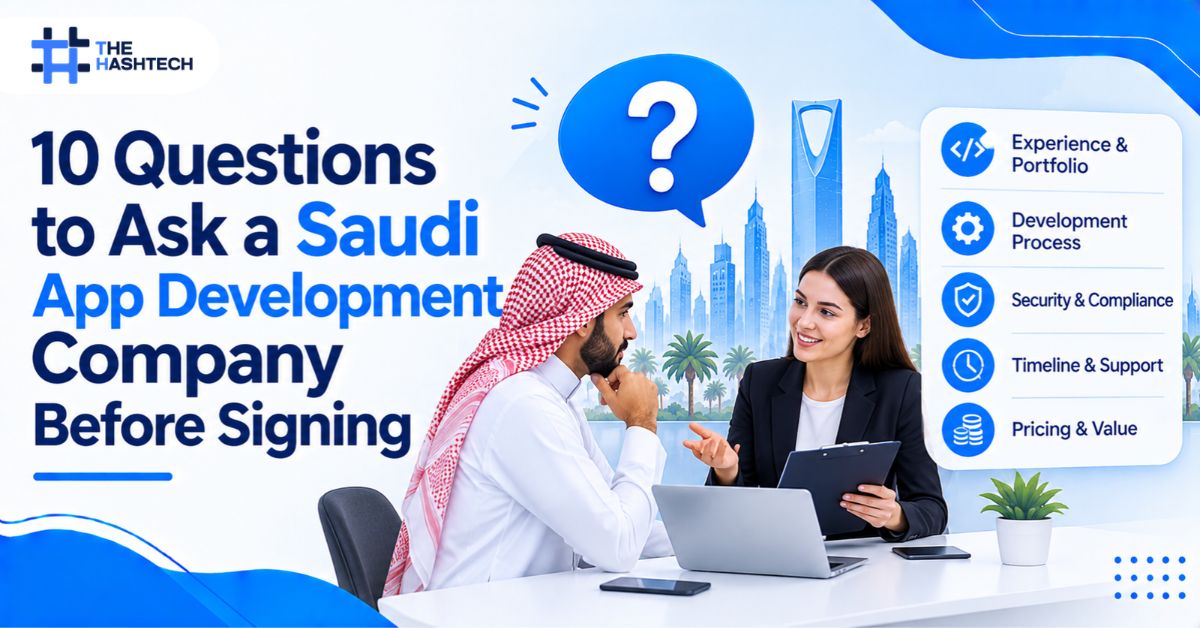
10 Questions to Ask a Saudi App Development Company Before Signing


13 November, 2026
Quick answer: Before signing with a Saudi app development company, verify its local registration and portfolio, its compliance with Saudi data and invoicing rules, its Arabic and RTL expertise, its pricing structure, who owns the source code, and what support it offers after launch. A vendor that answers these ten questions clearly and in writing is far less likely to cause budget overruns, legal trouble, or a failed launch.
Saudi Arabia is one of the most active digital markets in the Middle East. Vision 2030 has pushed government services, fintech, retail, and healthcare onto mobile, and users expect fast, Arabic-first, secure apps. A wrong vendor choice therefore costs more than money. It can cost you market timing and regulatory standing. Here are the ten questions that matter most, each with the answer you should expect to hear.
1. Is the company legally registered and operating in Saudi Arabia?
A credible vendor holds a valid Commercial Registration (CR) issued by the Ministry of Commerce, a tax registration with ZATCA, and a verifiable office address in the Kingdom. Ask for the CR number and check it on the official portal. A registered local entity can issue compliant VAT invoices, sign enforceable contracts under Saudi law, and be held accountable if something goes wrong. Offshore teams without a local entity can still be capable, but they make contracts, payments, and dispute resolution harder.
2. Can they show relevant Saudi projects and real client references?
Ask for live apps in the App Store and Google Play that were built for Saudi clients, then ask to speak with two or three of those clients directly. A strong portfolio in your industry, whether fintech, logistics, healthcare, or e-commerce, tells you the team already understands your users’ habits and your sector’s regulations. Screenshots alone prove nothing. Download the apps, test them, and check their ratings and update history.
3. How large is their team, and who will actually build your app?
Many agencies sell with senior staff and deliver with juniors or outsourced freelancers. Ask for the names, roles, and experience of the project manager, designers, developers, and QA testers assigned to you. A dependable mobile app development company in Saudi Arabia will have dedicated in-house specialists for iOS, Android, backend, and UX, and will tell you plainly which parts, if any, are subcontracted.
4. Do they comply with Saudi data protection and cybersecurity regulations?
Compliance is not optional. The Personal Data Protection Law (PDPL), overseen by SDAIA, governs how you collect, store, and transfer user data, and the National Cybersecurity Authority (NCA) publishes controls that many organizations must follow. Ask how the company handles consent, data residency, encryption, and breach response. If your app serves government or financial clients, ask whether they have experience meeting those higher standards. A vendor who cannot explain PDPL in simple terms is a red flag.
5. Do they have local presence in the city where you operate?
Time zones, language, and in-person meetings matter more than most people expect, especially during discovery and testing. Face-to-face workshops speed up decisions and reduce misunderstandings. If your business is in the Western Region, a partner offering app development services in Jeddah can run on-site workshops, test with local users, and respond quickly during launch. Riyadh and Dammam are also major hubs, so ask where the team sits and how often they will meet you in person.
6. How strong is their Arabic and RTL experience?
Arabic support is more than translating text. Right-to-left layouts mirror navigation, icons, animations, and forms, and poor implementation makes an app feel foreign to Saudi users. Ask whether the designers build Arabic-first interfaces, whether they test with native speakers, and how they handle bilingual switching without breaking the layout. Also ask about cultural details like Hijri dates, local address formats, prayer-time features where relevant, and tone of voice in copy.
7. Can they integrate with Saudi payment, identity, and government systems?
Your app will likely need local integrations. Ask about their experience with Mada, Apple Pay, STC Pay, and buy-now-pay-later providers like Tabby and Tamara. For identity and government services, ask about Nafath, Absher, and Tawakkalna integrations. For businesses issuing invoices, ask about ZATCA e-invoicing (Fatoora) compliance. Previous hands-on integration experience saves weeks of trial and error and lowers the risk of rejected transactions at launch.
8. How do they price the project, and what does the budget include?
Get a detailed written estimate that breaks down discovery, design, development, testing, deployment, and project management. Ask whether the price is fixed or time-and-materials, what counts as a change request, and whether the 15% VAT is included. Costs vary widely depending on features, platforms, and integrations, so a guide to app development cost in Saudi can help you benchmark quotes before you negotiate. Be cautious of any quote far below the others, because it often hides missing features or future add-ons.
9. Who owns the source code and intellectual property?
The contract should state clearly that you own the source code, designs, databases, and all related assets once payment is complete. Ask whether you will receive full repository access, documentation, and the developer accounts or app store credentials in your company’s name. Never let the vendor publish the app under their own Apple or Google account, because that creates a lock-in problem if the relationship ends. Also ask about third-party licenses and open-source components so you understand any restrictions.
10. What happens after launch?
Apps need ongoing updates for new iOS and Android versions, security patches, bug fixes, and performance tuning. Ask what the warranty period covers, whether there is a maintenance plan with defined response times, and how support requests are handled. Ask about hosting and monitoring responsibilities too. A good partner treats launch as the start of the relationship and provides service level agreements in writing, not verbal promises.
How do you compare the answers and decide?
Put the answers from each shortlisted company side by side and score them on compliance, local experience, transparency, and communication. The best partner is not always the cheapest or the biggest. It is the one that answers directly, shows proof, and puts commitments in the contract. Before signing, have a legal professional review the agreement, especially the clauses on payment milestones, intellectual property, confidentiality, delays, and termination. Request a paid discovery phase or a small pilot if you are unsure, since it lets you assess how the team works before committing the full budget.
Final thoughts
Choosing a development partner in the Kingdom is a strategic decision, not just a purchase. Asking these ten questions exposes weak vendors early and gives strong ones a chance to prove their value. If you are ready to start shortlisting, begin with a trusted partner for app development in Riyadh or another major Saudi city that can answer every question above openly, in writing, and with real examples.
Frequently Asked Questions
How long does it take to build an app in Saudi Arabia?
A simple app usually takes two to four months, a mid-complexity app with payments and user accounts takes four to seven months, and a complex platform with multiple integrations can take eight months or longer. Timelines depend on feature scope, the number of platforms, approval cycles on your side, and app store review. Ask the vendor for a milestone-based schedule so delays can be spotted early.
Do I need a Saudi-registered company to develop an app for the Saudi market?
No law forces you to hire a locally registered developer, but doing so is strongly advisable. A local entity can issue ZATCA-compliant invoices, sign contracts enforceable under Saudi law, and align the app with PDPL and local payment requirements. It also simplifies dispute resolution if the project goes wrong.
Should my app be built in Arabic only or bilingual?
Most businesses benefit from a bilingual Arabic and English app with a true right-to-left layout for Arabic. Arabic-first design builds trust with Saudi users, while English support helps expatriates and international audiences. The key is to design both languages from the start rather than translating at the end.
What is the best way to find a reliable app development company in Riyadh?
Start with a shortlist of three to five companies, check their Commercial Registration, review live Saudi apps in their portfolio, and speak to past clients. Then compare written proposals on compliance, pricing detail, and post-launch support. Companies offering app development in Riyadh can also meet you in person, which makes discovery and testing faster.
What should a Saudi app development contract include?
A solid contract defines the scope of work, payment milestones, delivery dates, source code and intellectual property ownership, confidentiality, data protection duties under PDPL, warranty and support terms, and conditions for termination. Have a qualified Saudi legal professional review it before you sign.