What Tech Stack Do Mobile App Development Companies Use in Saudi Arabia? (Full Breakdown)


9 October, 2026
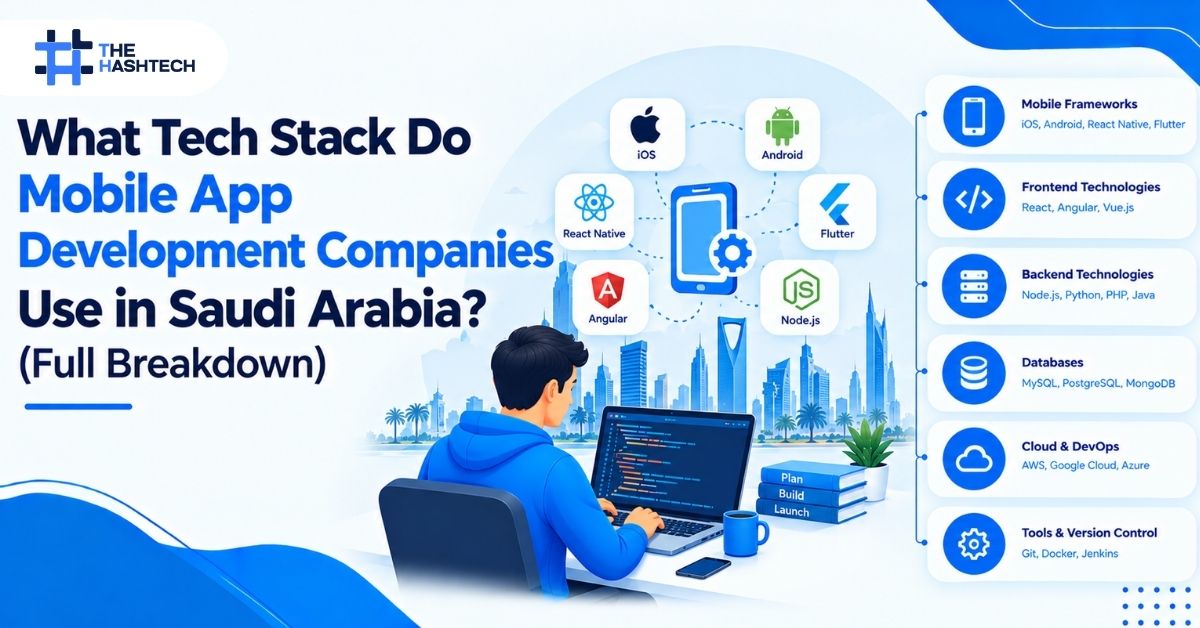
Choosing the right technology stack is one of the most important decisions when building a mobile application in Saudi Arabia. Mobile app development companies in Saudi Arabia commonly work with Flutter, React Native, Swift, Kotlin, Node.js, Python, cloud platforms, and modern databases. The best combination depends on your app’s features, budget, security requirements, Arabic-language experience, integrations, and long-term growth plans.
For businesses planning an app in Riyadh, Jeddah, Dammam, or elsewhere in the Kingdom, understanding the technology behind development helps you compare proposals, estimate project complexity, and select a solution that can scale.
What Is a Mobile App Development Tech Stack?
A mobile app development tech stack is the collection of programming languages, frameworks, tools, databases, APIs, and infrastructure used to build, operate, and maintain an application.
Think of an app as a complete digital system. The mobile interface allows users to interact with it, the backend processes requests, the database stores information, and cloud infrastructure supports availability and performance. Security tools, analytics, and third-party integrations connect these components into a working product.
The tech stack used by mobile app development companies in Saudi Arabia typically includes several layers:
- Mobile development: Flutter, React Native, Swift, or Kotlin.
- Backend development: Node.js, Python, Java, PHP, or .NET.
- Database management: PostgreSQL, MySQL, MongoDB, or Firebase.
- Cloud infrastructure: AWS, Microsoft Azure, or Google Cloud, subject to regional availability and project requirements.
- APIs and integrations: REST APIs, GraphQL, payment gateways, identity services, and enterprise software.
- Security and monitoring: Authentication, encryption, logging, testing, and performance monitoring.
These technologies are not interchangeable in every situation. A small booking application may need a relatively straightforward architecture, while a banking platform or enterprise application may require stricter access controls, extensive auditing, complex integrations, and additional security reviews.
Which Mobile App Development Technologies Are Most Common in Saudi Arabia?
There is no single technology stack used by every app development company in the Kingdom. However, several established technologies cover most mobile development requirements.
| Technology | Main purpose | Best suited for |
| Flutter | Cross-platform mobile development | Businesses launching on iOS and Android |
| React Native | Cross-platform mobile development | Products with JavaScript or React expertise |
| Swift | Native iOS development | iPhone and iPad applications |
| Kotlin | Native Android development | Android-focused and hardware-intensive apps |
| Node.js | Backend development | Real-time features and API-driven applications |
| Python | Backend and AI development | Data processing, automation, and AI features |
| Java and .NET | Backend and enterprise development | Large business systems and complex integrations |
| PostgreSQL and MySQL | Relational databases | Structured business and transactional data |
| MongoDB | Document-oriented database | Flexible document-based data models |
| Firebase | Managed app services | Prototypes, notifications, authentication, and selected real-time features |
| AWS, Azure, and Google Cloud | Hosting and infrastructure | Scalable backend services and production workloads |
This overview is a starting point, not a recommendation to use every technology in one project. Experienced developers select components according to the app’s functional requirements and operational needs.
1. Flutter: A Popular Choice for Cross-Platform Apps
Flutter is Google’s UI development framework that uses the Dart programming language. It enables development teams to build applications for multiple platforms from a shared codebase.
For Saudi businesses planning to release an app on both Android and iOS, Flutter can reduce duplicated development work. It also gives developers considerable control over the application’s visual appearance and reusable interface components.
Why do companies choose Flutter?
Flutter can be useful when a business needs:
- An Android and iOS release from one primary codebase.
- Consistent design across supported platforms.
- Custom interfaces and interactive screens.
- A practical foundation for a minimum viable product (MVP).
- Faster iteration when the product team frequently changes features.
Arabic-language support should be considered from the beginning. Flutter can support right-to-left (RTL) layouts, but developers still need to test Arabic text, mixed Arabic-English content, number formatting, navigation, and screen layouts thoroughly.
When is Flutter the right choice?
Flutter is worth evaluating for e-commerce, delivery, booking, education, retail, and service-marketplace applications. It may also suit startups that need to validate a product before investing in separate native implementations.
However, Flutter is not automatically the best choice for every app. Complex platform-specific features, specialized hardware integrations, and requirements for highly native interactions may justify native development or a hybrid architecture combining Flutter with native modules.
2. React Native: Reusing Mobile and JavaScript Expertise
React Native is a cross-platform framework associated with the JavaScript and React ecosystem. It allows development teams to build mobile experiences while sharing selected code and development practices across platforms.
Companies that already operate a React-based website or web application may consider React Native because their teams could reuse relevant JavaScript or TypeScript knowledge. The amount of code that can be shared depends on the product architecture.
Key advantages of React Native
- Shared application logic for iOS and Android.
- Familiar development patterns for teams with React experience.
- Integration with backend APIs and existing business systems.
- Access to native functionality through platform APIs and modules.
- A broad ecosystem of libraries and development tools.
React Native can work well for consumer-facing applications, customer portals, booking products, and business applications. It is particularly worth assessing when a company wants to connect its mobile application to an existing web platform.
What should businesses consider?
A shared codebase does not eliminate every platform-specific task. Developers still need to test both operating systems, maintain dependencies, handle permissions, and implement native modules when required.
When comparing the tech stack used by mobile app development companies in Saudi Arabia, ask how the team handles platform-specific features, application upgrades, performance testing, and Arabic RTL behavior in React Native.
3. Swift: Native Development for Apple Devices
Swift is Apple’s programming language for building applications across its platforms, including iOS. Teams commonly use it with Apple’s development tools and frameworks to create applications designed specifically for iPhone and iPad users.
Native development can offer direct access to platform capabilities and a user experience aligned with Apple’s interface conventions.
When should a Saudi business choose Swift?
Swift may be a strong option when an application:
- Is exclusively intended for iOS users.
- Relies heavily on Apple platform features.
- Requires sophisticated camera, Bluetooth, or device integrations.
- Needs detailed control over platform-specific behavior.
- Has performance or user-experience requirements that justify a dedicated iOS implementation.
For premium retail experiences, specialized enterprise applications, and selected financial products, native iOS development may be appropriate. The final decision should be based on requirements and risk assessments rather than the assumption that native development is always superior.
What are the trade-offs?
If a business also needs Android support, a separate native Android implementation generally requires additional development and maintenance effort. A company should compare that investment with the benefits of native functionality before selecting Swift as part of its overall architecture.
4. Kotlin: Native Android Application Development
Kotlin is a modern programming language widely used for Android development. It works with the Android ecosystem and can be used alongside Android’s native development tools and libraries.
Kotlin is a suitable choice for businesses that want a dedicated Android application or need extensive access to Android-specific functionality.
What makes Kotlin useful?
- Native Android platform integration.
- Support for modern Android development practices.
- Access to device capabilities and platform APIs.
- Compatibility with existing Java-based Android projects.
- Flexibility for applications with specialized Android requirements.
Kotlin can be useful for logistics, field-service, retail operations, inventory management, and enterprise applications where Android device capabilities are central to the product.
For example, an inventory application used by warehouse employees may need barcode scanning, Bluetooth peripherals, offline data storage, and device-specific workflows. These requirements should be tested early to determine whether native Android development, a cross-platform framework, or a combination is most suitable.
Read Also: App Development Cost in Saudi Arabia?
5. Backend Technologies: Node.js, Python, Java, PHP, and .NET
The mobile interface is only one part of an application. Most production apps also need backend services to process requests, manage accounts, enforce business rules, communicate with databases, and connect with third-party systems.
The backend technology can influence maintainability, performance, security, and the availability of developers who can support the product over time.
Node.js
Node.js is frequently considered for API-driven applications and services that handle many concurrent connections. It can be useful for chat, live order updates, booking systems, notifications, and marketplace applications.
Its suitability depends on workload design, database operations, deployment configuration, and how developers handle CPU-intensive tasks.
Python
Python is widely used for backend services, automation, data processing, and AI-related functionality. It can be useful when a mobile application includes recommendation systems, document processing, intelligent search, or integration with machine-learning services.
Python does not automatically make an application an AI product. AI features still require appropriate models, data pipelines, evaluation, infrastructure, and ongoing monitoring.
Java
Java is a mature option for backend systems, enterprise applications, and services that require established development frameworks. It may be considered when a mobile application must integrate with large business systems or existing Java-based infrastructure.
PHP and Laravel
PHP, particularly when used with the Laravel framework, can support web backends, APIs, business dashboards, and content-driven applications. It can be a practical choice for applications that need conventional business workflows without unnecessary architectural complexity.
.NET and C#
Microsoft’s .NET ecosystem can be suitable for enterprise applications, internal business systems, and projects that integrate with Microsoft technologies. Its appropriateness depends on the existing environment, team expertise, and deployment requirements.
Which backend should you select?
| Backend | Consider it when | Important evaluation point |
| Node.js | Real-time or API-heavy products | Concurrency, architecture, and dependency management |
| Python | AI, automation, and data-intensive features | Workload performance and model integration |
| Java | Enterprise services and established platforms | Maintainability and system integration |
| Laravel | Business applications and API development | Application complexity and team expertise |
| .NET | Enterprise systems and Microsoft environments | Existing infrastructure and operational needs |
A reliable development company should explain why its proposed backend fits your product rather than recommending a language simply because the team already uses it.
6. Database Technologies: PostgreSQL, MySQL, MongoDB, and Firebase
Databases store the information that makes an application useful. Depending on the product, that information may include customer profiles, products, bookings, orders, messages, transactions, or operational records.
The database should be selected according to the structure of the data, transaction requirements, query patterns, consistency needs, and expected workload.
PostgreSQL
PostgreSQL is a relational database suitable for structured data and complex queries. It is worth considering for applications that manage relationships among customers, orders, products, subscriptions, and business records.
MySQL
MySQL is another widely used relational database. It can support e-commerce platforms, booking applications, content-driven products, and business systems with structured data requirements.
MongoDB
MongoDB stores data in a document-oriented format. It may suit workloads with flexible document structures, although its benefits depend on the data model and access patterns. It is not automatically a better choice simply because an app handles large amounts of data.
Firebase
Firebase offers managed services that can simplify selected mobile development tasks, including authentication, notifications, analytics, and certain real-time data workflows.
It can help teams build prototypes or applications that benefit from managed infrastructure. However, businesses should review pricing as usage grows, data access patterns, security rules, vendor dependency, and whether the service fits their long-term architecture.
How do you choose the right database?
A simple content application may need a different data model from a financial platform. For transactional systems, the team should carefully assess data integrity, consistency, backups, recovery procedures, access controls, and audit requirements.
For many business applications, a relational database is a reasonable starting point. Other data stores can be introduced when there is a clear technical reason, rather than adding unnecessary complexity at the beginning.
7. Cloud Infrastructure: AWS, Microsoft Azure, and Google Cloud
Cloud infrastructure provides the computing resources, storage, networking, and managed services required to operate an application. It can also support backups, monitoring, scaling, and disaster recovery.
Mobile app development companies in Saudi Arabia may propose AWS, Microsoft Azure, Google Cloud, or other infrastructure providers. The right choice depends on regional availability, service requirements, existing enterprise agreements, security obligations, and data-location needs.
Amazon Web Services (AWS)
AWS offers a broad range of infrastructure and managed services for hosting backend applications, storing files, running databases, processing workloads, and monitoring production systems.
Microsoft Azure
Azure may be suitable for organizations already using Microsoft technologies or requiring integration with enterprise identity, data, and application services.
Google Cloud
Google Cloud offers infrastructure and data services that can support application hosting, analytics, and machine-learning workloads.
What matters when hosting an app in Saudi Arabia?
Do not select a cloud provider based on brand recognition alone. Ask the development team to identify the actual services and deployment regions proposed for your application.
Businesses should evaluate:
- Whether the required cloud services are available in the intended region.
- Data residency and cross-border transfer requirements.
- Encryption, identity management, and access controls.
- Backup schedules and disaster recovery objectives.
- Expected traffic and infrastructure costs.
- Monitoring, incident response, and operational ownership.
Some workloads may have specific in-Kingdom hosting or regulatory requirements. These should be determined through a project-specific legal and compliance assessment rather than assuming every application must use the same hosting arrangement.
8. APIs and Third-Party Integrations
APIs allow the mobile app to exchange information with backend services and external platforms. They can connect an application to payment providers, identity systems, logistics services, maps, customer relationship management tools, and enterprise software.
Common API technologies include REST and GraphQL. WebSockets may be useful for certain real-time communication requirements.
For Saudi businesses, the relevant integrations depend on the app’s business model. An e-commerce app may need payment processing and delivery tracking, while an employee application may need single sign-on and enterprise resource planning integration.
Potential integration categories include:
- Payment gateways and digital payment services.
- SMS and one-time password (OTP) providers.
- Maps, geolocation, and address services.
- Customer support and CRM platforms.
- ERP and inventory management systems.
- Push notifications and email delivery.
- Analytics, reporting, and fraud monitoring.
For example, an online shopping application may need a payment provider that supports the payment methods its customers expect. The development team must confirm provider availability, merchant eligibility, settlement requirements, security obligations, and supported APIs before committing to an implementation.
Third-party integrations also introduce dependencies. A complete proposal should explain what happens if a provider changes its API, experiences downtime, or increases its fees.
9. Security Technologies and Data Protection
Security should be part of the architecture from the start, not a final task before launch. The app may process personal details, location information, customer records, payment-related information, or sensitive business data.
A suitable technology stack should support secure authentication, authorization, data protection, logging, and timely maintenance.
Essential security capabilities
Authentication and identity: Secure sign-in, session management, multi-factor authentication where appropriate, and safe account recovery.
Authorization: Role-based access controls that prevent users and employees from accessing information they do not need.
Encryption: Protection of sensitive information in transit and at rest, with appropriate key-management practices.
Secure API design: Input validation, rate limiting, access controls, and protection against common application vulnerabilities.
Monitoring and auditing: Logs, alerts, incident investigation capabilities, and records appropriate to the application’s risk profile.
Testing and updates: Dependency checks, vulnerability assessments, security testing, and a defined process for applying fixes.
What about Saudi regulations?
Projects operating in the Kingdom may need to account for the Saudi Personal Data Protection Law (PDPL), applicable implementing regulations, and relevant cybersecurity or sector-specific requirements. Financial applications may also be subject to requirements from the Saudi Central Bank (SAMA), depending on the business activity and regulatory status.
Not every mobile application has identical compliance obligations. A development company should identify the requirements relevant to the business, data, users, and service model, then involve qualified legal or compliance specialists where necessary.
10. Arabic Language, RTL Design, and Local User Experience
A mobile app serving Saudi Arabia should treat Arabic support as a core design and engineering requirement when Arabic-speaking users are part of the target audience.
Supporting Arabic involves more than translating buttons. Arabic is written from right to left, and mixed Arabic-English interfaces can introduce alignment, ordering, and readability challenges.
Developers should consider:
- Right-to-left screen layouts and navigation.
- Correct alignment of forms, menus, and buttons.
- Mixed Arabic and English text.
- Arabic numerals, dates, and currency formatting where required.
- Font rendering and text expansion.
- Accessibility and screen-reader behavior.
- Localization of notifications, validation messages, and error states.
Flutter, React Native, Swift, and Kotlin can all support Arabic experiences when implemented correctly. The quality depends on the framework, application architecture, design decisions, and testing process.
A useful test is to review real screens with Arabic content, not just inspect a language selector. Test long text, forms, checkout, search, notifications, and mixed-direction content on actual devices.
11. Industry-Specific Tech Stacks for Saudi Applications
The ideal stack changes according to the industry and its operational demands.
| Application type | Possible mobile technologies | Backend and data considerations |
| E-commerce | Flutter, React Native, Swift, Kotlin | Product catalog, inventory, orders, payments, analytics |
| Food delivery | Flutter, React Native, native development | Real-time order status, dispatch, maps, notifications |
| Fintech | Native or cross-platform, based on risk and requirements | Strong access controls, transaction integrity, auditing, regulatory assessment |
| Healthcare | Native or cross-platform | Privacy controls, secure integrations, appropriate data handling |
| Education | Flutter, React Native, or native apps | Learning content, progress tracking, identity, offline access |
| Logistics | Kotlin, Swift, Flutter, or React Native | Location updates, offline workflows, scanning, route integration |
| Enterprise operations | Native or cross-platform | ERP integration, role-based access, device management, reporting |
| AI-powered applications | Flutter, React Native, Swift, or Kotlin | Model APIs, data processing, monitoring, privacy controls |
These combinations are illustrative starting points, not fixed prescriptions. A technology stack should be validated against the app’s functional requirements, operational environment, and expected scale.
12. How to Choose the Right Tech Stack for Your Business
Selecting a technology stack should follow a structured process. The objective is not to choose the most fashionable framework; it is to create a maintainable product that meets business requirements.
Step 1: Define the product requirements
Document the app’s primary users, essential features, target platforms, integrations, expected traffic, and success metrics.
For example, a simple appointment-booking app has different requirements from a delivery platform with separate customer, driver, restaurant, and administrator interfaces.
Step 2: Decide between native and cross-platform development
Choose cross-platform development when shared code, faster delivery, and consistent interfaces align with your goals.
Consider native development when deep platform integration, specialized hardware, or platform-specific performance is especially important.
Compare the total lifecycle cost rather than looking only at the first development quote.
Step 3: Evaluate backend and database needs
Map the application’s data, transactions, APIs, and integration requirements. Choose technologies that the development team can maintain reliably and that can evolve as the product grows.
Avoid adding microservices, multiple databases, or complicated infrastructure unless the requirements justify them.
Step 4: Review security and compliance needs
Identify the types of data the application will process and determine the relevant privacy, cybersecurity, and industry-specific obligations.
Decide on hosting, access controls, logging, backups, and incident response before the architecture becomes difficult to change.
Step 5: Build and test a small but representative version
An MVP should validate the app’s most important assumptions. It should include enough of the real architecture to test the key user journey, critical integrations, and major technical risks.
For example, a marketplace MVP should test the core transaction flow rather than merely demonstrate a set of attractive screens.
Step 6: Plan for maintenance and future growth
Before development begins, define who will manage cloud infrastructure, security updates, operating-system compatibility, analytics, backups, and support after launch.
A stack that is inexpensive to build but difficult to maintain can create higher costs later.
13. What Should You Ask a Mobile App Development Company Before Hiring It?
When comparing mobile app development companies in Saudi Arabia, ask each team to explain its technical decisions in terms of your business requirements.
Use these questions during vendor evaluation:
- Which mobile framework do you recommend, and why? Ask the team to compare its recommendation with at least one reasonable alternative.
- What backend and database will the app use? Request an explanation of how they support the application’s data and expected workload.
- How will Arabic and English interfaces be tested? Ask for examples of RTL handling and localization testing.
- Where will the application and its data be hosted? Confirm the proposed cloud services, deployment region, and any applicable data-location requirements.
- How will the app integrate with payment providers and other systems? Clarify dependencies, provider approval, integration testing, and error handling.
- What security measures are included? Discuss authentication, authorization, encryption, vulnerability testing, and incident response.
- Who owns the source code and technical accounts? Clarify ownership, repository access, licenses, and account administration in the contract.
- What happens after launch? Confirm maintenance responsibilities, service-level expectations, monitoring, and update costs.
A capable development partner should be able to explain the proposed architecture clearly, identify trade-offs, and acknowledge where further technical discovery is needed.
14. How Does the Tech Stack Affect Mobile App Development Cost?
Technology choices can influence development effort, testing, infrastructure, and maintenance, but they do not determine the entire project price.
A cross-platform app may reduce duplicated work across iOS and Android. However, complicated workflows, custom interfaces, third-party integrations, or security requirements can still make it a substantial project.
Native development may require separate platform-specific implementation and maintenance, although the additional effort can be justified for products with specialized needs.
The main cost factors include:
- Number and complexity of features.
- Native versus cross-platform approach.
- Backend architecture and database requirements.
- External APIs and integrations.
- UI/UX design and Arabic localization.
- Security, privacy, and compliance work.
- Testing, deployment, and ongoing maintenance.
Ask vendors to separate initial development, third-party service fees, cloud costs, maintenance, and future enhancements in their proposals. This makes it easier to compare quotes fairly.
15. Common Tech Stack Mistakes to Avoid
Choosing a framework only because it is popular
A popular framework is not automatically the right fit. Evaluate the product’s requirements, the development team’s expertise, and the long-term maintenance plan.
Ignoring Arabic RTL testing
Adding Arabic late in development can lead to rework across screens, forms, navigation, and user journeys. Localization should be included in design and testing from the beginning.
Overengineering the backend
Microservices and complex infrastructure can be valuable for certain systems, but they introduce operational overhead. Start with an architecture that meets the actual requirements and can evolve when needed.
Treating cloud hosting as an afterthought
Cloud regions, data handling, backups, access controls, and recovery requirements can affect architecture decisions. Confirm these early.
Failing to plan for ownership and maintenance
The business should know who owns the code, who manages production access, how dependencies will be updated, and what happens if the original development team is replaced.
How The Hashtech Approaches Mobile App Technology Selection
The Hashtech develops digital products across mobile, web, game, AI, blockchain, and custom software development saudi. For mobile applications, the technology decision should begin with the product’s requirements rather than a fixed framework preference.
Depending on the project, relevant mobile technologies include Flutter, React Native, Swift, and Kotlin, with backend services such as Node.js supporting application functionality.
A technology assessment should consider the target platforms, user experience, backend requirements, integrations, security needs, and plans for future maintenance. For Saudi-focused products, Arabic and English localization, RTL testing, and relevant data-protection requirements should also be considered where applicable.
Before development starts, businesses should expect a clear explanation of the proposed stack, its trade-offs, the expected delivery scope, and the responsibilities involved in maintaining the product after release.
The objective is to build an application that serves its users reliably today while giving the business a practical path to improve and expand it over time.
Final Thoughts
The tech stack used by mobile app development companies in Saudi Arabia varies according to the product, business goals, technical requirements, and operating environment. Flutter and React Native can support cross-platform development, while Swift and Kotlin provide native options for iOS and Android. Backend technologies such as Node.js, Python, Java, Laravel, and .NET support different application architectures, and databases and cloud services complete the system.
For Saudi businesses, the decision should also account for Arabic-language usability, integrations, data protection, security, and long-term maintenance. The strongest technology choice is not necessarily the newest or most complicated one. It is the combination that meets the app’s requirements, can be maintained by a capable team, and supports sustainable business growth.
Frequently Asked Questions
1. What tech stack do mobile app development companies in Saudi Arabia use?
Common options include Flutter and React Native for cross-platform development, Swift for iOS, Kotlin for Android, and backend technologies such as Node.js, Python, Java, PHP, and .NET. PostgreSQL, MySQL, MongoDB, Firebase, and cloud platforms may also be used depending on the application’s requirements.
2. Is Flutter better than React Native for app development in Saudi Arabia?
Neither is universally better. Flutter may suit projects that need a highly customized interface and a shared codebase, while React Native can be attractive to teams with existing JavaScript and React expertise. Both can support Arabic and English interfaces when localization and RTL behavior are implemented and tested correctly.
3. Should I choose native or cross-platform app development?
Choose cross-platform development when sharing code across iOS and Android supports your budget, delivery goals, and feature requirements. Consider native development when the app needs deep platform integration, specialized device functionality, or a highly platform-specific experience. The decision should follow a technical assessment.
4. Which backend technology is best for a mobile app in Saudi Arabia?
Node.js, Python, Java, Laravel, and .NET can all be appropriate. The right option depends on the application’s features, integration needs, performance requirements, existing systems, and the development team’s ability to maintain it. No single backend is best for every app.
5. Do mobile apps in Saudi Arabia need Arabic and English support?
Not every app has the same language requirements, but businesses targeting both Arabic- and English-speaking audiences should plan localization from the beginning. This includes RTL layouts, mixed-direction text, translated content, date and number formatting, and testing across real devices.
6. Which cloud platform is best for a Saudi mobile application?
AWS, Microsoft Azure, and Google Cloud are all possible options, depending on service availability, architecture, security, cost, and regional requirements. Businesses should verify the actual deployment region and applicable data-location obligations before choosing a hosting arrangement.
7. How can I evaluate a mobile app development company’s technology expertise?
Ask the company to explain its framework and backend recommendations, show relevant project experience, describe its security and testing practices, and clarify code ownership and maintenance responsibilities. A strong team should be able to explain why its proposed stack fits your app and what trade-offs it involves.