
What Is Custom Mobile App Development and Why Do You Need It?


23 September, 2026
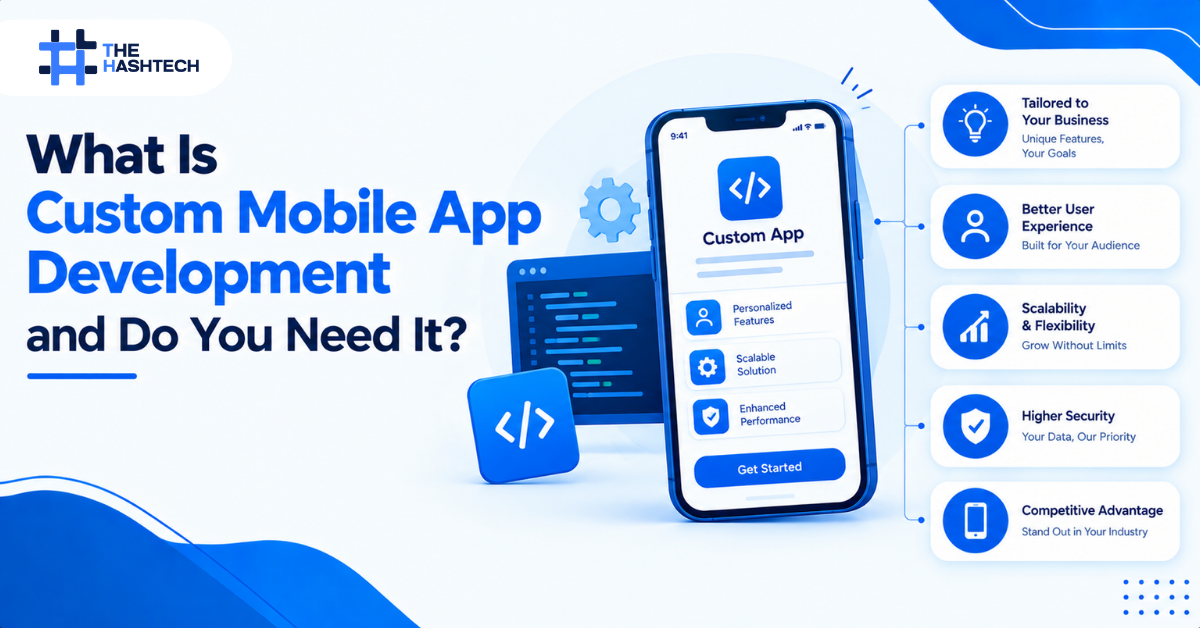
Custom” doesn’t mean expensive, and it doesn’t mean unnecessary; it means built around your specific business process instead of an average user’s generic workflow. That distinction gets lost in most explanations, which either oversell custom development as the only serious option or dismiss it as overkill for anyone without an enterprise budget. Neither is accurate. The real question isn’t “is custom better”; it’s whether your specific use case actually needs it.
What Custom Mobile App Development Actually Means
Custom mobile app development is building a mobile application from the ground up around a specific business’s workflows, users, and requirements as opposed to configuring a pre-built template, no-code platform, or off-the-shelf software product. The defining difference isn’t the amount of code written; it’s whether the app is shaped around your process, or whether your process gets shaped around the software’s existing constraints.
Custom Development vs. the Alternatives
Off-the-shelf software is a pre-built product (project management tools, POS systems, generic CRMs) configured with settings rather than built from scratch.
- Faster and cheaper to start
- Limited to what the vendor’s roadmap decides to build
- You adapt your process to the tool, not the other way around
No-code/low-code platforms’ visual builders (Bubble, Glide, FlutterFlow) that let you assemble an app without traditional programming.
- Good for validating an idea fast, minimal upfront cost
- Hits real ceilings on performance, complex logic, and deep integrations as usage scales
- Often becomes a migration project later rather than a permanent solution
Custom development built specifically for your workflow, data model, and integrations.
- Higher upfront cost and longer timeline
- No functional ceiling built to handle exactly what your business needs, including things a generic tool was never designed for
- Full ownership of the code and architecture, with no vendor lock-in
- Real trade-offs worth acknowledging: longer time to launch, more upfront planning required, and integration or scaling work still takes real effort even with a custom foundation. “Custom” reduces limitations; it doesn’t eliminate all future work
According to industry research on custom software adoption, businesses that invest in custom mobile app development report roughly 45% higher operational efficiency and a 30% improvement in customer satisfaction compared to those relying on generic, off-the-shelf solutions — a meaningful gap when the app is core to how the business actually operates.
Signs You Actually Need Custom Development
Not every business does, but these are the situations where off-the-shelf or no-code genuinely stops being enough:
- Your workflow doesn’t fit any existing template. If you’re bending your actual business process to match a tool’s assumptions rather than the other way around, that friction compounds over time.
- You need deep integration with existing systems. Real-time sync with a proprietary backend, a specific ERP, or legacy infrastructure is something templates and no-code tools handle poorly, if at all.
- Performance or scale requirements are non-negotiable. High transaction volume, real-time features, or large user bases tend to expose the technical ceiling of no-code platforms fairly quickly.
- You’re building something that IS your competitive advantage. If the app’s functionality is the product, not a supporting tool, a generic foundation limits how differentiated you can actually be.
- Security or compliance requirements are strict. Healthcare, fintech, and similar regulated use cases often need architecture-level control that off-the-shelf platforms weren’t built to provide.
- You’ve already outgrown a no-code MVP. A common, legitimate path: validate cheap and fast with no-code, then rebuild custom once real usage proves the demand. The rebuild isn’t a failure; it’s the natural next stage.
When You Probably Don’t Need It (Yet)
If you’re still validating whether the core idea has demand, a no-code MVP or an off-the-shelf tool is usually the smarter first move. Spending months and a serious budget on custom architecture before confirming anyone wants the product is one of the more common expensive mistakes early founders make. A scoped MVP focused on essential features only typically runs 30,000-75,000 and 2-3 months, even when built with real development work rather than pure no-code — a fraction of a full custom build, and enough to gather real usage data before committing further. Custom development earns its cost once you know what you’re building and why it needs to be built exactly that way.
Do You Need It? A Quick Framework
Answer these honestly:
- Does an existing tool cover at least 80% of what you need, with only minor workarounds for the rest? → Off-the-shelf or no-code is probably enough.
- Are you consistently working around a tool’s limitations rather than occasionally? → That friction is a sign custom development is worth evaluating.
- Is the app itself the core product, not a supporting internal tool? → Custom is usually the right call, since generic foundations limit differentiation.
- Do you have validated demand and a defined budget, or are you still testing the idea? → Validate first with something lighter-weight before committing to a custom build.
The Cost of Getting This Decision Wrong
Choosing the wrong side of this decision tends to be expensive in one of two predictable ways. Businesses that go custom too early often end up with a large, expensive build around requirements that hadn’t actually been validated yet, burning months and a serious budget on an idea that needed testing, not full architecture. Businesses that stay on off-the-shelf or no-code too long tend to hit the opposite problem: they keep layering workarounds onto a platform that was never built for their actual workflow, until the accumulated inefficiency and technical debt costs more than a proper custom build would have, and the eventual migration becomes its own expensive project.
Neither mistake is really about the technology; both come from skipping the honest assessment of where the business actually is before committing to a build path.
Final Thoughts
The custom-versus-off-the-shelf decision isn’t really about which option is “better” in the abstract; it’s about matching the tool to where your business actually is. A validated, scaling product with a workflow no generic platform can accommodate is a genuinely different situation than an idea that hasn’t proven demand yet, and the right answer for one is often the wrong answer for the other.
If you do move forward with a custom build, remember that launch isn’t the finish line. A healthy custom app typically needs updates roughly every 20-40 days — bug fixes, security patches, and feature refinements based on real usage — to stay relevant and secure as user expectations and platform requirements shift. Budget for that ongoing cadence from the start rather than treating post-launch support as an afterthought once the initial build is done.
The businesses that get the most value from custom development are the ones that made the decision deliberately based on a genuine functional need, not because custom “sounds more serious” than a simpler alternative.
Frequently Asked Questions
Is custom mobile app development always more expensive than off-the-shelf options?
Upfront, yes, custom builds typically cost significantly more than configuring an existing tool. But total cost of ownership can favor custom development over time if an off-the-shelf tool requires expensive workarounds or eventually needs replacing anyway as the business scales.
Can I start with no-code and move to custom development later?
Yes, and it’s a common, sensible path. Validating an idea with a no-code MVP before committing to custom architecture reduces risk — the transition happens once real usage data confirms the product is worth the bigger investment.
What industries most commonly need custom mobile app development?
Healthcare, fintech, logistics, and any business with proprietary workflows or strict compliance requirements tend to outgrow off-the-shelf and no-code options fastest, since generic tools weren’t built around their specific regulatory or operational constraints.
How do I know if my business idea needs custom development or a simpler tool?
If an existing tool covers most of your needs with only minor workarounds, start there. If you’re consistently fighting a tool’s limitations, or the app itself is your core product rather than a supporting tool, custom development is worth seriously evaluating.
Does custom development mean building everything completely from scratch?
Not necessarily. Custom development can still use established frameworks, libraries, and third-party integrations; the “custom” part refers to the application being architected specifically around your requirements, not that every component is built with zero existing tools.
How often does a custom mobile app need updates after launch?
A healthy app typically needs updates roughly every 20-40 days for bug fixes, security patches, and feature refinements based on real usage. This should be budgeted as an ongoing cost from the start, not treated as optional once the initial build ships.
What’s the biggest risk of choosing custom development too early?
Committing serious budget and months of development to architecture built around requirements that haven’t actually been validated yet — the risk isn’t the technology; it’s building the wrong thing well rather than testing the idea cheaply first.
Still Not Sure Which Path Fits Your Idea?
Our custom mobile app development team builds custom applications when they’re genuinely the right call, and we’ll tell you honestly when a lighter-weight option would serve you better first.
If you’ve already decided custom development is the right direction, our guide on what services a mobile app development company offers covers the vendor-evaluation questions worth asking next.
You can see custom builds in practice across our case studies.
Talk to our team about your specific use case; we’ll help you figure out whether custom development is actually necessary before quoting anything.