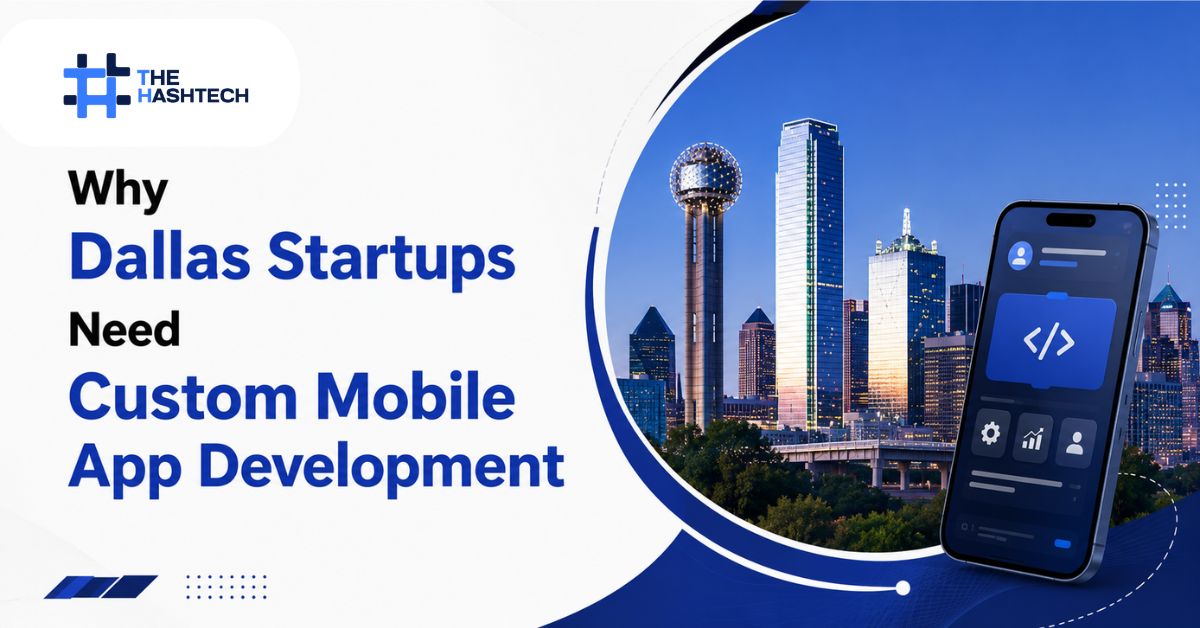
Why Dallas Startups Need Custom Mobile App Development


26 July, 2026
Dallas has been quietly making a name for itself as one of the strongest startup ecosystems in the country. In fact, the city is home to a thriving tech scene, with over 2,500 tech companies – really, anything tech-related- as well as several venture capital firms and a lot of startups that support these companies. (In fact, the startup scene in Dallas has grown so fast that the city now boasts over a thousand active startups and is a recognized leader in the aerospace and healthcare industries.)
That means, while there is still a tendency for early-stage startups to think that Facebook or Twitter-style features will be the winning edge, the number of competitors that favor an app with a polished experience from the moment it launches is actually quite high. For founders who are trying to decide whether to build custom or settle for an off-the-shelf solution, it’s a no-brainer: the section below lays out where the work is overwhelming and where you will actually see results when investing in custom mobile app development dallas.
The temptation to cut corners early is understandable. Budgets are tight, timelines are tighter, and a pre-built app template promises to get something live in weeks instead of months. But founders who’ve been through a full product cycle in Dallas’s competitive market consistently point to the same lesson: you get what you pay for, to a higher degree than in most other markets. Here, custom mobile app development dallas businesses invest in early tends to pay for itself many times over, while generic solutions often need to be rebuilt from scratch once the startup actually starts scaling. This guide walks through why that gap matters so much, and what Dallas founders specifically should weigh before choosing a development path.
Dallas’s Startup Ecosystem Rewards Speed and Differentiation
A Market That’s Growing Fast and Getting Crowded
Dallas-Fort Worth has become one of the top startup hubs in the U.S., showing remarkable momentum in tech-driven sectors that didn’t have any local presence even 10 years ago. Of course, all that growth is a good thing for founding teams looking for a top-tier talent pool, ease of access to cash, and new customers to test their product-market fit against. At the same time, you’re sharing that customer pool with dozens of startups on one or more of a handful of categories.
That penetration of your target customer base means that the apps you build to connect with your audience need to stand out, and this is where the investment in custom mobile app development is paying off. If you’re just another app in the mix, there’s no point in launching; you need to give customers even a little incentive to pick your app over something that will get the job done.
Custom apps allow you to do that. The multicultural nature of the Dallas metro area is a bonus here as well. As opposed to a single-industry tech hub, the diversity of industries and sectors creates a marketplace of sorts, with each one having different customer dynamics and engagement expectations. The long-established local knowledge base of appointments and infrastructure required to support logistics, health care, biotech, manufacturing, banking and critical industrial systems means you get a significantly larger talent pool to work from, a more likely shot at a strong investor relationship and a willing, receptive consumer base. That’s good news for everyone, but it’s additional motivation to go the extra mile.
Local Customer Expectations Are Rising
And finally, the reason tech companies of any kind (whether they are consumer-focused or not) should be producing the most attractive digital experience possible. Dallas consumers and business customers both have grown accustomed to the smooth digital experiences offered by some of the biggest brands in the world, headquartered in or near Dallas. That’s the level of expectation for any app (including one you’ve just built), whether it’s consumer or B2B, cheap or not.
And finally, the thing that the best startups will be most sure to really deliver on is a very sleek, very attractive, very intentional digital experience. This is the main thing that can disqualify a startup, no matter what they sell. The cheap “cookie cutter” template experience you put together with a very inexpensive, very easy-to-sell-engineering week is what makes the entire core value proposition seem less credible.
What Custom Development Actually Solves for Startups
Building Around Your Specific Business Model
The biggest advantage of custom mobile app development that Dallas startups pursue over template-based alternatives is that the app gets built specifically around how the business actually operates, rather than forcing the business to adapt to such limits. Logistics startups coordinating real-time deliveries, for instance, have different needs than health care startups managing patient scheduling. The templates are built for broad use cases and those use cases almost always come with compromises on features most relevant to the specific startup. Custom development, on the other hand, starts from how the business operates and builds the product out from there. That product tends to be far more usable, especially as you next consider the importance of iteration.
Scalability Without a Costly Rebuild
Basically, this means that startups that invest in cheap, inflexible platforms don’t give these out-of-the-box apps a second thought until they run out of space for growth. They typically never think, “But what if our business doubles in size? if we add several more tools that integrate with our app? What if our users decide to double the amount of items they buy from us? What if we add a new feature?” Custom mobile app development dallas businesses invest in from the outset is typically architected with growth in mind. This means that the app can scale alongside their business rather than becoming a bottleneck just as things start hitting their stride.
The Cost Comparison Founders Actually Need to See
Why “Cheaper Upfront” Often Means More Expensive Later
Template-based app builders and low-cost development shops often use speed and affordability to make their case. But for a startup build intended to set you apart from the Dallas competition, the math tends to shift once you perform a full lifecycle cost of ownership analysis. What will cost a bit more up-front, say, custom mobile app development dallas studio will likely save you time and money down the road as your business evolves. This is because generic solutions are likely to need ever-increasing workarounds, plugin upgrades, and/or an eventual rebuild.
Where Custom Development Pays for Itself
The return on that investment is usually evident in three places: fewer support headaches from a product that actually fits the business, stronger retention from users who get an experience tailored to their actual needs, and the ability to add new features without hitting a platform’s built-in ceiling. A founder who has experienced both paths will almost always say that custom mobile app development in Dallas was more expensive on paper, but actually cheaper in the long run: the difference in total cost is often nullified once you add up the cost of lost customers and emergency rebuilds that happen with a template alternative.
There is also a timing element worth considering, especially among startups. If you have the option, then delaying big investment decisions by a few months seldom makes financial sense: economic uncertainty and the near-certainty that product-market fit will reveal itself in time makes it best to start the clock on dedicated investment now, rather than kicking the clock down the road and causing lasting pain that could have been avoided. And that is especially true of investing in a custom-built mobile app in Dallas.
Choosing the Right Development Partner in Dallas
What to Look for Beyond a Portfolio
Remember, not every development shop that offers custom android app development for startups in Dallas needs to be equipped to handle the full life cycle of a growing product. It’s worthwhile to dig a little deeper beyond a polished portfolio. Ask the following questions: How does your team handle scaling challenges? What happens after launch? Did the team have direct experience with the unique compliance or technical requirements for my business? Larger shops with more experience in healthcare or fintech apps will be able to move faster and avoid costly missteps a generalist shop might not anticipate until it’s too late.
The Value of Local Presence and Market Knowledge
The ability to work with a team that understands the relatively unique mobile app development dallas customers respond to is such an advantage for anyone living here. Of course, a highly skilled team working in the local market, familiar with it and going through the various phases of app development in the city, will execute much faster. Then again, it’s still this local market knowledge that is missing from a team that is remote or offshore. Developing this sense of expertise can make a real difference in the success of the end product.
Common Mistakes Startups Make When Skipping Custom Development
Underestimating How Fast Templates Become Limiting
If you want to open the curtains and look deeper into the realities of bootstrapping, the most common regret is, even too strong a word almost all founders I’ve talked to realize is this: those things they thought were minor when they were planning out their minimal MVP quickly became major once they started onboarding actual paying users and they hit a wall. It’s sort of like an Airbnb owner who thought that offering a towel to travelers would be an amazing upgrade, until they discover that the towel has to be premium quality.
Treating the App as a One-Time Project Instead of a Growing Asset
Too often, startups treat their first app build as something to check off their list before moving on. They’re eager to get their thing out into the wild, no matter how much it might need a little care and attention before the process begins. Custom mobile app development dallas businesses do with us is truly the beginning of a partnership. Their app is a living, breathing product that will need its own roadmap for growth along with the business itself. Sometimes, of course, that’s not the case, but every milestone you reach with your app is a victory that’s worth celebration because of the foundation it was built on and the fact that you aren’t stopping the journey here. You’re building toward something. We all are. We’ll follow through on that journey with you, wherever it takes you.
Custom Apps and Investor Confidence
Why Investors Notice the Difference
Over the last few years, Dallas’s exponentially growing venture capital and angel investor community has sat through enough pitches to know immediately when a startup is running off a hastily assembled template, and when they’re really building an engine that can scale. When investors evaluate the technical readiness of a startup, the questions are pointed and specific, and they have a knack for spotting the early warning signs of tech challenges. Founders trying to get by on a generic no-code or slider-based platform often struggle to answer questions convincingly, rarely time their searches for external capital with the right amount of progress, and routinely grossly underestimate their leverage when they do.
Avoiding Technical Debt Before It Becomes a Liability
A joke in the tech startup world is that technical debt on a rigid, template-based platform is bound to surface at exactly the wrong time in the run-up to a big customer or prospect demo or just before due diligence with a potential investor. When a potential investor’s technical advisor switched on the minute details of how the app was put together, for example, the CEO and CTO of the company suddenly had to unravel the quick choices they made when building their app without having the time to go back to the drawing board to really optimize data structures and flow. This is one of the many advantages of choosing custom development early.
Final Thoughts
Certainly, startups (and VCs and investors) in Dallas and beyond can’t afford to always pick the best, hottest new thing. But the fact is, the startups who are racing ahead of the pack are the ones who treat their app as a real strategic asset and not just a checkbox before launch. And, even then, custom mobile app development in Dallas rather than just copying and pasting someone else’s code is nearly always the better option. Taking the shortcut may seem cheaper in the short run, but when the real costs of rebuilding, workarounds, and lost customer trust are factored in, it usually snowballs into a nice fat bill at the end of the line.
FAQs
1. Why should a Dallas startup choose custom app development over a template?
You will have to put out a huge amount of money at the beginning for a custom app that is specifically made for your business. But once you have real users giving you feedback, those small quirks turn into huge pains. Not to mention that templates can force you into a rigid workflow and therefore make it very hard to change as you grow.
2. Is custom app development worth the higher upfront cost for a startup?
For most growing startups, yes. Custom development often costs more the first time but quickly becomes cheaper as you avoid the need to continually add plugins, workarounds. And workarounds to workarounds, and rebuild the generic solutions required once a business begins growing past its earliest stage.
3. Do investors care whether a startup’s app was custom-built or template-based?
Many investors are probably thinking the same about technology. There are probably 3 or so questions on architecture and scaling, that founders will need to answer to have credibility with investors. I explain how you can be ready to answer those questions with a custom build.
4. How do I know if my startup has outgrown a template-based app?
Common signs of a need for a rebuild include hitting those feature limitations that you didn’t think would be an issue back in planning, having to work around some of the basic functionality, like notifying people about updates who haven’t opted in, and supporting scaling as the number of users grows.
5. Should I work with a local Dallas development team or an out-of-state agency?
Having a team with direct experience in the Dallas market results in sharper questions during planning and a better understanding of local customer expectations in our dominant industries. This local context doesn’t replace strong technical execution. But it does lead to a better fit of the final product for its intended market.