
Fixed Price vs Time & Materials for App Development in Saudi Arabia


11 November, 2026
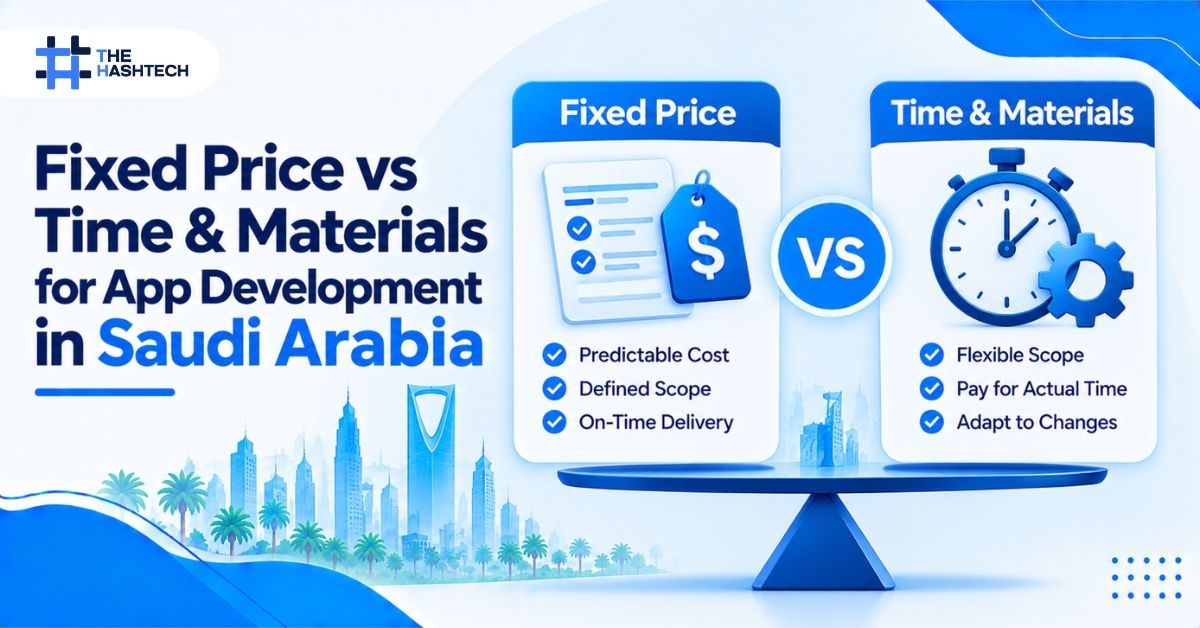
In fixed price vs. time & materials, the right choice depends on one thing: how well you can define the scope today. Choose fixed price when you can write the scope down in detail and expect few changes. Choose time & materials when requirements will move or you are still learning from users. For most Saudi projects, a hybrid works best: a short paid discovery phase, then fixed price per phase, or time and materials with a written budget cap.
This guide explains how each model works, what changes for Saudi buyers, which clauses protect you, and how to pick a model for your project. It is general information, not legal advice. Have Saudi counsel review your contract.
Fixed Price vs Time & Materials: The Short Answer
| Your situation | Best-fit model |
| Clear scope, stable requirements, fixed deadline | Fixed price |
| Early idea, MVP, or unproven product | Time and materials with a cap |
| Large build with some known and some unknown parts | Hybrid: discovery first, then phases |
| Long-term product with a continuous roadmap | Dedicated team |
| Vendor builds, runs, and later hands over | Build-operate-transfer |
If you are unsure, start with a paid discovery phase. It turns unknowns into a written scope, and then the pricing choice becomes easier.
How Each Model Works
Fixed Price
You agree on a scope, a price, and usually a date. The vendor carries most of the overrun risk. In return, the vendor adds a buffer to the price.
A fixed price does not remove risk. It prices the risk and hands it to the vendor. If the scope is vague, the vendor either pads the quote heavily or fights over change requests later.
Time & Materials
You pay for the hours actually spent, at agreed rates. You keep control of priorities, and you can change direction as you learn. The client carries most of the effort risk.
Without controls, hours can grow without a finished product to show. A budget cap, regular hour reports, and working demos remove most of that danger.
Side by Side
| Fixed price | Time & materials | |
| What you agree | Scope, price, date | Rates, team, working method |
| Who carries the overrun risk | Mainly the vendor | Mainly the client |
| Changing your mind | Written change request, priced first | Reprioritize the backlog |
| Price includes | Work plus a risk buffer | Work as it happens |
| Budget certainty | High, if scope holds | Lower, unless capped |
| Flexibility | Low | High |
| Best when | Requirements are clear | Requirements will evolve |
What Changes for Saudi Buyers
The pricing model is global. The details around it are local. A mobile app development company in Saudi Arabia should address each of these points in its proposal.
- Currency and VAT. Ask for prices in SAR with the 15% VAT shown as a separate line. Standard VAT has been 15% since July 2020.
- Invoices. Saudi e-invoicing rules require Arabic invoices, which may be bilingual, with the seller’s VAT registration number. B2B invoices are cleared through ZATCA. Ask your vendor how they invoice, especially under time and materials, where invoices repeat every month.
- Approval cycles. Many boards and procurement teams need a defined budget ceiling before they approve a project. A fixed price, or time and materials with a cap, gives them a number to approve.
- Compliance unknowns. PDPL, SAMA requirements, government integrations, and approvals can change scope. Fixed price on a project with open compliance questions invites disputes.
- Contract language. Saudi private contracts are often bilingual. Courts require Arabic or a certified Arabic translation, so a bilingual contract needs a clause that says which language prevails.
- Disputes. Arbitration agreements must be in writing under Saudi law. State the institution, seat, and language.
For a full list of what a vendor should put in writing, see our checklist for a mobile app development proposal in Saudi Arabia.
When Fixed Price Works
Fixed price fits well when:
- You can list the screens, features, and integrations in detail
- Requirements are stable, and you have approval to freeze them
- The deadline matters more than flexibility
- The project is small to mid-sized
- Your approval process needs a single fixed budget
It also works for a short, well-defined phase, such as a prototype or an integration with a known API. Our mobile app development team can help you judge whether your scope is stable enough to fix.
Risks of Fixed Price
- A padded price. Vendors add a contingency to protect themselves. If the project goes to plan, you pay for risk that never happened.
- Change-request friction. Every small change becomes a negotiation.
- Quality pressure. A vendor racing a tight margin may cut corners on testing.
- A false sense of security. A fixed price buys a defined scope, not protection from change.
Clauses to Ask For
- A frozen scope baseline with named deliverables and exclusions
- Acceptance criteria for each deliverable
- A written change-order process with a rate card for changes
- Milestone payments tied to accepted work
- A warranty period for defects after launch
- Clear terms for source-code and IP handover
When Time & Materials Works
Time and materials fits well when:
- You are building an MVP or testing a new idea
- Requirements will change as you learn from users
- The project involves unknowns, such as new integrations or compliance steps
- You want to steer priorities every sprint
- The vendor and your team work closely together
Many founders prefer this model for unproven products. Every lesson from users becomes a backlog decision, not a formal change order.
Risks of Time & Materials
- Budget drift. Without a cap, costs can grow.
- Weak incentives. Hours billed do not equal value delivered.
- Management load. You must prioritize and review work every week.
- Hard approvals. Boards dislike open-ended spending.
Controls That Make It Safe
- A not-to-exceed cap per phase or per month
- An early warning. The vendor alerts you when spending reaches an agreed share of the cap, such as 70%.
- Written approval to go beyond the cap
- Weekly hour reports with task detail
- A working demo at the end of every sprint
- The same IP, handover, and warranty terms as a fixed price contract
With these controls, time and materials gives you flexibility without a blank cheque.
Hybrid Models That Many Saudi Projects Need
Few real projects fit one model cleanly. Hybrids split the project into parts with different levels of certainty.
| Hybrid model | How it works | Best for |
| Fixed discovery, then fixed phases | A short paid discovery produces a written scope, then each phase gets a fixed price | Mid to large builds |
| Time & materials with a cap | Hourly work with a ceiling and written approval to exceed it | MVPs and evolving products |
| Fixed core, capped changes | The core scope is fixed. Changes are billed hourly against a rate card | Projects with a firm core and some uncertainty |
| Fixed build, monthly support | A fixed price for the build, then a retainer for maintenance | Apps that need ongoing care |
A common pattern works well. Run a paid discovery phase at a fixed price. Then fix the well-understood parts, and use capped time and materials for the integrations or features that carry unknowns. If the project includes enterprise backends, our software development company in Saudi Arabia team can scope those parts in the same plan.
Dedicated Team and Build-Operate-Transfer
Two other engagement models sit beside fixed price and time and materials.
- Dedicated team. A team works only on your product, month after month. It suits long-term roadmaps and businesses that want an extension of their own team.
- Build-operate-transfer (BOT). The vendor builds and runs the product, then hands it over to you or a government entity. It suits organizations that want to take ownership gradually.
Both need a clear notice period, a team structure, and a transfer plan in the contract.
Which Model for Which Project?
| Project type | Suggested model | Why |
| Small app with a clear spec | Fixed price | Scope is defined |
| Startup MVP | Time & materials with a cap | You will learn and change course |
| Enterprise portal with known requirements | Fixed phases after discovery | Budget approval needs certainty |
| Fintech or regulated app | Hybrid with compliance discovery first | Regulatory steps can change scope |
| Government-adjacent platform | Phased, with approval dependencies named | External approvals can move dates |
| App rescue or modernization | Time & materials after a code audit | Hidden issues appear as work begins |
| Long-term product | Dedicated team | Continuous development |
For payments, identity, and compliance work, unknowns often hide in the integrations. See our guides on how to comply with PDPL in Saudi Arabia and how to add Nafath login to a mobile app to spot those unknowns before you price.
Fixed Price vs Time & Materials: Which Costs More?
Neither is always cheaper.
- Low uncertainty: fixed price can be efficient, because the buffer is small and change orders are rare.
- High uncertainty: a fixed price carries a larger buffer, and change orders pile up anyway. Time and materials may cost less because you pay only for work actually done.
- Total cost: includes VAT, hosting, third-party fees, and maintenance under both models.
No honest source gives one price for both. See what drives each line in our guide to mobile app development cost in Saudi Arabia, and compare quotes on the same brief.
Questions to Ask Every Vendor
When you compare fixed price vs. time & materials offers, ask each vendor the same questions.
- Which model do you recommend for my project, and why?
- What assumptions sit behind your fixed price?
- How do you price and approve changes?
- What is the cap, and how do you alert me before I reach it?
- How often do I see working software?
- How do invoices work, and do they show VAT and follow Saudi e-invoicing rules?
- What happens if the scope grows or a third party delays us?
- Who owns the source code and accounts at the end?
- What does support cost after launch?
- How can I end the contract, and what help do I get to transition?
If a vendor only offers one model for every project, ask why. Our guide on how to choose a mobile app development company lists more questions worth asking.
Common Mistakes
- Choosing fixed price on a vague scope. You get a padded quote or a stream of change orders.
- Choosing time and materials with no cap. Budgets drift without a ceiling.
- Comparing only the headline number. Check exclusions, VAT, and pass-through costs.
- Skipping discovery. A paid discovery phase is cheaper than a failed estimate.
- Ignoring acceptance criteria. “Done” must be defined.
- Forgetting compliance. PDPL, SAMA, and government steps affect scope and dates.
- Leaving IP terms for later. Ownership belongs in the first contract.
- Using one model for everything. Mix models by project phase.
How We Work at The Hashtech
We offer fixed price, time and materials, dedicated team, and build-operate-transfer engagements. We say which one we recommend and why, based on how clear your requirements are. We work in short sprints with regular demos, so you see working software during the build, not only at the end.
For unclear scopes, we suggest discovery first. For clear scopes, we fix the price per phase and list exclusions and change rules in the proposal. You can see the stages in our process on our services pages.
Building enterprise systems beside the app? We can scope the backend and mobile work together.
Final Thoughts
Fixed price vs. time & materials is not a contest. It is a match between your certainty and your model. If you know exactly what you need, fix the price and write the scope tightly. If you are still learning, keep flexibility and add a cap. If you are somewhere in between, use a hybrid.
Whatever you choose, put it in writing: scope, acceptance criteria, change rules, VAT, payment milestones, IP, and exit terms. A clear contract protects you more than any pricing model.
Frequently Asked Questions
What is the difference between fixed price and time & materials?
Fixed price sets one price for an agreed scope, so the vendor carries most of the overrun risk. Time and materials bills actual hours at agreed rates, so the client carries most of the effort risk but keeps flexibility.
Which model is better for an app MVP in Saudi Arabia?
Time and materials with a written cap usually fits an MVP, because requirements change as you learn from users. A short fixed-price discovery phase first can make the cap easier to set.
Does a fixed price include VAT?
Check the proposal. In Saudi Arabia, the standard VAT rate is 15%, and the proposal should show it as a separate line so you know the full cost.
Can I cap time and materials costs?
Yes. Ask for a not-to-exceed cap, an alert before you reach it, and written approval to go beyond it.
Is fixed price cheaper than time & materials?
Not always. A fixed price includes a buffer for risk, which you pay even if the project goes well. Time and materials can cost less when work goes to plan, but it puts overrun risk on you.
What is a hybrid contract?
A hybrid mixes models. For example, you pay a fixed price for discovery and the core build, then use capped time and materials for parts that carry unknowns.
Do Saudi contracts need to be in Arabic?
Generally, there is no legal requirement, except in some cases such as contracts with the government. But Saudi courts require Arabic or a certified translation, so bilingual contracts should say which language prevails.
This article is general information, not legal or tax advice. Pricing-model guidance reflects widely published industry practice. VAT, e-invoicing, contract language, and arbitration points come from public Saudi tax and legal guidance. Rules change, so confirm current requirements with ZATCA and qualified Saudi counsel.
Not Sure Which Pricing Model Fits Your App?
Tell us your goals, scope, and approval process. Talk to our team, and we will recommend a model and show you what each option would look like in a proposal.