How Long Does It Take to Build an App in Jeddah?


8 October, 2026
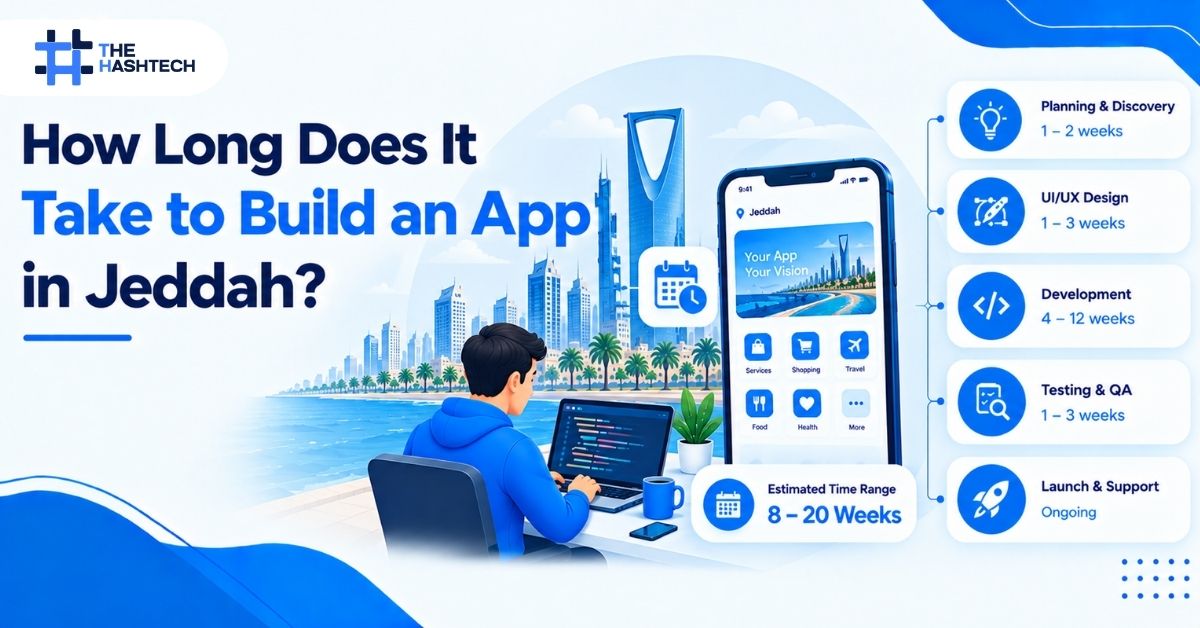
In Jeddah, the calendar matters as much as the code. Most MVP-stage apps take 3 to 6 months from discovery to launch. Simple single-purpose apps can ship in 2-3 months. Apps with heavy integrations, like retail inventory sync or shipment tracking, often run 5-8 months. The number depends on scope. But the launch date you can actually hit depends on something else: when your busy season starts.
Every Jeddah client asks me the same thing on the first call. How long does it take to build an app in Jeddah? My answer is never one number. It’s a range, and I explain what moves you within it.
Why Jeddah Timelines Run on a Different Calendar
Jeddah is the Kingdom’s commercial gateway. Its business rhythm follows peak tourism periods and shipping seasons. A hospitality client wants the booking app live before guests arrive. A logistics client wants tracking live before volumes spike.
That changes how I plan. A finished app that launches the week after your peak season is a missed opportunity. So I plan backward from your business calendar, not forward from a start date.
Our mobile app development company in Jeddah team works from a local office in Al-Safa. That helps here. We sit in the same time zone and the same market rhythm as our clients, so we hear about a seasonal deadline early, not in month four.
Timeline by Project Type
| Project Type | Timeline | What Adds Time |
| Simple single-purpose app | 2-3 months | Core features, standard UI |
| Standard MVP-stage business app | 3-6 months | Custom design, a few integrations |
| Multi-integration app (retail, logistics, hospitality) | 5-8 months | POS sync, shipment APIs, booking flows |
| Large multi-feature platform | 8-12 months | Multiple user roles, deep backend work |
Use this as a starting range. So, how long does it take to build an app in Jeddah for your project type? Find your row, then adjust for the factors below.
An Illustrative Example: A Three-Branch Retail App
Here’s a sample schedule for a typical mid-size retail app. This is an illustration of how I plan, not a record of one specific client.
- Weeks 1-2: Planning, scope lock, and integration access
- Weeks 3-6: Bilingual UI/UX design and prototype testing
- Weeks 7-20: Development in two-week sprints, including POS and inventory sync
- Weeks 21-24: QA across devices and both languages
- Weeks 25-27: Store submission with a rejection buffer
That’s about six months. If the same retail app skipped the multi-branch inventory sync, it could shrink to roughly four. The integration alone explains the gap.
Phase One: Planning (1-3 Weeks)
I start with the questions that decide everything else. What must the app do on day one? What can wait for version two? Which outside systems does it need to talk to?
Language is a big one in Jeddah. Many apps here serve Arabic and English users, and often international visitors too. Arabic means right-to-left layouts. That affects every screen. I settle this in planning, because changing it mid-build is slow and expensive.
I also lock the tech stack here. Flutter or React Native fit most retail and service apps. For live tracking, such as shipments or deliveries, I often recommend native development. That choice can move the build phase by weeks, so I make it early.
Phase Two: UI/UX Design (2-5 Weeks)
Next come wireframes and interactive prototypes. I test them against real user flows before any production code gets written. A design flaw costs an afternoon to fix at this stage. The same flaw found in QA costs a sprint.
Bilingual design takes extra care. Arabic text runs longer or shorter than English in places, and buttons and menus must hold up in both. I design for both languages from the start, not as a translation afterthought.
Phase Three: Development (8-24+ Weeks)
This is the longest phase. I work in two-week sprints, and every sprint ends with a working demo. You see real software, not status reports. If something drifts from your vision, we catch it in days, not months.
Integrations drive most of the variation here. A payment gateway is a few days of work. A retail app that syncs inventory across several branches and an existing POS system is a different job. A logistics app pulling live data from shipment-tracking APIs needs careful testing against real-world delays and dropped signals.
I also defend scope hard in this phase. Every feature added mid-build resets part of the clock. If a feature is truly urgent, I’ll tell you what moves to make room for it.
Scope drives budget as much as it drives time. If you’re weighing both, read our breakdown of how much app development costs in Jeddah alongside this guide.
Phase Four: Testing and QA (3-6 Weeks)
An app that works on my test phone isn’t the same as an app that works for your customers. I test across devices, network conditions, and both languages.
For Jeddah, two areas get extra attention. First, multilingual flows: booking, payment, and notifications must work correctly in Arabic and English. Second, real-time features: tracking has to hold up on weak mobile networks, not just office Wi-Fi.
I run manual and automated tests. Anything that handles payments or personal data also gets a security pass.
Phase Five: Launch (1-3 Weeks)
App Store and Play Store submission takes time, and I always budget for a rejection cycle. Both stores flag things that testing never catches, like an unclear permission or a data disclosure that needs another pass. A one-week delay here is normal. It only hurts when the launch date has no buffer.
This is exactly why seasonal planning matters. If your peak season starts on a fixed date, I want the app approved weeks earlier, not days.
Phase Six: Post-Launch
Launch isn’t the finish line. I monitor crashes, fix bugs, and watch how real users behave. The first weeks always show something the test environment missed. Apps that stay healthy are the ones where someone keeps watching after day one. I plan the first two weeks after launch for fast fixes, then move to a steady cycle of updates based on real usage data. Operating systems also change every year, so ongoing OS-compatibility updates belong in your plan from the start.
What Actually Delays Jeddah Projects
When clients ask me how long it takes to build an app in Jeddah, they expect an answer about code. The real answer is about delays. Jeddah projects rarely stall on regulators. They stall on three other things.
Third-party integrations. POS systems, shipping APIs, and payment gateways all have their own documentation quality, sandbox access, and support response times. I can’t control those. I can start integration work early and test often, so surprises show up in week six, not week twenty.
Content and translation readiness. A bilingual app needs final Arabic and English text. If your team is still writing copy when development ends, launch waits. I ask for content early and keep placeholder text out of the final build.
Feedback delays. A sprint that waits a week for approval loses a week. Fast, decisive feedback is the cheapest way to shorten any timeline.
How Jeddah Compares to Riyadh
Riyadh projects often run longer because many involve SAMA compliance or government API approval. Those steps run on a regulator’s schedule. I explain this in detail in our guide on how long it takes to build an app in Riyadh.
Jeddah’s mix leans more commercial: retail, hospitality, logistics, and services. That usually means fewer external approvals. But there’s one honest exception. If your Jeddah app handles payments or financial data, the same compliance rules apply, and the same extra time with them. The city doesn’t change the regulation. The type of app does.
How to Plan Your Launch Date Backward
The honest answer to how long it takes to build an app in Jeddah starts with your launch date, not your feature list. Here’s the method I use with every Jeddah client.
- Name your hard date. This is the day the app must be live, such as the start of a peak season.
- Subtract launch buffer. Take off three to four weeks for store review and a possible resubmission.
- Subtract testing. Take off another three to six weeks for QA.
- What remains is your build window. Match your scope to that window, not the other way around.
If the scope doesn’t fit, cut features, not testing. A smaller app that works beats a bigger one that crashes in week one.
Budget moves with timeline, too. A rushed schedule usually costs more, because it needs more people working in parallel and less room for rework.
How Your Engagement Model Affects the Timeline
The way we work together also shapes the schedule.
- Fixed price suits clear scope and a firm date. Changes mid-build need a new estimate, so lock scope first.
- Time and materials suit an MVP you expect to adjust as you learn. It keeps you flexible, but it needs active budget tracking.
- A dedicated team suits long-term products. A team focused only on your app moves faster over many releases.
- Build-Operate-Transfer suits clients who want us to build and run the product, then hand it over later.
Pick the model that matches how stable your requirements are. A fixed price on shifting requirements causes the most schedule friction I see.
What I Tell Clients to Do Early
A few early decisions protect your timeline more than anything that happens mid-build.
- Decide your languages up front. Arabic-only, English-only, or both changes design and QA time.
- Share integration access early. Give us POS, shipping, or payment sandbox access in week one, not week eight.
- Prepare your content. Final text, images, and product data should be ready before development ends.
- Name one decision-maker. Feedback that waits for three approvals loses days.
- Lock your MVP scope. Write down what’s in version one and defend it.
Want to see these early decisions play out on real delivered work? Browse our case studies for examples across consumer, AI, and logistics-style apps.
Frequently Asked Questions
How long does it take to build an app in Jeddah?
Most MVP-stage apps take 3 to 6 months from discovery to launch. Simple apps can take 2-3 months, and multi-integration apps for retail, logistics, or hospitality often take 5-8 months.
What slows down app development in Jeddah?
Third-party integrations, content and translation readiness, and slow client feedback cause most delays. Retail apps that sync inventory across branches often need extra integration time with existing POS systems.
Does a bilingual Arabic and English app take longer?
Yes, usually. Right-to-left layouts, two sets of content, and QA in both languages add design and testing time. Planning for both languages from day one keeps the extra time small.
Is app development faster in Jeddah than in Riyadh?
Often, yes, because fewer Jeddah projects need SAMA review or government API approval. But a Jeddah app that handles financial data faces the same compliance steps and timelines as one in Riyadh.
Can I launch before a peak season if I start late?
Sometimes, with a tightly scoped MVP. Plan backward from your launch date, leave a buffer for store review, and cut features before cutting testing.
Can the timeline be shortened without hurting quality?
Yes. Lock scope early, share integration access in week one, prepare content ahead of time, and give fast feedback. Skipping QA to save time almost always costs more later.
Working Backward From Your Launch Date?
Every range in this guide is a starting point, not a quote. If you’re still asking how long it takes to build an app in Jeddah for your specific project, the real answer depends on your integrations, languages, and season. That’s the first conversation I have with every client.
Talk to our team about your launch date. We’ll tell you which parts of your timeline we control, and which depend on outside systems.