
How to Hire the Right Mobile App Developers for Your Project


28 September, 2026
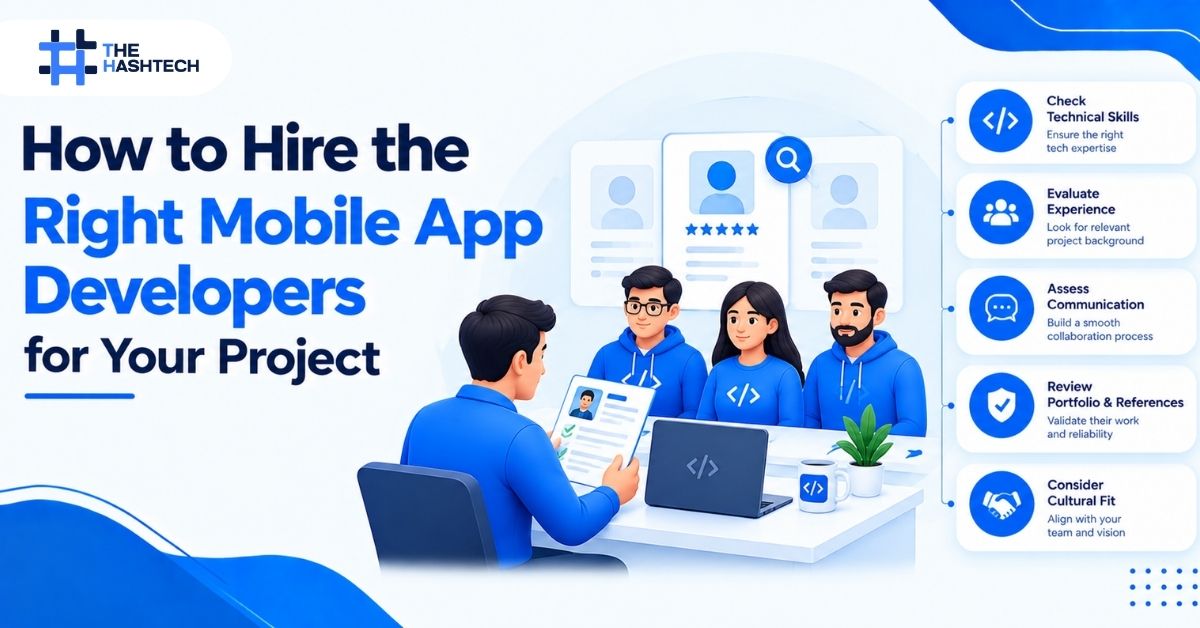
Picture this. You hire a developer who looks perfect on paper. Three months later, the app crashes on half the phones you test, and nobody can explain why. This story is common. It usually starts with a hiring process built around price and speed instead of proof. If you want to learn how to hire mobile app developers who actually deliver, start by changing what you measure. Skills you can verify beat promises you can’t.
This guide walks you through the full process. You’ll learn the hiring models, the real costs, the interview questions that expose weak candidates, and the contract terms that protect you.
Why Most Hiring Processes Fail
Most founders make the same three mistakes. They start searching before they define the project. They compare quotes instead of comparing proof. And they skip the paid trial because they feel rushed.
Each mistake has a cost. A vague brief produces vague estimates. A cheap quote often hides missing QA, missing security work, or missing post-launch support. A rushed contract leaves you without clear ownership of your own code.
Knowing how to hire mobile app developers means avoiding all three. The steps below fix each one in order. Follow them, and you’ll filter out most weak candidates before you spend a single dollar.
Your Four Hiring Options
Every hiring path fits a different project. Pick the wrong one, and even a talented developer will struggle.
Freelance Developers
Freelancers work independently, usually on a contract basis. Published estimates put their rates between $15 and $100 an hour, depending on skill and location. They suit small, well-defined tasks, such as a prototype or a single feature. The risk is simple: if your freelancer disappears, your project stalls. You also carry the project management yourself, which takes real time.
In-House Employees
A full-time hire gives you total control. It also costs more than most founders expect. Published salary data shows $90,000 to $180,000 a year for North American talent. Remote developers from other regions typically cost $35,000 to $70,000. Recruiting a single senior mobile developer often takes two to four months. You also pay for benefits, equipment, and management time. These extras rarely appear in a salary comparison.
Development Agencies
An agency gives you a full team: developers, designers, QA testers, and a project manager. Verified Clutch profiles show agency rates from under $25 to $149 an hour. The range reflects location, seniority, and specialization. Agencies also absorb the recruiting, management, and replacement risk that you would otherwise carry alone.
Staff Augmentation
This model adds individual specialists to your existing team. It works well when you already have a product lead but lack mobile skills. You keep control of the roadmap while borrowing expertise for a set period.
Step 1: Define What You’re Building First
Developers can’t quote accurately without a clear brief. Write down the problem your app solves. List the must-have features. Separate them from the nice-to-haves.
A good brief covers five things:
- The problem your app solves and who has it
- Your target users and the devices they use
- Must-have features for version one
- Integrations with payments, maps, or existing systems
- Your budget range and launch deadline
Share this brief with every candidate. It makes their quotes comparable, and it shows you who asks smart follow-up questions.
Ask yourself one more question. Does your idea need a tailored build, or would a template work? Our guide on custom mobile app development explains when a custom build earns its cost and when a lighter option makes more sense.
A clear brief saves money. It also filters out candidates who quote a number without asking a single question.
Step 2: Choose Your Hiring Model
Match the model to your stage, not your ego.
| Your Situation | Best Model | Why |
| Testing an idea on a tight budget | Freelancer | Low cost, fast start |
| Building your first production MVP | Agency | Full team, structured process |
| Continuous product development at scale | In-house team | Deep control, long-term ownership |
| Filling one specific skill gap | Staff augmentation | Targeted expertise |
Notice what the table leaves out. There is no universal winner. The best choice depends on your budget, timeline, and how often your roadmap will change.
What Each Model Really Costs Beyond the Rate
An hourly rate tells only part of the story. Look at the full picture before you decide.
Freelancers look cheap until you count your own management time and the cost of replacing one who leaves. In-house hires look stable until you add recruiting fees, benefits, tools, and months of onboarding. Agencies look expensive per hour, yet they bundle design, QA, and project management into one accountable team.
Ask every candidate for a stage-by-stage breakdown. Compare total cost to launch, not the hourly number alone. A vendor that refuses to itemize their estimate is telling you something.
How Long Each Option Takes to Start
Speed matters when a launch date is fixed. Here is a realistic view of start times.
Freelancers can often start within a few days. Mobile app development companies usually need one to three weeks for scoping, contracts, and team assignment. Staff augmentation falls in between. In-house hiring is the slowest path, because recruiting a senior mobile developer often takes two to four months.
Plan backward from your launch date. If you need to ship in four months, a full-time hire may not even start in time. An agency or a contracted specialist keeps your timeline realistic.
Questions to Settle Before You Choose
Answer these honestly before you talk to any candidate.
- How long will this product need active development? Six months, or six years?
- Do you have someone who can manage developers day-to-day?
- Will your roadmap change often as you learn from users?
- Do you need design, QA, and backend skills, or only mobile coding?
- What happens to the project if your main developer leaves?
Short projects with clear scope favor freelancers. Long-running products favor in-house teams. Everything in the middle usually favors an agency, because it covers the skills you don’t have and the gaps you can’t afford.
A Simple Budget Check
Set your budget before you collect quotes. Then add a buffer of 15 to 20 percent for ongoing maintenance each year. Many owners forget this cost until the first OS update breaks something.
A realistic budget also protects you from underpriced offers. If one quote sits far below the others, ask what it leaves out. Missing testing, missing security work, and missing support explain most suspiciously low prices.
Step 3: Pick Your Platform and Skills
Your platform choice decides which skills you need. iOS developers work in Swift. Android developers work in Kotlin. Cross-platform developers use Flutter or React Native.
Each platform brings different testing needs and store rules. Look for these skills by platform:
- iOS: Swift, SwiftUI, Xcode, App Store submission experience
- Android: Kotlin, Jetpack Compose, Play Store compliance, device testing
- Cross-platform: Flutter or React Native, plus backend and API skills
If you hire for Android, look for proof they’ve handled device fragmentation. A dedicated android app development company will test across many screen sizes and OS versions as a default step.
Reading this while comparing options? Talk to our team for a straight answer on which hiring model fits your project and budget.
Do You Need Both Platforms?
Not always. Many apps launch on one platform first. We break down this exact decision in our guide to iOS vs Android developers, including when two native teams make sense and when cross-platform saves you money.
Step 4: Find Vetted Developers
Where you search shapes who you find. Understanding how to hire mobile app developers also means knowing where the good ones actually look for work. Use these sources in order of reliability.
- Referrals from founders you trust. They know how a developer handles pressure.
- Review platforms like Clutch and GoodFirms. Read the actual reviews, not just the star rating.
- Freelance marketplaces like Upwork and Toptal. Useful, but you must vet each profile yourself.
- Portfolio and app store searches. A live app tells you more than a slide deck.
Shortlist three to five candidates. More than that slows your decision without improving it.
Step 5: Verify Their Work
Talk is cheap. Proof is not. Before any interview ends, ask for these four things.
- Live app store links. Download the apps. Use them for ten minutes. Look for crashes and slow screens.
- Client references. Call at least two. Ask about communication, deadlines, and how problems got handled.
- A code sample or architecture walkthrough. A strong developer explains their decisions in plain language.
- Proof of relevant experience. A fintech app needs someone who understands payment compliance. A fitness app needs someone who knows sensor data.
Be careful with candidates who cannot show a single live release. Screenshots prove nothing.
Interview Questions That Reveal Real Skill
Generic questions get rehearsed answers. These ones don’t.
- What was the hardest bug you fixed on a live app, and how did you find it?
- How do you decide between native and cross-platform for a new project?
- How do you handle a rejected App Store or Play Store submission?
- What does your testing process look like before release?
- How do you protect user data inside the app?
- Which parts of a project do you estimate poorly, and why?
- Tell me about a project that failed. What changed afterward?
- How do you handle a client who changes requirements mid-sprint?
- What happens if a new iOS or Android version breaks the app after launch?
- Who owns the source code when we finish?
Listen for specifics. Strong candidates name tools, trade-offs, and real mistakes. Weak candidates speak in slogans.
Step 6: Run a Paid Trial First
Never hand a stranger your entire budget on day one. Start with a small, paid task instead. A two-week trial works well. Pick a real feature, not a made-up test.
Judge three things during the trial. First, watch how quickly they respond. Second, check the quality of their code. Third, see how they handle feedback. Someone who argues about every revision during a trial will argue for six months on the full project.
Contract Terms to Lock Down
Verbal promises disappear once a dispute starts. Put these terms in writing before work begins.
- Source code ownership. You should own the code and all design assets on final payment.
- Non-disclosure agreement. Sign it before you share your idea in detail.
- Milestone-based payments. Tie payment to delivered work, not elapsed time.
- Change request process. Define how extra scope gets priced.
- Post-launch support. Spell out what’s covered, for how long, and at what cost.
- Account access. Confirm you hold admin control of your developer accounts and cloud services.
How to Onboard and Manage Your Developers
Hiring is only half the job. The first two weeks after signing set the tone for the whole project.
Give your developers a written brief, access to design files, and a single point of contact on your side. Agree on a weekly demo, so you see working builds instead of status updates. Set up a shared project board where anyone can check progress.
Then protect the relationship. Answer questions quickly, because slow feedback stalls sprints faster than any technical problem. Batch your change requests instead of sending them one at a time. And review builds on real devices, not just screenshots.
Good developers thrive with clear direction. Vague direction produces vague results, whatever the price you pay.
Red Flags During the Hiring Process
Some warning signs appear early. Watch for them.
- A quote arrives before anyone asks about your goals
- The developer promises an unusually short timeline
- Nobody can name who will actually write your code
- The candidate avoids sharing live apps or references
- Pricing is vague, with no breakdown by stage
- They pressure you to sign quickly
One flag deserves a follow-up question. Three flags deserve a different candidate.
Final Thoughts
Learning how to hire mobile app developers comes down to one habit: verify everything. Check the live apps. Call the references. Run the paid trial. Read the contract twice.
The cheapest quote rarely stays cheapest. Rework, missed deadlines, and abandoned code cost far more than a careful hiring process. The best developer for your project isn’t the one with the most impressive pitch. It’s the one whose past work, communication, and answers hold up under pressure.
Take your time with this decision. The time you spend hiring well is the time you won’t spend fixing later.
Frequently Asked Questions
How do I start when I want to know how to hire mobile app developers?
Start with a written brief covering your goals, must-have features, and budget. Then choose a hiring model, shortlist three to five candidates, and verify their live work before any interview.
How much does it cost to hire a mobile app developer?
Costs vary by model. Published estimates show freelancers at roughly $15 to $100 an hour and North American full-time salaries between $90,000 and $180,000. Agency rates on Clutch range from under $25 to $149 an hour.
How long does it take to hire a mobile app developer?
Freelancers and agencies can often start within days or weeks. Recruiting a full-time senior mobile developer typically takes two to four months.
Should I hire a freelancer or an agency?
Freelancers suit small, clearly scoped tasks on tight budgets. Agencies suit production apps that need design, development, QA, and project management together.
Can I test a developer before committing?
Yes. A small paid trial task, usually two weeks, shows their communication, code quality, and response to feedback before you commit the full budget.
Ready to Skip the Hiring Guesswork?
If you’d rather see proof than promises, browse our case studies to see how we’ve delivered real projects for real clients.
When you’re ready to talk specifics, get in touch with our team. We’ll show you how to hire mobile app developers the right way for your project, with an honest assessment of your timeline and budget.